

THE ORTHODOX CONCEPT: TRADITION AND ORTHODOXY
For a long time, some western writers looked to “tradition” as blind obedience to the past, a means of mechanically conveying inert thoughts and ideas. Their point of view holds tradition as a precise catalog of ancient doctrines, canons and rites, or else a museum for antiquity. Therefore, they consider the traditional church obsolete, an obscurant to modern mores, and attached to what is old simply for its antiquity.
In this simple work, I would like to explain our concept to “tradition” through the Holy Bible, patristic thought and our practical church life.
Fr. Tadros Y. Malaty
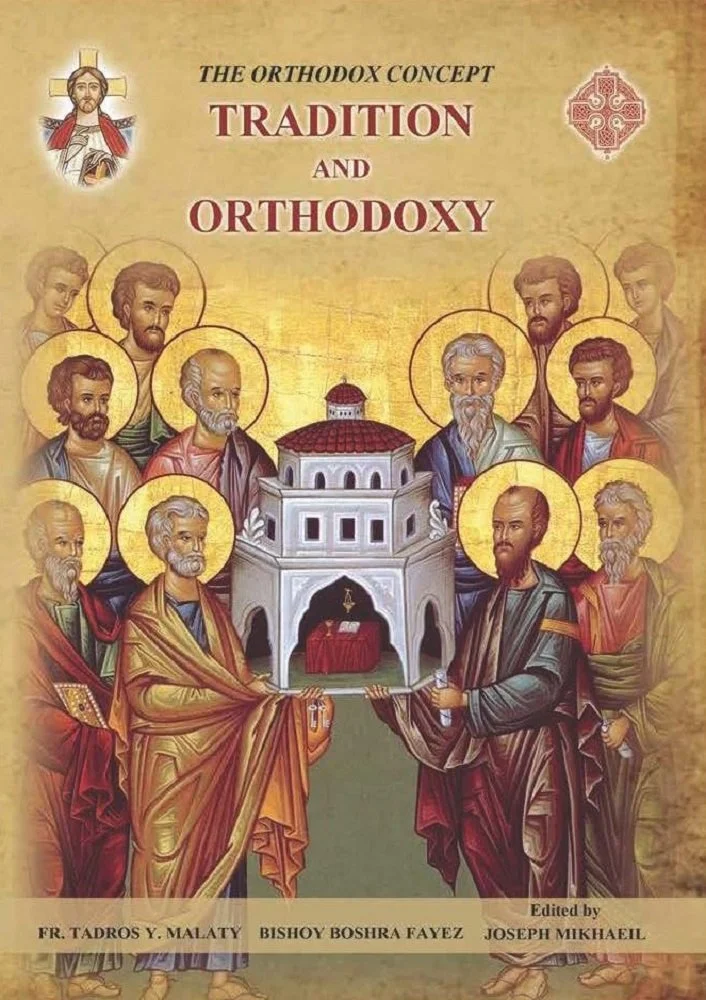
THE ORTHODOX CONCEPT
TRADITION
AND
ORTHODOXY
2017
FR. TADROS Y. MALATY
BISHOY BOSHRA FAYEZ
Edited by
JOSEPH MIKHAEIL MORGAN STAGGERS
Queen Mary & Prince Tadros
COPTIC ORTHODOX CHURCH
South Brunswick, N.J.
ST GEORGE COPTIC ORTHODOX CHURCH
SPORTING - ALEXANDRIA
Contents
THE SUBJECT OF CHRISTIAN TRADITION
TRADITION IN THE APOSTOLIC AGE
THE HOLY TRADITION AND THE GOSPEL
TRADITION PRESERVES THE DEEDS AND WORDS OF CHRIST
TRADITION ACCORDING TO ST. IRENAEUS
TRADITION AND THE INTERPRETATION OF THE SCRIPTURE
TRADITION ACCORDING TO TERTULLIAN
TRADITION ACCORDING TO OTHER FATHERS
CHRISTIAN TRADITION AND JEWISH TRADITION
JESUS AND THE JEWISH TRADITION
THE JEWISH TRADITION AND CHRISTIAN CHURCH
THE HOLY TRADITION AND CHURCH LIFE
TRADITION AND ETHICAL TEACHING
CHURCH TRADITION BETWEEN CLERGYMEN AND LAYMEN
TRADITION AND THE WRITINGS OF THE FATHERS
TRADITION AND THE PRESENT CHURCH
TRADITION AND CHURCH ECUMENICAL MOVEMENT
INTRODUCTION
Published in Los Angeles in 1971, this book first appeared as a chapter in my book: Church, House Of God and written with Sunday school students in mind.
In 1975, it was revamped as a separate book and republished in Alexandria.
In this edition, I add more details as I introduce it to the students of the Theological School of Alexandria.
Fr. Tadros Y. Malaty
THE HOLY TRADITION
For a long time, some western writers looked to “tradition” as blind obedience to the past, a means of mechanically conveying inert thoughts and ideas. Their point of view holds tradition as a precise catalog of ancient doctrines, canons and rites, or else a museum for antiquity. Therefore, they consider the traditional church obsolete, an obscurant to modern mores, and attached to what is old simply for its antiquity.
In this simple work, I would like to explain our concept to “tradition” through the Holy Bible, patristic thought and our practical church life.
THE MEANING OF “TRADITION”
In Greek, the word “tradition”―as it is mentioned in the New Testament―is “Paradosis” (which makes no reference to “limitation”). Its cognate verb is “paradidomi,” which can be translated as “hand over,” “surrender,” “give up” or “transmit.” A closely associated verb is “paralambano,” which means “to receive something,” as instructions or oral stories.
In Hebrew two terms correspond to these two Greek verbs: “masar” (“hand over” or “deliver”) and “qibbel” (“receive”)[1].
Thus, the word “tradition” is not consistent with “limitation of the past.” Biblically, it means “delivering substance of teaching” and receiving its precepts. One generation delivers the faith; another receives it.
THE SUBJECT OF CHRISTIAN TRADITION
What is the subject of Christian traditions? What is the substance of teaching the Church received and preserved through successive generations?
In fact, Christ did not deliver His disciples and apostles a written document. Instead, He prepared them to follow Him and to accept Him dwelling within their hearts. They heard Him teach and followed Him everywhere. They saw Him pray, comfort people, treat sinners kindly, heal the sick and give life to the dead. They saw Him celebrate the Last Supper and grant them peace after His resurrection. At last, He sent them
His Holy Spirit, not only to remind them of His own words and help them to follow His example but also to attain unity with Him and to participate in His divine life
This is the essence of our tradition; it is “the unity with Christ through the Holy Spirit.” For God the Father delivered His own Son to us, and the Son also gave Himself up for us (Gal. 2:20; Eph. 5:2).
This is the “tradition,” i.e., “the faith once delivered to the saints” (Jude 3) or the “Gospel” written in our lives and engraved within our hearts. It is a living thing, received by the apostles who delivered it to their disciples by the Holy Spirit, who bears witness to Christ within the life of the Church, and unites her with the Savior.
In other words, the act of transmission is realized not only by the apostles’ writings, but also by the Holy Spirit Who guided their feelings, attitudes, worship, behavior and their preaching. He granted them new life, that is, “the life in Christ.” It is the action of the Holy Spirit that the “tradition of Christ” is preserved in Church life through the successive generation, as He always lives and acts in the Church yesterday, today and tomorrow―inspiring her life and making it a continuity of life, Faith and love―not a mechanical repetition of the past[2].
Thus, tradition is the living stream of the one life of the Church, which brings up the past with all its aspects as a living present, and extends the present towards tomorrow without deformation.
Thus, tradition is the living stream of the one life of the Church, which brings up the past with all its aspects as a living gift, and extends the present towards the morrow without deformation.
This is the essence of the “tradition” which we must concentrate our study. They are:
1. The message of Faith in the Holy Trinity and God’s redeeming deeds.
2. The deeds and words of Christ.
3. The books of the Old Testament.
4. The spiritual and ethical design in Jesus Christ.
5. The curriculum of worship, its concept and order.
TRADITION IN THE APOSTOLIC AGE
In the apostolic age, the New Testament books were already in existence but not yet canonized officially. The tradition was the only source of Christian faith, doctrines and worship. Its role in the Church life of that period may be summarized in the following points:
1 - When the Church was born the books of the Old Testament were already extant and in use. The early Christians, on the authority of Christ and His apostles, received these Scriptures from the Jews and treated them as the inspired and authoritative word of God. The early Church considered herself as the heir of the Jewish Church in this old tradition, i.e., the Scriptures.
It is worthy to note that the early Church read the Scriptures with an eye enlightened by specific Christian revelation. She conceived the prophecies mentioned in these books using a particular method of exegesis[3], of which the Jews did not yet know. This type of exegesis was received from the apostles and there is every reason to suppose that our Lord Himself set the precedent.
2 - Although the books of the New Testament were not canonized until the middle of the 2nd century, through tradition the Fathers of the Church accepted them as the inspired word of God and many quotations were used in their writings.
3 - Through tradition the Fathers of the Church conceived the unity of the Holy Scriptures―the unity between the Old and the New Testaments―as the one and same word of God, even before the canonization of the New Testament books.
4 - The apostles revealed that one of the sources of the authority of their apostleship is the tradition which they had received through their discipleship to Jesus Christ. They preached as eyewitnesses to the events of Christ’s life and His saving deeds.
St. John states, “That which was from the beginning, which we have heard, which we have seen with our eyes, which we have looked upon and touched with our hands, concerning the word of life...” (John 1:1).
In his gospel, he also says, “He who saw it has borne witness―his testimony is true, and he knows that he tells the truth―that you also may believe” (John 19:35).
St. Luke also pointed out that accounts of the events of Christ’s life “were delivered to us by those who from the beginning were eyewitnesses and ministers of the word” (Luke 1:2).
When the eleven apostles wished to fill the place of Judas, they determined to choose only one “of the men who have accompanied us during all the time that the Lord Jesus went in and out among us, beginning from the baptism of John until the day when He was taken up from us―one of these men must become with us a witness to His resurrection” (Acts. 1:21-22).
Yet this apostolic tradition started by the eyewitness to the Lord’s life’s events was not sufficient to permanently maintain it. The Holy Spirit―Who guides the life of the Church, reveals the truth and gives her the unity with God in Jesus Christ―established this tradition and provides the basis for its continual conveyance throughout the generations until today. “We are witnesses of these things,” the apostles say, “and so is the Holy Spirit.”
St. Paul the apostle, who was interested in establishing “the tradition of Christ” to the Church, was not an eyewitness to these events but he received a special commission to the apostleship. By the Holy Spirit he received the Church tradition as if it was given to him from God directly. He asserts, “Paul, an apostle―not from men nor through man, but through Jesus Christ and God the Father...” (Gal. 1:1). He also says, “I received (“Paralarnbano”) from the Lord (“apo tou Kyriou”) what I also delivered (“paradidomi”) to you....“ (I Cor. 11:23). It has been argued that the use of the preposition “apo” in the phrase “from the Lord” indicates conveyance of the information through one or more intermediaries whereas “para” with the genitive would have routed out such mediation[4].
5 - The tradition the apostles received from Christ and deposited unto the Church was in its essence “the new life in Jesus Christ,” or “the unity with God in Christ by the Holy Spirit.” In other words, the apostolic tradition was not a static deposit, but bears within itself the continuity of the Pentecost in the Church as a whole and in every living member. Through the apostolic tradition not only does the Christian community―as a whole―practice this new life by the Holy Spirit but every member of the Church accepts a personal relationship with God in Spirit without isolation (as found with the Catholic Church).
Through this point of view, we also look to our tradition―in its essence―as a spiritual gift. It is not offered from one person to another but has its mutual effect upon the provider and the receiver. “I long to see you,” wrote St. Paul to the Romans, ”that I may impart to you some spiritual gift to strengthen you―that is, that we may be mutually encouraged by each other’s faith, both yours and mine” (Rom 1:11-12).
To this effect, St. Augustine says, “Because for you, I am a bishop; with you, I am a Christian[5].” As a bishop, he felt deeply that he was appointed by God to deposit the Christian tradition to his people. At the same time, he practiced this tradition with them as a Christian, being part of their community.
6. The apostles subjected themselves to some Jewish traditions of worship and rites in harmony with their faith after “Christianizing” them (of which I will discuss in more detail, if God permits).
7 - Through tradition, the Church stressed loyalty to the episcopate since she regarded the bishop― the successor of the apostle―as the appointed guarantor of purity of doctrine.
In brief, we can say that the Church in the apostolic age accepted the living tradition by which she received the books of the Old Testament
1. conceived its prophecies;
2. discovered its types and symbols;
3. acknowledged its unity with the apostolic testimony;
4. received the witnesses of the apostles;
5. declared the authority of their successors in preserving the Christian faith; and
6. practiced the true worship of God.
THE HOLY TRADITION AND THE GOSPEL
Our faith in the Messiah, the Savior―“the gospel of the Church”―is at the core of the holy tradition. More than once St. Paul the apostle told his listeners that he had delivered to them the tradition of the “gospel of salvation,” the “word of hearing” or the “saving deed of God,” which he had received from the Church.
He says, “Moreover, brethren, I declare unto you the gospel which I preached unto you, which also you have received and wherein you stand.... For I delivered unto you first of all that which I also received, how that Christ died for our sins according to the scriptures; and that He was buried, and that He rose again on the third day according to the scriptures” (1 Cor. 15:1;3-4).
“When you received the word of God which you heard of us, you received it not as the word of men but as it is in truth, the word of God, Which effectually works also in you that believe” (1 Thess. 2:13).
The apostles received this “Gospel of Christ”―which is also “the Gospel of the Church”―not written on paper but through His spoken word in order to deliver it unto the Church by the oral tradition as well as by the written one.
To this effect theologian Cyril Richardson (1909-1976) says, “Hence Christian preaching was founded on the Old Testament and on the living tradition of Jesus, passed from mouth to mouth. This feeling for personal witness was very strong in the Early Church. Papias, for instance, records his disdain for books and his preference for the living and abiding voice... [6]”
Western scholars began to discover that oral tradition does not stand side by side with the written works as separate and distinct, but as one. What the Book declares, the church had received by oral tradition.
F. Bruce, the professor of Biblical Criticism and Exegesis in the University of Manchester says, “Whereas western Christians tend to set a ‘scripture’ and ‘tradition’ over against each other, as though tradition were oral only and not written, there is no reason why tradition should not take a written form. If it is apostolic tradition, in due course it takes a written form and becomes apostolic scripture. Whether Paul’s teaching was given orally or in writing, it equally carried apostolic authority; hence he can encourage the Thessalonian Christians to ‘stand firm and hold to the traditions which you were taught by us, either by word of mouth or by letter’" (2 Thess 2:15)[7].’”
The New Westminster Dictionary of the Bible reads, “The term (tradition), however, came to be used in a good sense of the apostolic teaching handed down in the church either by the oral word or by letter” (1 Cor. 11:23; 15:1;3-4; 2 Thess, 2:15)[8].”
J.N.D. Kelly FBA (1909-1997) states, “Hence by tradition the Fathers usually mean doctrine which the Lord or His apostles committed to the Church, irrespective of whether it was handed down orally or in documents... The ancient meaning of the term is well illustrated by Athanasius’ reference9 to the actual original tradition teaching and faith of the Catholic Church, which the Lord bestowed, the apostles proclaimed and the Fathers safeguarded[9].”
In fact, the Church received the “word of God” before it was written on paper. She enjoyed its good tidings and understood the deepest meaning of the word of God by the Holy Spirit through the oral tradition, not only by words but also as a mode of life. She received her life before she had the written New Testament by more than twenty years. And when the evangelists and apostles wrote it by the inspiration of the Holy Spirit, the Church accepted it, venerated and understood it as a life she had previously practiced.
Thus, the Gospel is not separate from tradition; the first is part of the latter. Both declare the “One Truth” and explain the nature of the Church.
Perhaps one may ask if oral tradition was annulled by the appearance of the books of the New Testament. We point to the apostles themselves who, in their letters to the early Christian communities, often reminded the believers of oral tradition from which they may gain an understanding of the Christian truth.
“Having many things to write unto you, I would not write with paper and ink, but I trust to come unto you, and speak face to face, that our joy may be full” (2 John 12).
“I had many things to write, but I will not with ink and pen write unto you. But I trust I shall shortly see you and we shall speak face to face” (3 John 13-14).
“...And the rest (remaining matters) will I set in order when I come” (1 Cor 11:34).
“For this cause I left you in Crete that You should set in order the things that are wanting, and ordain presbyters in every city” (Titus 1:5).
In many places the apostle Paul commands his disciples to preserve tradition, deliver it unto others, maintain the traditions they were taught―either by word of mouth or by letter―and to withdraw themselves from every idle and disruptive believer who does not live according to the tradition which he had received from us (2 Thess. 3:6). He also charges us to be aware of every tradition of men against faith “according to the elements of the world and not according to Christ” (Col. 2:8).
Moreover, in the early Church, many nations furnished converts to Christianity although they had no translations of the Bible as yet in their own language. Therefore they could not learn the truth from it, but relied instead on oral tradition.[10].
St. lrenaeus, in the 2nd century, is the first to discuss the matter of tradition. He poses these questions: Suppose, as might have happened, we had no Scriptures. To what should we have to make our appeal? “Should we not have to go back to the most ancient Churches, in which the apostles lived, and take from them... what is fixed and ascertained? What else could we do? If the apostles themselves had not left us writings, should we not be obliged to depend on the teaching of the tradition which they bequeathed to those to whose care they left the Churches?[11]”
TRADITION PRESERVES THE BIBLE
The Holy Scriptures are the book of the Church, which we receive through Church tradition. By tradition, the “canon” of the holy books affirming their inspired character is established.
v By tradition, I knew the four gospels, and that they are the true ones.
Origen
v Learn also diligently, from the Church what are the books of the Old Testament, and what are those of the New[12].
St. Cyril of Jerusalem
v I would not have believed in the gospel, unless the voice of the Universal Church convinced me[13].
St. Augustine
v If we try to dismiss the unwritten traditions as if they are unworthy, we disregard that thus we disdain the important element of preaching, and make the evangelic preaching merely a name.
St. Basil The Great
It is worthy to note that Church tradition gives testimony to the Holy Scripture, and that the Scripture itself is a part of the Church tradition, but this does not lessen the Scripture’s uniqueness. It preserves its own nature as the word of God, the eternal revelation of divinity, addressed not only to this age but to the ages to come..
Although tradition testifies to the Holy Scripture, it is not its criterion. On the contrary, tradition is recognized when founded in disagreement with the Scripture [14].
Moreover, the Scripture is given to each believer to judge, in accordance with his personal taste, the value and inspiration of a given work. But no one can by himself decide questions relative to the divine inspiration of the Scriptures and the presence of the Holy Spirit in the Bible. Only the Holy Spirit Who lives in the Church gives this. This cannot be a question of personal choice but it depends only on the judgment of the Church[15].
What is more, this close relation between Scripture and the Church tradition does not mean extinguishing personal feelings towards the Scripture. On the contrary, Church tradition asserts our personal attitude towards the Bible and asks us to live in the Bible but not isolated from the Church.
TRADITION PRESERVES THE DEEDS AND WORDS OF CHRIST
By tradition we receive the holy gospels which contain (but not all of) the deeds and words of Christ. As our teacher John concludes his gospel by saying, “And there are also many other things which Jesus did: which if they should be written every one, I think that even the world itself could not contain the books that should be written” (John 21:25).
The disciples and apostles heard many sayings, preserved them and lived by them but did not record all of them in the gospels. For instance, we mention what the apostle Paul says:
“Even so has the Lord ordained that they who preach the gospel should live of the gospel” (1 Cor. 9:14).
“And unto the married I command—not I but the Lord—let not the wife depart from her husband” (1 Cor. 7:10).
The apostle Paul received these Lord’s commandments and sayings from the disciples and the apostles who heard the Lord and examined them by Spirit, preserved and delivered them unto others
Concerning the deeds of Christ, the apostle Paul also says, “For I received from the Lord what I also delivered to you, that the Lord ("Kyrios") Jesus the same night in which He was betrayed took bread...” (1 Cor. 11:23). The apostle did not receive this deed directly from the Lord in the night of His suffering, but as Professor Oscar Cullmann (1902-1999) explains[16], the word “Kyrios” here designates the Oral Tradition concerning Jesus. The apostle did receive many direct visions and revelations but the Lord through the Church tradition delivered this deed.
What is wonderful is that the ancient liturgies, as that of the “Apostolic Tradition” of St. Hippolytus, quoted the same expression of St Paul in the “Narrative of Institution.” It is because the apostolic Tradition reflects a general tradition in the early Church from which St. Paul also quoted, as well all other apostolic liturgies.
TRADITION ACCORDING TO PAPIAS
After the departure of the apostles and the disciples who were eyewitnesses to the recorded events of Christ’s life, the Fathers of the Church like Papias, lrenaeus and Clement of Alexandria were interested in preserving the oral tradition―the “tradition of the elders (Presbyters)”―which they claim had come down to them from apostolic times.
We know Papias, bishop of Hierapolis in Phrygia (around 130 CE) chiefly through the writings of lrenaeus and Eusebius. The evidence of the former is all the more valuable because he belongs to the same circle as Papias, and lived only a few decades after him[17]. lrenaeus states that Papias witnessed the sermons of St. John and was a companion of St. Polycarp. He compiled five books[18]. He lavishes praise on these work since he regarded them as a direct lineage to apostolic times[19]. This work was still extant in the 14th century, if not later, but no copy of it is now known to survive[20].
Eusebius preserved the preface of Papias’ work and also its title Exposition of the Oracles (aka “Sayings”) of the Lord[21]. In the preface, Papias decided, shortly before the middle of the 2nd century, to collect the living memories of those who had personally known the apostle. He says, “I will not hesitate to set down along with my interpretations all the things derived from the elders (presbyters), for I have ever carefully learned them, and carefully recalled them, and am confident of their truth.... If anyone who attended the presbyters came, I asked him minutely about their sayings: What did Andrew or Peter say, or what was said by Philip by Thomas, by James, by John, by Matthew, or by any other of the Lord’s disciples....? For I imagined that what was to be got from books was not so profitable to me as what came from the living and abiding voice.”
TRADITION ACCORDING TO ST. IRENAEUS
St. lrenaeus, in the second half of the 2nd century, valued the oral tradition. It is evident from the terms in which he reminds his former acquaintance Florinus of their earlier days with St. Polycarp in Smyrna[22].
“I remember the events of those days more clearly than those of recent date, for the things that have been learned from childhood grow up with the soul and become one with it. So I can describe even the place where the blessed Polycarp sat and held discourse, how he came in and went out, his manner of life and personal appearance, the discourses which he delivered to the people, and how he reported his communications with John and with the others who had seen the Lord, how he recalled their words, and what he had heard from them about the Lord, His mighty works and His teachings, how he, Polycarp, had received (Paralambano) those things from the eyewitnesses of the life of the word and reported them all in conformity with the Scriptures. Even then I listened eagerly to those things by the mercy of God which was bestowed upon me, making notes of them not on papyrus but in my heart; and the grace of God I always ruminate on them truly[23].
TRADITION AND THE INTERPRETATION OF THE SCRIPTURE
In the 2nd century, the Gnostics exploited the Holy Scripture to their own ends by quoting some verses out of context, distorting the meanings and concepts of Scripture as a whole and apart from the tradition of the Church. Moreover, they claimed that they had received hidden traditions from the apostles[24] and that they themselves knew better than either bishops or apostles[25].
Many early Church Fathers opposed the Gnostics and argued against their opinions.
One was St. lrenaeus, called the “Father of the Ecclesiastical Tradition.” His conception of “tradition” may be summarized in the following points:
1. The tradition originating from the apostles is guaranteed by the unbroken succession of presbyters in the Church[26].
2. The tradition is preserved in the Church by the Holy Spirit Who renews the Church’s youth[27].
3. The apostolic tradition is not secret but within the power of all who wish to accept the truth. It is manifested in every Church throughout the whole world[28].
4. The heretics misinterpreted the Scripture by quoting isolated passages and rearranging them to suit their own ideas[29] while disregarded the underlying unity of the Scripture. They made use of the texts but since they did not read them within the tradition of the Church, they did not read them according to the tradition of the apostles.
The true understanding of the Scripture is found only in the Church, where the Holy tradition and the apostolic doctrines are kept. The Church has been planted as a paradise in this world. Therefore the Holy Spirit says you may freely eat from every tree of the garden (Gen 2:16); that is, partake from every Scripture of the Lord, but you shall not eat with uplifted mind, nor touch any heretical discord. For these men do profess that they have themselves the knowledge of good and evil and they set their own impious minds above God Who made them[30].
HIS SAYINGS IN TRADITION
As I have already observed, the Church, having received this preaching and this faith―although dispersed across the world, yet as if occupying but one house―carefully preserves it. For although the languages of the world are dissimilar, the import of the tradition is yet one and the same. For those churches planted in Germany do not believe or hand down anything different, nor do those in Spain, nor those in Gaul, nor those in the East, nor those in Egypt, nor those in Libya, nor those which have been established in the central regions of the world...[31] When we cite traditions originating from the apostles and preserved by means of the successions of presbyters in the Churches to heretics, they object to tradition. They say that they themselves are wiser, not merely than the presbyters but even than the apostles themselves, because they have discovered the unadulterated truth. For they maintain the apostles intermingled the law with the words of the Savior.... Thus, these men consent neither to Scripture nor to tradition.
Such are the adversaries with whom we clash, my very dear friends. They endeavor like slippery serpents to escape at all points. Therefore, they must be opposed at all points. By cutting off their retreat, we may succeed in turning them back to the truth.
Therefore, in every Church, it is within the power of all who may wish to see the truth to contemplate clearly the tradition of the apostles manifested throughout the whole world…
The apostles desired for men to be very perfect and blameless in all things―those whom they were leaving behind as their successors―and to deliver their own place of government to these men. If they discharged their functions honestly, these successors would be a great boon to the Church. But if they strayed, the direst calamity would befall them.
In this order, and by this succession from the apostles, the ecclesiastical tradition and the preaching of the truth have come down to us. This is the most abundant proof of the one vitalizing faith, which has been preserved in the Church from the apostles until now and handed down in truth.
Since therefore we have such proof, it is not necessary to seek the truth among others. Truth is easy to obtain from the Church because the apostles, like a rich man depositing his money in a bank, lodged in her hands most copiously all thing pertaining to the truth. Thus, every man can draw from her the water of life (Rev. 22:17). For she is the entrance to life; all others are thieves and robbers. On this account we are bound to avoid them, but instead choose with the utmost diligence that which pertains to the Church and to perceive the tradition of truth.
How does this apply to us today? Suppose a dispute arises relative to some important question among us―should we not have recourse to the most ancient Churches with which the apostles held constant communications and learn from them what is certain and clear in regard to the current question? For how should it be if the apostles themselves had not left us sacred texts? Would it not be necessary to follow the course of tradition, which they handed down to those to whom they committed the Church? To which course many nations of those barbarians who believe in Christ do assent, having salvation written in their hearts by the Spirit, without paper or ink, and carefully preserve the ancient tradition....
Since therefore the tradition from the apostles does thus exist in the Church, and is permanent among us, let us revert to the Scriptural proof furnished by those apostles who also wrote the Gospels. Here they recorded doctrine regarding God, pointing out that our Lord Jesus Christ is the truth (John 14:6), and that no lie is within him....
This gift from God―the faith in Christ received through tradition―has been entrusted to the Church, just as breath was to the first created man. This purpose of this gift? That all members receiving it may be vitalized. The means of communion with Christ has been distributed throughout the centuries, all across the earth. In other words, the Holy Spirit―the earnest beacon of virtue and purity, the means of confirming our faith―is our ladder ascending to God. “For in the Church,” it is said, “God has set apostles, prophets, teachers” (1 Cor. 12:28) and all other means through which the Spirit works. Those partakers who do not join themselves to the Church defraud themselves of life through their perverse opinions and insidious behavior. For where the Church is, there is the Spirit of God. Where the Spirit of God is, there is the Church―and every kind of grace[32].
TRADITION ACCORDING TO TERTULLIAN
Tertullian’s position regarding tradition does not differ from that of St. lrenaeus in any important respect. We may summarize his outlook in the following points:
1. He emphasizes that no secret tradition existed. He says, “It is inconceivable that the apostles were either ignorant of the whole scope of the message which they had to declare, or failed to make known to all men the entire rule of faith....[33].
2. Like lrenaeus, Tertullian found the surest test of the authenticity of the doctrine in the fact that the churches had been founded by the apostles and were continuously linked with them[34]. For example, he says, “We hold communion with the apostolic churches because our doctrine is in no respect different from theirs. This is our witness of truth He emphasizes that no secret tradition existed. He says, “It is inconceivable that the apostles were either ignorant of the whole scope of the message which they had to declare, or failed to make known to all men the entire rule of faith....[35]”
He also says, “Such are the summary arguments which we use, when we take up arms against heretics for the faith of the gospel, maintaining both that order of periods, which rules that a late date is the mark of forgers, and that authority of churches which lends support to the tradition of the apostles; because truth must needs precede the forgery, and proceed straight from those by whom it has been handed on[36].”
3. Tertullian states that the oral tradition or the “Rule of Faith” ("Regula Fidei") is the key for the correct exegesis of Scripture. For the heretics were able to make Scripture say what they liked because they disregarded the “Rule of Faith[37].”
4. Tertullian mentions the tradition of practical worship, which became the custom in the church for many generations. He says, “And how long shall we draw the saw to and fro through this line, when we have an ancient practice, which by anticipation has made for us the state, i.e., of the question? If no passage of Scripture has prescribed it, assuredly custom, which without doubt flowed from tradition, has confirmed it. For how can anything come into use, if it has not first been-handed down? Even in pleading tradition, written authority, you say, must be demanded. Let us inquire, therefore, whether tradition, unless it be written, should not be admitted. Certainly we shall say that it ought not be admitted, if no cases of other practices which, without any written instrument, we maintain on the ground of tradition alone, and the countenance thereafter of custom, affords us any precedent.”
To deal with this matter in brief, I shall begin with baptism. Just before we are to enter the water, in the presence of the congregation and under the hand of the president, we solemnly profess that we disavow the devil, his pomp and his angels. Hereupon we are thrice immersed, making a somewhat ampler pledge than the Lord has appointed in the Gospel. Then when we are taken up as new-born children in faith, we taste first a mixture of milk and honey, and from that day we refrain from a daily bath for a whole week.
In our congregations before daybreak, and from the hand of none but the presidents, we celebrate the sacrament of the Eucharist, which the Lord commanded to be eaten at mealtimes....
As often as the anniversary occurs, we make offerings for the dead as birthday honors.
We count fasting or kneeling in worship on the Lord’s Day to be unlawful. We rejoice in the same privilege also from Easter to Whitsunday.
We feel pained should any wine or bread... be cast upon the ground.
At every forward step and movement, at every entrance and egress, when we put on our clothes and shoes, when we bathe, when we sit at a table, when we light the lamps, when we lie on a couch or perch on a seat―in all the ordinary actions of daily life, we trace upon the forehead the sign of the Cross.
If, for these and other such rules, you insist upon having positive Scripture injunction, you will find none. Tradition will be held forth to you as the originator of them, custom as their reinforcement, and faith as their observer. That reason will support tradition, and custom, and Faith. You will either perceive or learn from someone else...
These instances therefore make it sufficiently plain that you can vindicate the keeping of even unwritten tradition established by custom. It is the proper witness for tradition as demonstrated by long continued observance[38].
TRADITION ACCORDING TO OTHER FATHERS
ST. CLEMENT OF ALEXANDRIA
Eusebius comments, “In the first of Stromateis, Clement shows us that he himself was very close to the tradition of the apostles.... He promises that he would write traditions that he had heard from the presbyters of the olden times[39].”
According to St. Clement, “the true Gnostic (his ideal Christian), having grown old in the Scriptures, and maintaining apostolic and ecclesiastical orthodoxy in his doctrines, lives most correctly in accordance with the gospel, and derives from the law and the prophets the proofs for which he has made search.... For the life of the Gnostic, in my view, consists simply in deeds and words which correspond to the tradition of our Lord[40].”
He states that he who spurns the Church tradition ceases to be a man of God,42 and that gnosis (knowledge) came down from the apostles through their successors to a few (of us) being handed on orally (aypows)[41].”
ORIGEN
According to Origen, tradition or “the Canon of Faith” is the body of beliefs currently accepted by Christians.
He states that Church tradition is handed down from the Apostles and is preserved in the Church. “The teaching of the Church is preserved unaltered, handed down in unbroken succession from the apostles and is existing to this day in the churches[42].”
In his exegesis of the Scripture, Origen refers to the tradition and to the writings of the presbyters―the Fathers of the Church. For example, concerning the parable of the Good Samaritan, he writes, “One of the Presbyters (elders) said that the man who was going down to Jericho is Adam; Jerusalem is Paradise; Jericho the world; the thieves, the evil powers; the Samaritan is Christ[43].” Theologian Jean Daniélou (1905-1974) claims the same exegesis had already appeared in lrenaeus[44] but since it is doubtful that Origen would call Irenaeus “one of the elders,” the common source of both passages must be the tradition in question[45].
Origen believes that true understanding of the Scripture is only found in the Church. He says, “The true disciple of Jesus is he who enters the house, that is to say, the Church. He enters it by thinking as the Church does, and living as she does; this is how he understands the word. The key of the Scriptures must be received from the tradition of the Church, as from the Lord Himself[46].”
ST. CYPRIAN
St. Cyprian insists that outside the Church there is no salvation, either for heretics or for schismatic. “For no one can have God his Father who has not the Church for his mother[47]. Therefore, the true interpretation of the Scripture and the orthodox doctrines are found only within the true Church. The tradition of the true Church is the safeguard of the Christian faith.”
ST. GREGORY OF NYSSA
In the 4th century, there was a growing tendency to appeal to the Orthodox Fathers of the past as custodians and interpreters of the Church traditions.
St. Gregory of Nyssa writes, “It is enough for the proof of our statement, that we have the tradition descending to us from the Fathers, transmitted as an inheritance, by succession, from the apostles through the saints that followed them[48].”
ST. BASIL THE GREAT
1. St. Basil the Great mentions many quotations of the writings of the Fathers as witnesses of the orthodox faith.
2. He speaks of the oral tradition (agraphos) as a guide in the true interpretation of the Scripture, which the heretics try to destroy. He says, “The object of attack is faith. The one aim of the whole band of opponents and enemies of ‘sound doctrine’ (1 Tim. 1:10) is to shake down the foundation of the faith of Christ by leveling apostolic tradition to the ground, and utterly destroying it. So like the debtors – of course bona fide (good faith) – they clamor for written proof, and reject as worthless the unwritten tradition of the Fathers[49].”
3. St. Basil refers to the tradition as our guide in sacraments and ceremonies. Of the doctrines and practices—whether generally accepted or publicly enjoined―preserved in the Church, some of which we possess derived from written teaching while others we received in a mystery (1 Cor. 2:7) by the tradition of the apostles, both have the same force.
And these, no one anywhere who is even moderately versed in the institutions of the Church, will deny. For were we to attempt to reject such customs as having no written authority on the grounds that the importance they possess is small, we should unintentionally injure the Gospel in its very vitals or rather make our public definition a mere phrase and nothing more.
For instance, to take the first and most general example, who is there who has taught us in writing to mark the sign of the cross on those who have trusted in the name of our Lord Jesus Christ?
What writing has taught us to turn to the East at prayer? Which saint left us in writing the words of the invocation at the displaying of the bread of the Eucharist and the cup of blessing? For we are not, as is well known, content with what the apostles or the Gospel has recorded. Both in preface and conclusion we add other words as being of great importance to the validity of the ministry, and these we derive from unwritten teaching.
Moreover, we bless the water of baptism and the oil of the Chrism, and too the catechumens being baptized. On what written authority do we do this? Is not our authority silent and mystical tradition? Nay, by what written word is the anointing of oil[50] itself taught? And whence comes the custom of baptizing thrice? [51] As to the other customs of baptism? From what Scripture do we derive the renunciation of Satan and his angels? Does not this come from that unpublished and secret teaching which our Fathers guarded in silence...? We all look at the East in our prayers, but few of us know that we are seeking our own old country (Heb. 11:14) Paradise, which God planted in Eden in the East (Gen 2:8).
We pray standing, on the first day of the week, but we do not all know the reason. On the day of the resurrection (in Greek, “standing again”) we remind ourselves of the grace given to us by standing at prayer, not only because we rose with Christ and are bound to “seek those things which are above” (Col. 3:1), but because the day seems to us to be in some sense an image of the age which we expect....
Time will fail me if I attempt to recount the unwritten mysteries of the Church[52].
ST. JOHN CHRYSOSTOM
After saying that the apostles did not hand down all the epistles but provided much also without writing, St. Chrysostom adds, “The one and the other are worthy of credit. Therefore let us think that the tradition of the Church is also worthy of credit. It is a tradition: ask no more![53]”
ST. EPIPHANIUS OF SALAMIS
St. Epiphanius mentions that only the Church―not the heretics―has received the tradition, preserves it and hands it down. He also states, “We must use tradition, since all cannot be had from the divine Scripture; wherefore the divine apostles handed down something in writings, others in traditions[54].”
ST. AUGUSTINE
Treating the dispute about the validity of heretical baptism of the Donatists, St. Augustine writes, “I believe it (that their baptism is valid) comes from tradition of the apostles, like many things which are not found in their letters, nor in earlier councils, and yet, because they have been observed by the whole Church, they are believed to have been handed down and commanded by no others than by them[55].”
CHRISTIAN TRADITION AND JEWISH TRADITION
As one might expect, the early Hebrew tradition arose before written law or history. It was the only source of the Jewish faith. After receiving the written law, the tradition interpreted it and was added to it[56]. It was a practical commentary on the written law, growing over the centuries as rules and statues were applied to the changing conditions of life in succeeding generations.
We give here two examples of the relation between the written law and tradition.
1. According to the 4th commandment, “You shall do no work” on the Sabbath day (Exod. 20:10; Deut. 5:14). But what was the precise meaning of “work”? Which activities counted as work and which did not? In a simple agricultural community the answer was relatively easy. “Work” consisted of those activities that made up the daily routine of labor[57]. It was plain that even at plowing time and harvest they should have rest (Exod. 34:21). But in the time of Nehemiah, the Levites worked on the Sabbath day, for they were standing over the gates as guards (Neh. 13:19).
2. In Exod. 16:29 we read, “Let no man go out of his place on the seventh day.” This regulation which, if strictly applied, would have prevented any movement outside one’s home on the Sabbath. But “his place” was interpreted to include any point within 2000 cubits distance from a man’s home, or from whatever location he might designate in advance as his home for this purpose – the 2000 cubits being described as the “limit of the Sabbath” or Sabbath day’s journey[58].
SCHOOLS OF TRADITION
The Jewish tradition reflects the attitude of many Jewish leaders who preserved the letter of the law yet gave little interest to its spirit. In the time of Jesus Christ, there were two schools for oral tradition. One was headed by Rabban Gamaliel the Elder, a grandson of Hilel the Elder, and successor as head of the school which the latter founded.
In this school Saul of Tarsus was educated, and perhaps he would have been Gamaliel’s successor had he not converted to Christianity. The other school was headed by Shammai, which diverged quite sharply in some points of interpretation and application of the law. Yet for all their divergence they shared a large area of common ground; they accepted the principle of tradition as a means of adopting the requirements of the ancient law to changing circumstances, contrary to the Sadducees who insisted adhering to the strict letter of the written law[59].
WORKS OF JEWISH TRADITION
Before discussing Jesus’ point of view of the Jewish tradition, I would like to give a brief account of the important works of the Jewish tradition, even those works which were collected or compiled after the time of Christ.
THE TALMUD
The word “Talmud” in Aramaic means “teaching.”62 The name “Talmud” properly belongs to only a part of the collection (the Gemara) but is popularly used to designate the entire collection.
The Talmud is divided into two parts: the Mishnah and the Gemara.
THE MISHNAH
The word “Mishnah” means “repetition” or “Second Law.” The Mishnah is a collection of Jewish legal traditions transmitted orally until they were compiled by Rabbi Jadah ha-Nasi (the Prince) in about 200 CE. It contains the opinions of rabbis or teachers (“Tannaim”). It is divided into six sections or orders (seder):
1. Seeds (“Zeraim”), eleven tractates treating mostly agricultural tithes and offerings.
2. Festivals (“Moed”), twelve tractates on the Sabbath, Passover, etc..
3. Women (“Nashim”), seven tractates relating to marriage laws.
4. Damages (“Nezikim”), ten tractates on civil and criminal law.
5. Holy things (“Kodashim”), eleven tractates mostly on animal sacrifices.
6. Purifications (“Tohorath”), twelve tractates treating all phases of ritual impurity―how to avoid it and how to overcome it.
THE GEMARA
The word “Gemara” means “completion.” It is a commentary on the Mishnah containing the opinions of the interpreters (“Amorian”).
There are two main forms of Gemaras or Talmuds: The Jerusalem or Palestinian—completed in about the 4th century CE—and the Babylonian in the 5th or 6th century. They are similar in method and construction but they are by no means identical in content[60]. The latter is more authoritative in Jewish circles.
THE TOSEFTA
The word “Tosefta” means “addition” or “supplement.” It is a collection of opinions of the teachers (“Tannaim”) found outside the Mishnah. Its material is called “Baraita.”
THE MIDRASH
This name is derived from the Hebrew verb “darash” or “daras,” which means “investigate” or “search out,” i.e., to discover or develop a thought not apparent on the surface.
The word occurs in the Old Testament (2 Chr. 13:22, 24:27) to designate the source used by the Chronicler. The book of Sirach (51:23) speaks of the “Bet-Midrash, the house of Midrash…” which must designate a school where the sacred text was studied.
In rabbinical literature, Midrash means the study of the sacred text in general. More specifically it refers to a commentary, or an explanation of a homiletic character. It refers to the way in which exegetical material was attached to the text of Scripture as opposed to “Mishnah,” which refers to the repetition of exegetical material apart from the text of Scripture.
It is worthy to note that the Midrash looked for the maximum of edifying lessons; its goal was always the practical application to the present. Two types of Midrash are distinguished: the “halakha” and “haggadah.”
1. Halakha or Halaka. The Hebrew word means “walking,” “way,” “practice,” “rule” or “conduct.” It explains the law deriving principles of conduct. It arose from the pious wish to make the law apply to even the most trivial and unexpected situations in daily life. First it was handed down orally, then later compiled and written down.
2. Haggadah: The Hebrew word means “narrative.” It explains the narrative passages of the Pentateuch with an extremely wide scope of edifying lessons and consists of parables, legends, narrative, folklore and other subjects.
JESUS AND THE JEWISH TRADITION
Jesus Christ, who came not to abolish the law and the prophets but to fulfill them (Mat. 5:17), did not repudiate Jewish tradition. When He asked, “Why do transgress commandment of God for the sake of your traditions?” (Matt. 15:3; Mark 7:13; Col. 2:8), it did not mean His rejection of tradition itself, but rather their point of view concerning tradition. He rejected their traditions opposing the word of God and rejected their literal attitude in using laws or traditions. He gave an example of tradition that opposed the word of God, one that enabled a man to avoid the duty of maintaining his parents if he could claim that the money which he might have used for this purpose was already offered to the Temple as a “qorban” (“offering”)[61]. Another example: Jesus did not forbid His disciples while walking on the Sabbath from extracting kernels by rubbing the ears between their hands. The Pharisees considered them violating the law, for these deeds (reaping and grinding) were 2 of the 39 categories of work forbidden on that day, as mentioned in the Mishnah[62].
THE JEWISH TRADITION AND CHRISTIAN CHURCH
From the Apostolic age, the Christian Church did not neglect the living traditions of the Jews. She refused those traditions that opposed the word of God, and accepted others after christianizing them to serve the new faith.
We give some examples of the effect of these traditions of early Christianity.
1. St. Jude, in his epistle, mentions the dispute between Archangel Michael and the devil over the body of Moses (Jude 9), a story quoted from the old tradition.
In the same epistle, he also mentions a prophecy of Enoch (Jude 14, 15), quoting it from the old tradition.
St. Paul knew the names of “Jannes and Jambres” (2 Tim 3:8), who opposed Moses, from the same source.
The Book of Revelation mentions the teaching of Balaam who taught Balak to put a stumbling block before the sons of Israel that they might eat food sacrificed to idols (2:14-15) and quoted also from the old Tradition.
2. The early Fathers were affected by the Jewish tradition. St. Justin was in contact with the Jew Trypho and Origen, consulted rabbis and borrowed exegeses from them. Syrian literature in particular absorbed Jewish “Haggada,” notably from Eusebius of Emesa and St. Ephraem.
3. We borrowed many liturgical texts from the Jewish Tradition, in concordance with our faith[63].
4. The Didache (“The Teachings of the Twelve Apostles”) has a Jewish character. It reveals how Jewish Christians viewed themselves and how they adapted Gentile Christians to their traditions and practices. The first line of the treatise reads “The Lord’s instruction to the Gentiles (or Nations) through the twelve apostles” and includes the Lord’s Prayer in full.
THE HOLY TRADITION AND CHURCH LIFE
We have said that the Church tradition is the continuous stream of Church life in Jesus Christ through the work of the Holy Spirit. This life is not limited by our “faith” but also embraces the Church’s spiritual and ethical design alongside the church order of worship. Thus the tradition represents the “one” life of the Church, which cannot be separated into faith, spiritual teaching and worship.
TRADITION AND ETHICAL TEACHING
St. Paul delivered us the tradition regarding the spiritual and ethical design. He says: “As therefore you have received (paraimbano) Christ Jesus the Lord, so live in Him, rooted and built up in Him and established in the faith, just as you were taught”( Col. 2:6-7).
“As you have received (paralambano) from us how you ought to live and please God” (1 Thess. 4:1).
“Keep away from any brother who is living in idleness and not in accord with the tradition which you received (paralambano) from us” (2 Thess 3:6).
“What you have learned and received (paralambano) and heard and seen in me, do” (Phil. 4:9).
In the Christian tradition, faith is correlated with spiritual and ethical life. St. Mary is an archetype of the Church because she “kept the word of God in her heart” (Luke 2:19). Her faith was not a passive memory but the living word of God acting within her life.
When in the 2nd century the pagan Autolycus asked Theophilus of Antioch, “Show me your God,” Theophilus wisely replied, “show me your man and I will show you my God.” In other words, show me the soundness of the inner man of your heart then you will be able to see God and I will show Him to you. Thus, faith is correlated with our life.
TRADITION AND CHURCH WORSHIP
What we say concerning the ethical design, we repeat concerning the Church Order of Worship. Through tradition, we accepted our “Church life in Jesus Christ,” not only through Christian beliefs, doctrines, Holy Scriptures and the ethical design, but also through the Church liturgies, rites, canons and all that belongs to our worship. We received a true life of worship in an apostolic and patristic spirit, which strengthens our true faith.
TRADITION AND LITURGY
Tradition is the source of our Church liturgies of Baptism, Eucharist, Marriage, etc.... At the same time, these liturgies are tradition itself at its highest degree of power and solemnity[64]. For the liturgies in their wholeness are the celebration of the whole Christian mystery. They not only teach us but also bring us into real communication with the Christian Mystery.
TRADITION AND RITE
Rite is an essential element of liturgical, family and personal worship, for it means the participation of the body and spirit in worshiping God.
The rites we received by Tradition are not accidental in the life of the Church. In their symbolic meaning they are more than an expression that brings the senses and mind to the realities of faith.... They are real entries to the mystery of worship, and a declaration of the living Truth which abides in the Church.
For instance, by the church hymns, we practice the new heavenly song in Jesus Christ.... By these hymns we not only taste musical art but also practice heavenly life.
Throughout the Church Building and all its contents, we do not acknowledge merely as an art of architecture or precious antiquity, but receive living traditions. The building is a living icon of the heavenly Church, which expresses accurately the Church Faith.
Thus, in every kind of the Christian art, we meet with the spirit of Tradition. For instance, iconology offers us the life of the Church through the Holy Spirit and explains the life of faith in the Orthodox teaching. For we neither see icons as visible entities that help us in worship nor as religious decorations for the temple, but we taste in them our living faith in heavenly things and our love and unity with saints in Jesus Christ.
CHURCH TRADITION BETWEEN CLERGYMEN AND LAYMEN
We have seen that the Church tradition is the life of all members of the Church of Christ―clergy and laity―by the power of the Holy Spirit. Now, we ask about the responsibility of the clergy and the laity in preserving holy tradition and its continuity.
TRADITION AND COUNCILS
In the 1st century, the apostles assembled together in Jerusalem (Acts 15) to study the problem of accepting the Gentiles in the new faith and to give a Church decision matching Christ’s mind. It is the responsibility of the church Fathers to assemble in local or ecumenical councils to study the needs of the present church and to preserve its traditional life through new circumstances. They do not give individual but collective opinions. They assemble under the guidance of the Holy Spirit in one mind to satisfy their people’s needs. For example, they must study how to explain the church doctrines and dogmas to modern man and how to strengthen their people against every heresy or materialistic philosophy. They also discuss the pastoral and preaching needs and the church ecumenical role, etc....
In other words, it is the Fathers’ responsibility to preserve the Church’s traditional role as an active life with its spiritual effects, both locally and ecumenically.
TRADITION AND THE WRITINGS OF THE FATHERS
Besides the Church councils, the writings of the Church Fathers are one of the essential sources that preserve the Church tradition.
J N D KeIIy[65] gives many examples of “the appeal to the Fathers” in the early Church to affirm the traditional beliefs and doctrines.
1. Writing to the Egyptian monks in defense of the blessed Virgin’s claim to be called “Mother of God,” St. Cyril of Alexandria counseled[66] them to follow in the steps of the holy Fathers, since it was they who had preserved the faith handed down from the apostles and taught Christians to believe correctly.
Again, he was prepared to affirm[67] that the correct doctrine of the holy Trinity had been expounded by “the wisdom of the holy Fathers.”
As against Nestorius, he appealed[68] to “the holy worldwide Church and the venerable Fathers themselves,” claiming that the Holy Spirit spoke in them.
For the more formal justification of his Christological position, he prepared elaborate dossiers of patristic quotations, inserting them in his controversial writings[69] and producing them at the council of Ephesus[70].
St. Cyril states, “I am a lover of sound doctrines, treading in the religious footsteps of the Fathers[71].”
2. Theodoret, the Antiochene Father, speaks[72] of the orthodox faith as having been transmitted to us, not only by the apostles and prophets, but also by those who interpreted their teachings. These include lgnatius, Eustathius, Athanasius, Basil, Gregory, John and other luminaries of the world as well as the holy Fathers who before them assembled at Nicea. He added that anyone who deviated from their teaching must be labeled an enemy of the truth. Elsewhere[73] he explained that the Holy Spirit inspired the Fathers to elucidate the darker passages of the Scriptures.
Here I mention some quotations of the Father’s sayings concerning the relationship between the Church tradition and the Fathers.
v As the teaching of the church, transmitted in orderly succession from the apostles and remaining in the churches to the present day, is still preserved, that alone is to be accepted as truth which differs in no respect from ecclesiastical and apostolic tradition.
Origen
v If our reasoning be found unequal to the problem, we must keep for ever firm and unmoved the tradition which we received by succession from the Fathers[74].
St. Gregory of Nyssa
I mention also the commandment of St. Athanasius[75] to substantiate “The actual original tradition, teaching and faith of the Universal Church, which the Lord bestowed, the apostles proclaimed and the Fathers safeguarded.”
It is worthy to note that according to our Orthodox Church none of the Fathers alone can comprehend the Truth in its fullness as the whole Church does. Some of them had at times fallen into error and at times contradicted one another. For this reason our Church has never canonized patristic theology in its every word and has not even established a compulsory list of the Fathers and their writings[76].
To acknowledge the true Church tradition we must not simply know and quote the Fathers but we must also penetrate their spirit and attain “the patristic mind.”
TRADITION AND LAITY
What about the role, which the laity must play in preserving the traditional Church life? The decisions of the Church councils and the writings of the Church Fathers are insufficient in preserving the Church tradition.
Laity has an essential role in preserving tradition alive by practicing it in their daily lives and in their worship. For traditional Church life cannot be transmitted by canons or through books but through practice and life.
Every true believer represents a living stone of the spiritual temple of God.
He is laid on other previous living stones, i.e., he “receives traditional life Church from past generations, and at the same time he bears other living stones; i.e., he deposits this life into the life of the future generations.” Thus he becomes a living “member of the Church of Christ,” who transmits its traditional life by practicing it daily.
Thus, we can define “traditional believers” not as those who study accurately Church canons and acknowledge details of the rites or recite the church hymns, etc.... but rather those who discover their unity with God in Jesus Christ by the Holy Spirit through preserving and practicing the Church canons, rites, hymns, etc.
CHURCH TRADITION TODAY
TRADITION AND THE PRESENT CHURCH
Some assume that “Tradition” means “conservation” and “solidification” as if it prevents any development in the life of the Church.
In our Orthodox point of view tradition is the life of the Church throughout the history, which is guided and renewed by the Holy Spirit. The Church will never be satisfied until the perfection of all of mankind.
Archpriest Sergei Bulgakov (1871-1954) declares, “Tradition is not a book which records a certain moment in the development of the Church and stops itself, but a book always being written by the Church’s life. Tradition continues always and now not less than formerly, we live in tradition and create it. And nevertheless the sacred tradition of the past exists for us as present; it lives in our own life and consciousness....”
Ecclesiastical tradition does not substitute the voice of the past for the voice of the present; in it the past does not kill the present but gives it full force...[77] Tradition must be creative and at the same time conservative. There is no contradiction between these two elements but they are essential and are indispensable to each other. Tradition cannot be conserved unless it is continually developed. And it cannot be developed unless it takes place on the shoulder of the past[78]. “Conservatism” and “development” are two facets of the same process which we call holy tradition.
It is worthy to note that this development of the life of the Church is realized not by the actions of individuals but by action of the Church as a witness of the Holy Spirit Who lives in the Church and without deviation from her apostolic and patristic mind.
TRADITION AND CHURCH ECUMENICAL MOVEMENT[79]
Theologians, through their studies of the ecumenical movement that strives to attain global unity of the church, face this question: What is the true Tradition the church received to live its rules throughout the entire world?
If we return to the apostolic age, we find “many local church traditions” that afford varieties of culture. But all these traditions have one mind—the mind of Christ, one spirit; i.e., the Spirit of the Lord—and one aim; i.e., our salvation. For this reason, Alexandrian bishops did not hesitate to participate with the bishops of Rome, Antioch and Jerusalem, in one service and on one altar, even if there were some differences in the details of the rites or traditions. For all of them received but one shape for the worship with one spirit, i.e., One Tradition.
All the apostles lived with one opened spirit of preaching. "For, whereas I was free as to all, I made myself the servant of all, that I might gain the more" (1 Cor. 9:19).
When St Mark preached in Egypt, he spoke about the one Christ. The Egyptians worshiped through their culture but in true apostolic spirit, and with the same shape of worship of other bishoprics.
For instance, the Coptic hymns differ from the Syrian and Latin ones... but all had the quiet and modest spirit, the spirit of the heavenly new hymn, containing the deepest true dogmatic and spiritual concepts and teachings.
The Lights of the House of God are another example. All the apostolic churches in the world use lights during worship by day and by night, especially during reading the Gospel.... This is the spirit of Tradition, which declares that Christ is the Light of the world. Egyptian art was evident in the making of the candles of the Coptic Church; the attributes of Syrian, Latin, Greek, etc., art were clearly shown in the respective making of theirs.
Thus, while Orthodox Christians across the world have unity of faith and preserve tradition as a living truth, every local church expresses this one faith by her own language, her liturgical rites, hymns, sacred vestments, etc.... without dismissing the unity of faith. The church locality has not hidden the universal heavenly character of the Church.
In other words, the differences of traditions, in details and not in essence, do not stop the realization of the unity of the Universal Church as long as it has been established on the basic unity of faith and life.
We conclude this book with the following notes:
1 - The Orthodox Church, especially the Church of Alexandria, preserved—more than others—the holy Tradition in its details and in its spirit. This is because our church did not interfere in politics and had no worldly authority. She lived in her spirituality far from the spirit of the world . The appearance of the monastic movement has kept the tradition of the church in a humble, evangelic and ascetic spirit.
2 - The recent unity between the Non-Chalcedonian Orthodox Churches gives a practical and accurate lesson concerning the concept of Unity to theologians interested in the Ecumenical Movement.
These churches have differences in some details of tradition but have one Faith and one Tradition. In recent years the world has seen more than once the participation of the Patriarchs, Bishops, Presbyters, Deacons and Laymen from these churches in one service, giving one offering for all.
These churches must play an active role with their sisters, the Chalcedonian Orthodox churches, to express the one faith concerning the nature of Christ. Their views—in their essence—have become more aligned with those of ours. Having done this, the Orthodox Church should devote all her power to preaching across the entire world.
3 - We, as an Orthodox Church, ought to think seriously, of what we should offer to the world in our preaching. When a French man, for instance, accepts the Orthodox faith, it is our duty to accommodate him in worship with one spirit and with an orthodox, apostolic and patristic approach within the contours of a culture familiar to him.
H.G. Gregorius, the metropolite of Newdelhi, India, in his speech to the Orthodox Church leaders in Melbourne, said that we have to sow Orthodox seeds in the Australian soil, so that tree will be an Orthodox Australian one[80].
4 - As the Church of Alexandria has been opened to the outside world and thousands immigrated, the Church Mother must study her message. She must guide and help them to preach Orthodox thought and life to others without evasion from the spirit of Tradition or Rite.
She must not close herself to a local community or language but must bear an ecumenical responsibility.
Truly, it is too accurate a mission to offer the living Tradition to the universe with an opened heart and without evasion or disregard. It is the urgent work of the orthodox theologians today.
EPILOGUE
The church and Tradition are but two aspects for the life of Faith. They are inseparable; we cannot know one without the other.
By Tradition, the church has her existence, acknowledges her Bridegroom, practices His saving deed and accepts His divine mysteries...
By Tradition, we discover the church gospel, accept it, preserve it, live by its rules and preach it...
By Tradition, we recognize the sacramental and ecclesiastical life, the church liturgies, hymns, rites, etc.
By Tradition, we meet with the Church Saints and Fathers, discover their lives in Jesus Christ, read their writings, take the blessings of their prayers and enjoy our fellowship with them in Jesus Christ.
By Tradition we understand the Church canons, respect its holy councils and their works, etc.
In brief, we say that Tradition is the core of the church. Without Tradition the church can’t exist, can’t practice her apostolic life, her continual renewal, her unity nor live with her genuine characteristics.
[1] F. F. Bruce: Tradition: Old and New, Michigan 1972, p 20, 21.
[2] O’Brein: The Convergence of Tradition, p. 22.
[3] J. Kelly: History of the Early Christian Doctrines, N.Y 1960, p 32.
[4] F. F. Bruce, p. 33.
[5] J. P. Mackey: Tradition and Change in the Church, lrland 1968, p. 20.
[6] C. Richardson: Early Christian Fathers, p 21.
[7] F. F. Bruce, p 37.
[8] New Westminister Dictionary of the Bible, p. 957.
[9] J. Kelly, p 30, 31.
[10] P.E. Hallett: A Catholic Dictionary, London 1951, p. 782.
[11] St. lrenaeus: Adv. Haer 3:4:1. J.F. Bethume - Baker : An Introduction to the Early History of Christian Doctrine, London 1920, p 55-56.
[12] Catech. 4:33 N. and P. N. Frs, Series 2, Vol 7, p 27.
[13] Contra Epist. Manichae quam V Cant Fundamenti 6.
[14] Sergius Bulgakov: The Orthodox Church, N.Y. 1935, p. 21.
[15] Ibid.
[16] Scottish Journal of Theology 3 (1950), p 180.
[17] Jean Danieiou: A History of Early Christian Doctrine, vol 1, The Theology of Jewish Christianity, London 1964, p 46.
[18] lrenaeus: Adv. Haer 5:33:4.
[19] Jean Daniélou: The Theology of Jewish Christianity, p 46.
[20] F.F. Bruce, p 108.
[21] Eusebius: H.E. 3:39: 3 - 4. PG 20:297 Ante - Nicene Frs, vol, 1, p 151 – 155.
[22] F. F. Bruce, p. 111.
[23] Eusebius: H.E. 5:20:4 - 7.
[24] lrenaeus: Adv. Haer 3:3: 1.
[25] G.L. Prestige: Fathers and Heretics, London 1968, p 16.
[26] lrenaeus: Against heresies 3:2:2, 3:3:1, 3:4:1.
[27] lbid 3 :24:1.
[28] lbid 3:3:1.
[29] lbid 1:8:1.
[30] lbid 5.20:2.
[31] Probably referring to the Churches in Palestine (Ante Nicene Frs, vol 1, p 331).
[32] Irenaeus: Against Heresies 1:10:2; 3:2, 2:3, 3:3:1; 3:3:3; 3:4:1, 2; 3:5:1; 3:24:1. Ante-Nicene Fathers, vol 1. J. Stevenson: A new Eusebius, London, 1974, p 115 - 117.
[33] Tertullian: On prescription against heresies, 27 (See 22).
[34] J. Kelly, p 40.
[35] Tertullian: On prescription against heresies, 27 (See 22).
[36] Tertullian: Against Marcion 4:5.
[37] CF. De praescrip 9, De Resurr. 21, Adv. Prax. 26.
[38] Tertullian: The Chaplet or De Corona 3, 4. Ante - Nicene Frs, vol 3,94, 95.
[39] Eusebius: H.E 6:13:8, 9.
[40] Clement. Alex: Strom 7:16.
[41] lbid 6:7:61.
[42] Origen: De Princiipus: Praef. 2.
[43] Origen: Hom. Luc. 34.
[44] J. Danielou: “Le Bon Samaritan” in Mel Robert, Paris – Tournai 1957, p 457 - 465.
[45] J. Danielou: The Theology of Jewish Christianity, p 49.
[46] Yves Congar: Tradition and the Life of the Church, London 1964 -p. 83.
[47] St. Cyprian: Epistle 74:11, Unity of the Church 6.
[48] St. Gregory of Nyssa: Contra Eunomuim 4 PG 45:653.
[49] St. Basil: On the Spirit, ch. 10 (25).
[50] For the unction of catechumens (cf. Apost. Const. 7:22), of the baptized (Tert. De Bapt. 7), of the confirmed or oil of Chrism (Tert:De Bapt. 8) and of the sick (James 5:14).
[51] For trine immersion an early authority is Tertullian: Praxeam 26, Greg. Nyss.: De Bapti.
[52] St. Basil: On the Spirit, ch 27 (66,67).
[53] St. John Chrysostom. In 2 Thess., hom 4:4, PG 62: 488.
[54] St. Epiphanius: Adv. Hear. 61:6. PG 41:1048, Ancoratus 63.
[55] St. Augustine: Contr. Bapt. Dont. 2:7. PL 43:133.
[56] P.E. Hallett: A Catholic Dictionary, p 781.
[57] F. F. Bruce, p 22.
[58] Mishnah: Erubin 4:3 etc. The fixing of a limit of 2000 cubits was based on an extension of the principle of Num. 35.5.
[59] Josephus: Ant. 18:16 (Bruce, ch. 1).
[60] F.L. Cross Oxford Dict. of the Christian Church, London 1974, p. 1338.
[61] F.F. Bruce, ch 1, J.P. Mackey: Tradition and Change in the Church, Ireland 1968, p 2 f.
[62] Mishnah: Sabbath 7:1 f.
[63] For more details, see our book: Christ in the Eucharist 1973, p 188 - 191.
[64] Dom Guerager: Institution liturgiques. Yve Conger: Tradition and the Life of the Church, p 125.
[65] Kelly p 48, 49.
[66] Ad Monach. PG 77: 12, 13.
[67] In Joh. ev. 4:11 PG 74:216.
[68] Adv. Nect. 4.2.
[69] De recta Fide ad rign; apol c. Orient PG 76: 1212 f, 316 f.
[70] E. Schwartz: Acta conciliorum oecumenicorum 1:1, 7, 89 f.
[71] Quasten: Patrology, Vol 3, p 136.
[72] Epistle 89.
[73] Epistle 89.
[74] Quasten, vol, 3, p 285.
[75] Epist. ad Serapion 1:28.
[76] O’Brien, p 24.
[77] Bulgakov: The Orthodox Church. p 38, 36.
[78] cf J.P.Mackey: Tradition and Change in the Church, p 24.
[79] Meyendorff: Orthodoxy and Catholicity.
[80] He visited Melbourne on 1977.
