

The Coptic Orthodox Church as a Church of ERUDITION & THEOLOGY
Alexandria was famous for its many schools long before Christianity became established in the city. By far the largest school was the "Museum," founded by Ptolemy and destined to become the most renowned school in the East. Other celebrated institutions were the "Serapeum" and the "Sebastion." Each of these three schools possessed its own enormous library.
St. Jerome records that St. Mark himself founded the Christian School of Alexandria . The Holy Spirit inspired him to establish the school in order to teach Christianity since this was the only way to provide the new religion a solid foundation in the city.
The School eventually became the oldest center for sacred sciences in the history of Christianity.
The Christian School started as a Catechetical School where candidates were admitted to learn the Christian faith and some Biblical studies to qualify for baptism. Admittance was open to all people regardless of culture, age or background.
By the second century, its substantial influence on church life.
THE SCHOOL'S DEANS
A quick glimpse of the names heading the Christian School of Alexandria provides ample evidence of the school's history and its rank among similar institutions. Among these are Athenagoras, Pantaenus, Clement, Origen, Heraclas, Alexander, Dionysius, Theognostes, Peter, Macarius, Didymus the Blind as well as Athanasius the Apostolic, Cyril of Alexandria, Dioscorus, etc.
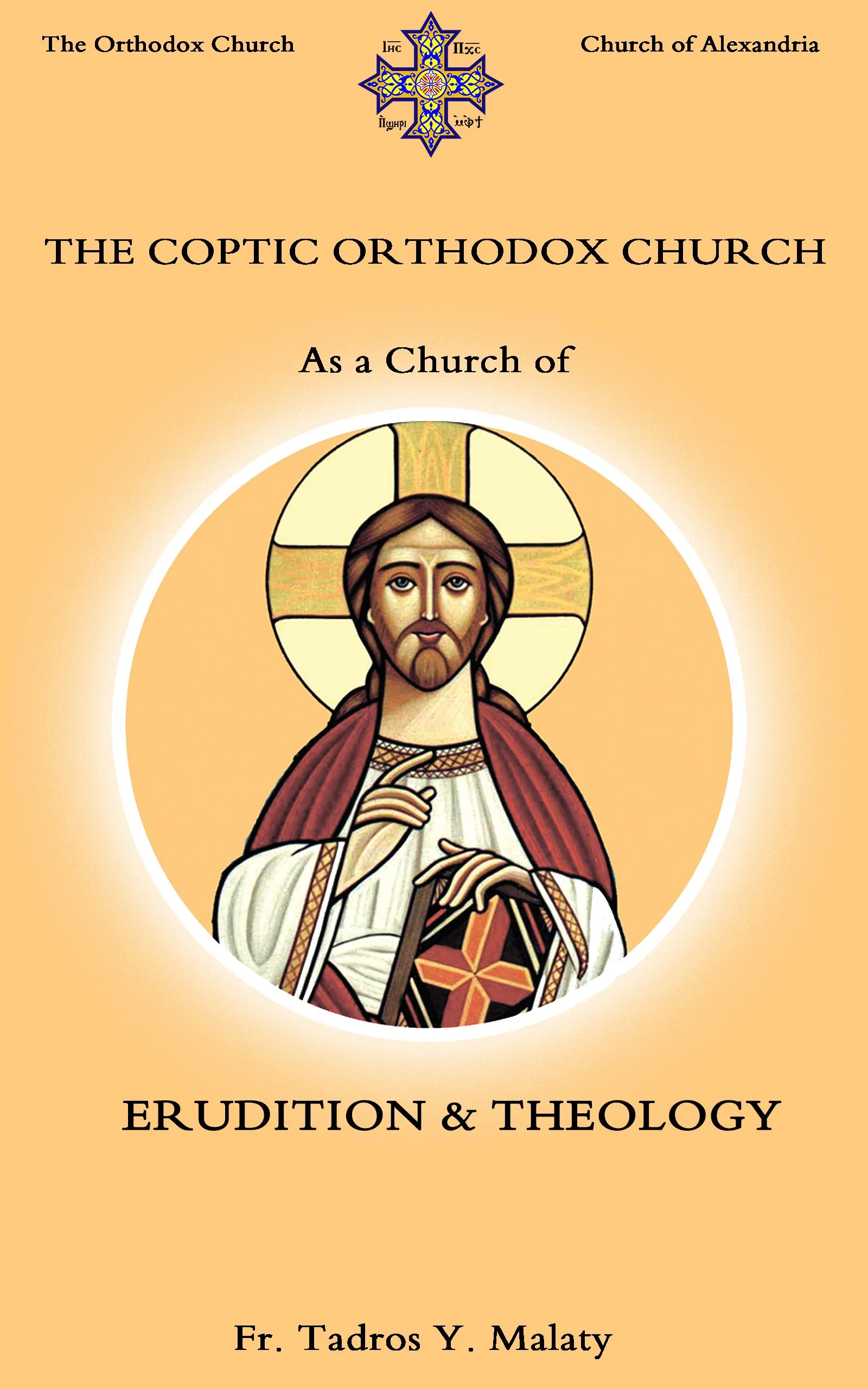
The Orthodox Church
Church of Alexandria
THE COPTIC ORTHODOX CHURCH
as a Church of
ERUDITION & THEOLOGY
Preparatory edition
2017
Fr. Tadros Y. Malaty
Bishoy Boshra Fayez
English Text revised by
Morgan Staggers
Jackie Youssef
Queen St. Mary & Prince Tadros
Coptic Orthodox Church
283 Davidsons Mill Road
South Brunswick, NJ 0883
Contents
THE DEANS OF THE SCHOOL OF ALEXANDRIA
HIS PLEA (Embassy, Presbeia, or Legatio)
ON THE RESURRECTION OF THE DEAD
2. ST. PANTAENUS THE PHILOSOPHER
PANTAENUS AND THE COPTIC ALPHABET
ST. CLEMENT'S VIEW OF PHILOSOPHY
ST. CLEMENT'S VIEW OF GNOSIS "knowledge"
1) THE EXHORTATION TO THE GREEKS (HEATHEN) (Protrepticus)
3) THE MISCELLANIES (Stromata)
WHO IS THE RICH MAN THAT SHALL BE SAVED? (Quis dives salvetur?)
ORIGEN AND THE SCHOOL OF ALEXANDRIA
ORIGEN'S VIEWPOINT ON PHILOSOPHY AND PAGAN LEARNING
THE ORIGENISTS AND THE TRAGEDY OF ST. CHRYSOSTOM
6. ST. DIONYSIUS OF ALEXANDRIA
HIS CONVERSION TO CHRISTIANITY
THE DEAN OF THE CATECHETICAL SCHOOL
A MEDIATOR BETWEEN ST. CYPRIAN AND ST. STEPHEN
DIDYMUS, ORIGEN, JEROME AND RUFINUS
2 - ON THE TRINITY (De Trinitate)
HIS THEOLOGY AND THOUGHTS THE HOLY TRINITY
SPIRITUALITY ACCORDING TO ST. DIDYMUS
1. SPIRITUALITY AND DWELLING OF THE HOLY TRINITY IN THE RATIONAL CREATURES
2. GROWTH AND DECLINE OF SPIRITUALITY
3. DIVINE GRACE AND SPIRITUAL STRUGGLING
10. POPE PETER THE LAST MARTYR
11. THE SCHOOL OF ALEXANDRIA AND THE ECUMENICAL COUNCIL
POPE ATHANASIUS AND THE COUNCIL OF NICEA
POPE TIMOTHY I AND THE COUNCIL OF CONSTANTINOPLE
POPE CYRIL THE GREAT AND NESTORIANISM
12. ST. ATHANASIUS AND ARIANISM
THE SPIRIT OF MARTYRDOM AND ASCETICISM
AT THE ECUMENICAL COUNCIL OF NICEA
1 - APOLOGETICAL and dogmatic writings such as:
2 - THE LETTERS: This includes:
3 - HISTORIC-POLEMICAL writings:
THE THEOLOGY OF ST. ATHANASIUS
13. ST ATHANASIUS And APOLLINARIANISM
APOLLINARIUS & THE ALEXANDRIAN THEOLOGY
IS THE ALEXANDRIAN THEOLOGY APOLLINARIAN?
14. ST. CYRIL AND NESTORIANISM
WAS NESTORIUS TRULY NESTORIAN?
ONE NATURE (MIA-PHYSIS) OF CHRIST
15. ST. DIOSCORUS & EUTYCHIANISM
THE RETURN OF THE CHRISTOLOGICAL CONTROVERSY
ST. DIOSCORUS & THEODORET OF CYRHUS
EUTYCHES' APPEAL TO THE EMPEROR AND BISHOPS
THE SECOND COUNCIL OF EPHESUS IN 449 A.D
1 - The Rehabilitation of Eutyches
2 - Condemnation of Flavian, Domnus, etc.
3 - The omission of The Tome of Leo
LEO OF ROME & THE COUNCIL OF CHALCEDON
ST. DIOSCORUS & THE COUNCIL OF CHALCEDON
1 - HIS PRESIDENCY OVER THE EPHESIAN COUNCIL
2 - THE STORY OF THE BLANK PAPERS
3 - THE REHABILITATION OF EUTYCHES
4 - THE CONDEMNATION OF FLAVIAN AND EUSEBIUS
THE SECOND SESSION (on 10 October)
THE THIRD SESSION (on 13 October)
WHY POPE DIOSCORUS WAS DEPOSED?
DEFENSE OF THE CHALCEDONIAN DEFINITION
WHY DO WE REJECT THE COUNCIL OF CHALCEDON?
SCHOOL OF ALEXANDRIA[1]
Alexandria was famous for its many schools long before Christianity became established in the city. By far the largest school was the "Museum," founded by Ptolemy and destined to become the most renowned school in the East. Other celebrated institutions were the "Serapeum" and the "Sebastion." Each of these three schools possessed its own enormous library.[2]
Justo L. Gonzalez states that the Museum's library - its directors among the most erudite scholars in the world at that time - eventually amassed 700,000 volumes. The sheer magnitude of the Museum's library made it a repository of knowledge astounding for its time. Its very name declares fealty to the Muses. The school beckoned the most distinguished writers, scientists and philosophers of the time to convene and work under its auspices. Due to the reputation of these institutions, Alexandria soon became recognized as a preeminent center of learning.[3] Numerous Jewish schools were also dispersed throughout the city.
In other words, the cosmopolitan city of Alexandria was chosen as a center of learning[4] and a unique hub of brilliant intellectual thinking.[5] Here Egyptian, Greek and Jewish cultures joined, influenced by eastern mystic thoughts. From this foundation, a new civilization emerged. Philip Schaff states:
Alexandria... was the metropolis of Egypt, the flourishing seat of commerce, of Grecian and Jewish learning, and of the greatest library of the ancient world, and was destined to become one of the great centers of Christianity, the rival of Antioch and Rome. There the religious life of Palestine and the intellectual culture of Greece commingled and prepared the way for the first school of theology which aimed at a philosophic comprehension and vindication of the truths of revelation.[6]
In such a polyglot environment, there was no alternative but to establish a Christian Institution, enabling the church to vie culturally with these powerful schools.
It is highly probable there were well educated Christians in Alexandria during apostolic times. In the Acts of the Apostles (18:24 ff.), St. Luke tells of Apollos, a learned Jew of Alexandria and knowledgeable in the scriptures. Apollos may well have learned of Jesus there, knowledge he possessed before meeting the emissary Christian missionaries Aquila and Priscilla.
THE CHRISTIAN SCHOOL
St. Jerome records that St. Mark himself founded the Christian School of Alexandria[7]. The Holy Spirit inspired him to establish the school in order to teach Christianity since this was the only way to provide the new religion a solid foundation in the city.[8]
The School eventually became the oldest center for sacred sciences in the history of Christianity.[9] Here the first system of Christian theology was formed and the Allegorical method of biblical exegesis was devised. In this context, Dom. D. Rees states:
The most renowned intellectual institution in the early Christian world was undoubtedly the Catechetical School (Didascaleion) of Alexandria, and its primary concern was the study of the Bible, giving its name to an influential tradition of scriptural interpretation. The preoccupation of this school of exegesis was to discover everywhere the spiritual sense underlying the written word of the Scripture.[10]
THE CHURCH'S DEVELOPMENT
The Christian School started as a Catechetical School where candidates were admitted to learn the Christian faith and some Biblical studies to qualify for baptism. Admittance was open to all people regardless of culture, age or background.
By the second century, its substantial influence on church life can be seen from the following:
1- It satisfied the thirst of the Alexandrian Christians for religious knowledge, encouraged higher studies and created research work in a variety of fields.
2- It incubated numerous spiritual and well-known church leaders throughout the years. Many of them merited to succeed St. Mark.
3- Through its missionary zeal, it won many souls to Christianity from Egypt and abroad.
4- In true ecumenical spirit it attracted students from other nations, many of whom became leaders and bishops in their own churches.
5- It established a common awareness of the importance of education as a basic element in religious structure.
6- It offered the world's first systematic theological study curriculum.
7- It used philosophy as a weapon against pagan philosophers, thus beating them at their own game.[11]
THE CHURCH'S PROGRAM
1. It would have been a grave error to limit the School's activities to theology.[12] First, the whole breadth of profound sciences was presented before introducing students to moral and religious philosophy. Finally, Christian theology was taught in the form of commentaries on the sacred books. This encyclopedic conception of teaching was an Alexandrian tradition; it was also used in Alexandrian pagan and Jewish schools.
2. St. Clement's trilogy -- consisting of his chief three works Protrepticus ('An Exhortation to the Heathen'), Pedagogus ('The Tutor'), and Stromata ('Miscellanies') -- broadly outlined the School's program at his time. From this trilogy, we may infer that three courses were available:
a. A special course for non-Christians, introducing candidates to principles of Christianity.
b. A course on Christian morals.
c. An advanced course on divine wisdom and commensurate knowledge for the spiritual Christian.
3. Worship went hand in hand with study in the School.[13] Teachers and their students prayed, fasted and practiced diverse ways of asceticism. In purity and integrity, their lives were exemplary. As a model for living, celibacy was recommended and observed by many. In addition to moderation in food and drink, they were also temperate with earthly possessions.[14]
THE SCHOOL'S DEANS
A quick glimpse of the names heading the Christian School of Alexandria provides ample evidence of the school's history and its rank among similar institutions. Among these are Athenagoras, Pantaenus, Clement, Origen, Heraclas, Alexander, Dionysius, Theognostes, Peter, Macarius, Didymus the Blind as well as Athanasius the Apostolic, Cyril of Alexandria, Dioscorus, etc.
THE DEANS OF THE SCHOOL OF ALEXANDRIA
1. ATHENAGORAS THE APOLOGIST
Not much is known about his life. A philosopher who held an academic position at the Museum at Alexandria, he was regarded as an authority on paganism. Like other Platonic philosophers, he sought to analyze Christianity for evidence of mistakes and corruption.
Eager to write against Christianity, he read the Holy Scriptures in an attempt to more accurately criticize their teachings. However, in the course of his study he became taken by the Holy Spirit and began defending the faith he previously attacked. He converted to Christianity (c. 176) and became known as one of the most famous deans of the Christian Theological School.[15]
HIS PLEA (Embassy, Presbeia, or Legatio)
In c. 177 A.D Athenagoras wrote a Plea of 37 Chapters on behalf of Christianity, addressed to the emperor and his co-ruler son. Its purpose was to show the falsity and absurdity of the calumnies against Christians. The Plea ends in a calm entreaty for equitable judgment. He proved that Christian worship and teachings were more reasonable and moral than those of their detractors. He appealed to Greek philosophers and poets in order to garner support for his claims.
This plea is written in a more moderate, learned and wise manner than that of Justin. It is non-rhetorical. It aims apparently at giving a clear, calm and unemotional statement of the Christian case[16].
Athenagoras analyzes the three accusations against Christians at that time: cannibalism, Atheism and Oedipean[17] ideals. The pagans misunderstood the behavior of Christians, they falsely accused them of the following:
1. Atheism, because Christians refused to recognize the heathen gods of the “cities,” to participate in the national traditional rites of their feasts, or to perform honors to the emperors of a sacral nature. They considered this conduct as disloyalty to the emperor and to the state, and hatred of gods and mankind. Apparently Christians were suspect not because they taught a new theology but because they rejected the old ways[18].
He clarifies that Christians are loyal to governors, praying for their stability and goodness. Athenagoras presents his political view mixed with theology.
As all things have been subordinated to you, father and son, who have received the kingdom from above--”for the king’s life is in God’s hand, says the prophetic Spirit--so all things have been subjected to the one God and the Word from him, known to be his inseparable Son[19].
2. Cannibalism (Thyestean banquets), evident in the celebration of the Eucharist (the body and blood of Christ). This accusation was untrue, since Christians do not murder anyone, and were terrified of witnessing executions, and disallowed women to abort children, because of their belief in the resurrection of the body.
3. Incest, or Oedipean intercourse, because of their close meetings in celebrating the Church sacraments, with a strong relation between Christians, both sexes sharing, even the study in the School of Alexandria, led to the doubts of pagans about those meetings, so they accused them of Oedipean cults to destroy those closed meetings.
The philosopher clarifies that Christian morals do not accept the false accusations of Oedipean cults, as they trust that God sees their thoughts, hearts, looks, their respect for each other and their adherence to the sanctification of chastity and marriage. Athenagoras draws attention to their peaceful and blameless life: “We are so far from committing the excesses of which we are accused, that we are not permitted to lust a woman in thought. We are so particular on this point that we either do not marry at all, or we marry for the sake of children, and only once in the course of our life.”
In his defense to clarify the supreme Christian life, he uses the same proof as the learned Justin against Celsus, since Christianity alone could raise the small flock to high virtues no philosopher could reach[20]. Justin tells of one Christian in Egypt who volunteered to be castrated by the prefect of Egypt to show that the charge of promiscuity in Christian assemblies was false[21].
Finally, Athenagoras acknowledges that the true accusation against the Christian was the name[22], as St. Peter (1 Peter 4:15f.) and many Christian apologists said[23].
ON THE RESURRECTION OF THE DEAD
This treatise (25 chapters) is the first attempt ever made by a Christian writer to prove this article of faith with philosophical arguments and not by revelation and the biblical texts alone.[24] It is probably the best early Christian treatise on the subject.[25] In this work, he also refutes all the philosophical arguments raised by the scholars of his day against this dogma. He states that the possibility of the resurrection is proved by God's omnipotence (1-10).
In the first part, Athenagoras refutes all the philosophers’ objections about the resurrection, due to lack of knowledge of God, His power , and His will in the resurrection,
a. Regarding knowledge, God who creates bodies, knows how to raise them.
b. Regarding power, God who could create, can also raise up the dead.
c. Regarding God’s will, the resurrection realizes God’s justice and is in harmony with His Divine power. Athenagoras states that it cannot be shown that God does not will a resurrection, for there is no injustice in the resurrection.
It is necessary for the following reasons:
1- Since man is rational, he is destined for eternal survival. (11-17)
2- Because of the necessity of retribution in the next world in which the body too must share. (18-23)
3- Because man is destined to eternal bliss which cannot found here on earth, but in the afterlife. (24-25)
2. ST. PANTAENUS THE PHILOSOPHER
Pantaenus was one of the greatest deans of the Catechetical School of Alexandria. His reputation was such that the historian Eusebius believed that he was the school's first leader.
Clement of Alexandria spoke of him as the greatest and perfect teacher. Although Clement knew many teachers, he found solace in Pantaenus alone, describing his meeting with these words: "It was the last in relation to the philosophers but the first in its effects... He was indeed like the Sicilian bee and, having feasted on the flowers of the field in the prophets and the Apostles, he deposited in the souls of his hearers an incorruptible treasure of knowledge."[26]
PANTAENUS AND PHILOSOPHY
Pantaenus was a well-known Stoic; he embraced Christianity at the hands of Athenagoras. In 181 A.D he succeeded his teacher as dean of the Theological (Catechetical) School. To him was attributed the introduction of philosophy and science into the School in order to appeal to heretics and educated pagans. Origen gives credence to this claim, saying that in studying Greek philosophy he was imitating Panteanus, who won over many educated people through his philosophical knowledge. This approach was introduced by Pantaenus, developed by his disciple St. Clement of Alexandria and then refined by Origen.
PANTAENUS AND THE COPTIC ALPHABET
Apart from being a great teacher, Pantaenus is credited with introducing the Coptic Alphabet by use of Greek letters added to seven letters from the ancient Demotic letters. Thus, the Holy Bible was translated into the Coptic language under his guidance. Scholars take special interest in this translation and consider it on an equal footing with the original Greek text.[27] All our religious literature was translated into this language as the last phase in the evolution of the ancient Egyptian and Coptic writers began using it instead of Greek.
PANTAENUS AS A PREACHER
The School of Alexandria was not merely a scholarly religious institution but also an inseparable part of the Church. Its leaders were spiritual churchmen. They devoted themselves to studying and teaching the Holy Scripture and Christian doctrines. They offered themselves to their disciples as an example of ascetic life, witnesses who preached the Gospel and sought the salvation of the world.
Pantaenus was not only a teacher but also "a helper to many people," closely identified with his flock, who called him "Our Pantaenus."
In 190 A.D Pope Demetrius selected him for the Christian mission of preaching in India. He left the School under the guidance of his disciple and follower Clement of Alexandria. He also preached in Ethiopia, Arabia and Yemen.[28]
During his journeys as a missionary in India, he discovered Christian communities there using the Gospel of St. Matthew written in Hebrew, brought by Bartholomew the Apostle.[29]
HIS WRITINGS
Pantaenus explained all the books of the Holy Writ from Genesis to Revelation. Thus his contemporaries called him "the Explicant of the Word of God." Unfortunately, nothing remains of his writings except for the few excerpts mentioned in Clement's books.
HIS BIRTHPLACE
It should be noted that Pantaenus was an Alexandrian native.[30] The 5th century historian Philip of Side says that Pantaenus hailed from Athens, but this speculation was likely due to his philosophical interests. Some scholars assumed that he came from Sicily, for his disciple Clement called him "the Sicilian bee." However, Sicilian honey is world-renowned and the moniker may merely have been tribute to the sweetness and nourishment derived from his teaching.[31]
3. ST. CLEMENT OF ALEXANDRIA
Titus Flavius Clement was the father of Christian philosophy of Alexandria[32] and versed in the Holy Scripture. He was born around the year 150 CE of pagan parents. Concerning his birthplace, there were two traditions during the time of St. Epiphanius[33] in the 4th century, crediting either Athens or Alexandria. The second arose from his long stay in that city while the first dovetails with his book "Stromata." (1:11)
Nothing is known of the date, circumstances or the motives of his conversion but it is acknowledged that he traveled extensively to southern Italy, Syria and Palestine. His purpose was to seek instructions from the most famous Christian teachers. He searched unceasingly for God. At the end of his journey he reached Alexandria, where the irresistible attraction of Pantaenus' lectures gave him cause to make the city his second home.[34]
Of his teacher Pantaenus he stated:
When I came upon the last (he was the first in power), having tracked him out concealed in Egypt, I found rest. He, the true, the Sicilian bee, gathering the spoil of the flowers of the prophetic and apostolic meadow, engendered in the souls of his hearers a deathless element of knowledge.
Clement became the disciple and assistant of Pantaenus. He was later ordained a priest in Alexandria, discharged his Catechetical duties with great distinction and succeeded Pantaenus as head of the School before 190 A.D. Among his disciples were Origen and Alexander, bishop of Jerusalem.
During the time of severe persecution by Septimus Severus about 202 A.D, he was forced to leave Alexandria, taking refuge probably in Palestine and Syria. In 215 AD, he died without seeing Egypt again.
Eusebius described him as "practiced in scripture."[35] St. Cyril of Alexandria lauded him as "fond of learning" and "exceptionally expert in Greek History."[36] St. Jerome notes that he produced a "notable volume, full of learning and eloquence, using both Scripture and secular literature"[37] while Socrates claimed he was "full of all wisdom."[38]
Ferguson states, "Clement was religious-minded. He was seeking God. But God had to satisfy him religiously, intellectually and morally. He found that the God of the Christian could do so."[39]
ST. CLEMENT'S VIEW OF PHILOSOPHY
Clement is the first Christian writer to combine Christian doctrine with the ideas and achievements of his contemporaries. He believed that the very constitution of the Church and Holy Scriptures was incompatible with Greek philosophy. He believed that there is no enmity between Christianity and philosophy. For, in his estimation, philosophy was not the work of darkness but in each of its forms a ray of light coming from the Logos. The aim of the philosophy of all schools was also the aim of Christianity, e.g., a nobler life. The difference: while the ancient philosophers had been unable to get more than the glimpses of the truth, it was left to Christianity to make known in Christ the perfect truth.[40]
To this effect, he wrote, "Philosophers are children until they have been made men by Christ."[41]
Philosophy from his point of view has two aspects: one is a gift from God, which He bestowed to philosophers to prepare Greeks (pagans) to accept the Christian truth; the other is human, which men spoiled from their own evils. This is why Clement explains that Plato plagiarized Moses and the Prophets without properly acknowledging them. Moreover, Greek philosophy, like the Law of Moses according to St. Paul, was meant as a tutor to bring the Greeks to Christ and to restrain sin.[42]
Clement knew the world from both paganist and Christian aspects. The Greek classics were as familiar to him as Christian Scripture was. He was equally at home with Greek philosophy and Pauline theology. Thus, he believed that through its teachings and the culture, the Church could Christianize the pagan world.
On this point, Clement is considered the precursor and forerunner of Origen, without whom Origen as we know him could not have existed.[43]
ST. CLEMENT'S VIEW OF GNOSIS "knowledge"
We have seen that prior to Clement the word "gnostic" was comparable to the word "heretic," for throughout the first two centuries heresies in various forms appeared under the title "Gnostics." Some Gnostics had pagan perspectives while others were Jewish postures and still others Christian. A fundamental Gnostic tenet was that the soul could achieve the Supreme God through knowledge (gnosis) and not through faith. St Clement did not attack "gnosis" but rather revealed the supreme Christian gnosis. According to him, the word "gnostic" meant supreme Christian gnosis. To him, the word "gnostic" did not refer to a heretic but to a spiritual believer who accepted gnosis as a divine gift. He states:
Here are the notes that characterize our gnostic: first, contemplation; then the fulfillment of the precepts; finally the instruction of good men. When these qualities are encountered in a man, he is a perfect gnostic. But, if one of them is missing, then his gnostic is crippled.[44]
Walter Volker points out that while St. Clement's gnosis is animated by basic concern for regulating one's life, it is above all a knowledge of the Scriptures through which Christ (the Logos) illuminates all things with the light of Church Tradition.[45]
Here are some of his essential texts concerning gnosis:
- Gnosis is the principle and author of every action conforming to the Logos.[46]
- The grace of gnosis comes from the Father through the Son.[47]
- Baptism makes it possible for us to know God by the fact that the eyes of our soul have been purified.[48]
- Christ gives us gnosis through reading Scriptures in Tradition.[49]
- The Gnostic is called to know God (ginoskein) or epignonai,[50] to see God[51] and to possess Him.[52]
- It is to this extent that the Gnostic attains this state so that he becomes equal to the angels.[53]
- Gnosis becomes securely found through charity[54] and charity is perfected by gnosis.[55]
- God is love and He is knowable (gnostos) to those who love Him... We must enter into His intimacy by the divine "agape" so that we can contemplate His likeness by the likeness.[56]
- Those who know the Son calls sons' God.[57] The Logos of God was made clear to man so that you might learn how man can become god.[58]
HIS WRITINGS
The chief work of St. Clement is the trilogy consisting of:
1 - 'The Exhortation of the Greeks' (Protrepticus).
2 - 'The Tutor' (Paedagogus).
3 - The Stromata ('Patchwork' or 'Miscellaneous Studies').
The trilogy, in fact, gives reliable information regarding Clement's theological system. He believes that God's plan for our salvation takes three steps.
First, the Word of God or the Logos invites humankind to abandon paganism through Faith.
Second, the Logos then reforms their lives by moral precepts.
Finally, He elevates those who have undergone this moral purification to the perfect knowledge of divine things, which he calls Gnosis ("Knowledge').
In other words, the work of Christ is considered an invitation to abandon idolatry, embrace redemption from sin and finally redemption from error, which left humankind blind and helpless.
This divine program for our salvation had its refection on the Alexandrian School at the time of Clement. The school concentrated its program on the same three steps -- conversion of pagans to Christianity, practicing moral precepts and instructing Christian to attain perfect knowledge of doctrine.
1) THE EXHORTATION TO THE GREEKS (HEATHEN) (Protrepticus)
This treatise stands in the tradition of apologetic writing. It vehemently criticizes the superstition, crudity and eroticism of pagan cults and myths while noting the great philosophers, despite their realization of the corruption of paganism, had failed to break with it.[59]
It was probably written about 190 A.D. It is a warm exhortation, addressed to the pagans, aiming at their conversion by encouraging them to listen to the Logos, who is called Protrepticus, e.g., "The Converter." For He is not only the sole Master who invites us to abandon paganism but also through Him alone, we seek total conversion.
If the Sun did not exist, night would be everywhere, in spite of the other stars. Similarly, if we did not know the Logos and He did not enlighten us, we should be no better than chickens fattened in darkness and destined for the spit. Let us receive the Light in order to receive God...[60]
The purpose of this work is to encourage pagans to accept the only true religion, the teaching of the Logos, who after being announced by the prophets, has appeared as Christ.
The immoralities of the Greek mythology, the prostitution of Greek art and the vagaries of the philosophers were unsparingly set forth with an extraordinary amount of direct quotation, often of Greek classics now lost. Clement went on to say that these philosophers -- Plato, Socrates and Pythagoras -- sometimes did find the truth in part and spoke by divine inspiration. This truth however is mixed with error and must be refined. It contrasted the purity and mobility of the teachings of the prophets and of Christ. The result was presumed to be conversion.
He assures that the Logos is not hidden from anyone, for He is the inclusive Light who shines now over the entire world, no longer obscured by darkness. Therefore, let all hurry to their salvation and renewal. (ch. 9)
At the end of this work, St. Clement defines it as follows:
What then is the address I give you? I urge you to be saved.
This Christ desires.
In one word, He freely bestows life on you.
Moreover, who is He?
Briefly learn, the Word of incorruption that generates man by bringing him back to the truth - the goad that urges to salvation - He who expels destruction and pursues death - He who builds up the temple of God in men that He may cause God to take up His abode in men. [61]
Eusebius states that it befitted Clement to declare the foolishness of paganism, for he passed through it and escaped from its plague.
2) THE TUTOR (Paedagogus)
In this work, Clement calls for enjoining the Christian life under the guidance of its Teacher and Instructor (Christ).
This work presents the continuation of the 'Exhortation,' a practical instruction guide dealing with the personal life and social conduct of those who followed his advice by accepting the Christian faith, given in his first treatise. Its aim is to teach those who converted to Christianity how to practice their new life and to be in the likeness of Christ. It reveals the personality of the Paedagogus.
Who is the Tutor?
He is the Son of God, the Immaculate Image of the Father, who became close to us through His human form.
He is without sin, the ideal Model whom we must strive to resemble. [62]
It consists of many moral commandments, but its aim is to be in the likeness of Christ and become children of God, who must be holy and heavenly citizens. He asks us to complete in our souls the beauty of the Church, as we are young children with a good mother (the Church).
Being baptized, we are illuminated;
illuminated we become sons;
being made sons, we are made perfect;
being made perfect, we are made immortal. [63]
The work consists of three books. The first speaks of the Tutor Who educates us in all facets of our lives, forgives our sins (ch. 1), reveals His great mercies (ch. 2) and teaches women as well as men (chs. 3-4). It also explains the basis and methods of education. (chs. 7-13)
His aim is to improve the soul, not to teach,
and to train it up to a virtuous, not to an intellectual life. [64]
Pedagogy is a training of children. [65]
The second book deals with many practical questions for the newly converted. He shows how the Christian is to dress (including jewelry and cosmetics), walk, talk, look and even laugh. There is also a section addressing the Christian's perspective toward amusements and public spectacles.
The third book deals with the elements of true beauty and concludes by explaining the aim of these moral commandments.
3) THE MISCELLANIES (Stromata)
He also called it 'Patchwork,' a title used by many philosophers at the time.
J. Quasten writes, "At the end of the introduction to his Tutor, Clement remarks: 'Eagerly desiring then to perfect us by a gradation conducive to salvation, suited for efficacious discipline, a beautiful arrangement is observed by the all-benignant Word who first exhorts, then trains, and finally teaches.'[66]
From these words, it appears Clement intended to compose as the third part of his trilogy a volume entitled the Teacher. But he abandoned his plan and chose to use the literary form found in The Stromata or 'Patchwork,' which was better suited to his genius. It allowed him to introduce splendid, extensive and detailed discussions in a light, entertaining style. The name Patchwork is similar to others used at the time, like The Meadow, The Banquets, and The Honeycomb. Such titles indicated a genre favored by philosophers of the day where they could discuss a variety of questions without strict order or plan and move from one problem to another without systematic treatment, the different topics being woven together like strands in a carpet.
The tome consists of eight books. Since it is a rough draft, the topics are therefore not well-ordered. It has been well described as "a varied mixture of science, philosophy, poetry and theology," controlled by the conviction that Christianity can satisfy man's highest intellectual yearnings. It aims at presenting a scientific account of the revealed truths of Christianity. In this work, he attacked the Gnostic heretics, for they placed a wide gulf between God and the world and a narrow gulf between God and the soul.
In the first seven books, he compiled numerous abstruse treatises of varied character. He himself says that a book of this kind is like a field full of all sorts of plants. A diligent man can find there what he is seeking but he must look for it. (6:2:4 -8) Elsewhere he writes that the mysteries of knowledge cannot be made too plain to readers undeserving of them. (5:8-9)
His discussion are most interesting as they make known to us the master of the School of Alexandria and the Christians who were around him. E. de Faye says, "This work is perhaps the most important of all Christian writings of the second and third centuries, and at the same time there is not one that is more difficult."
The contents of the eight books are as follows:
Book 1: Philosophy is a divine gift, but he fears using it too much, regarding philosophers as children when compared with believers.
Book 2: The nature of faith by which man became in the likeness of God.
Book 3: The Christian marriage.
Book 4: The true gnostic (the spiritual Christian) who has knowledge in his conduct.
Book 5: Faith, hope and the hidden education.
Book 6: A comparison between the Christian philosophies -- which attains the glory of the Gospel, acknowledges mysteries and is passionless -- and the Greek philosophy, which has very superficial knowledge yet it, too is a divine gift.
Book 7: The Christian gnosis alone is the true worshiper and the real philosopher who matures to become in the likeness of God. V.C. Samuel remarks that the pagans made their gods in their likeness. The foolishness of heretics is also mentioned.
Book 8: This book is lost to antiquity. It does not appear to be a continuation of the seventh but rather a collection of sketches and studies used in other sections of the work. It seems therefore that they were not meant for publication but rather that they were issued after his death against his wishes.
WHO IS THE RICH MAN THAT SHALL BE SAVED? (Quis dives salvetur?)
A delightful tract or sermon on Mark 10:17-31, greatly appreciated in antiquity. Some rich Alexandrian merchants were in despair, for they thought that richness makes salvation impossible. Therefore, Clement showed that wealth was not in itself evil, for sin not wealth depraved man from salvation. Wealth is a divine gift; we can use it for our benefit and for others if we are not enslaved to it. Richness supports the needy!
Let no man destroy wealth, rather than the passions of the soul, which are incompatible with the better use of wealth. So that becoming virtuous and good, he may be able to make a good use of these riches. The renunciation, then, and selling of all possessions, is to be understood as spoken of the passions of the soul.
I would then say this. Since some things are within and some without the soul, and if the soul make a good use of them, they are reputed good. But if a bad, bad;—whether does He who commands us to alienate our possessions repudiate those things, after the removal of which the passions still remain, or those rather. On the removal of which wealth even becomes beneficial. If therefore he who casts away worldly wealth can still be rich in the passions, even though the material [for their gratification] is absent,—for the disposition produces its own effects, and strangles the reason, and presses it down and inflames it with its inbred lusts,—it is then of no advantage to him to be poor in purse while he is rich in passions. For it is not what ought to be cast away that he has cast away, but what is indifferent; and he has deprived himself of what is serviceable, but set on fire the innate fuel of evil through want of the external means (of gratification).[67]
At the end, Clement tells the story of St. John the Apostle and the young man who had fallen among the robbers to prove that even the greatest sinner can be saved if he just repents.
OTHER WORKS
1. Outlines (Hypotyposeis). This work is lost. According to Eusebius,[68] it consisted of eight books containing allegorical interpretations of some verses from the Old Testament.
2. On the Passover. Eusebius[69] states that he wrote this book at the request of the contemporaries to record the traditions he had heard from the early fathers for the benefit of the future generations.
3. On Fasting.
4. On Evil-speaking.
5. On Patience. A discourse to the newly baptized.
6. Against the Judaizers. On the rules of the Church addressed to Alexander of Jerusalem.
7. On Providence (2 books)
8. On the Prophet Amos.
HIS THEOLOGY AND THOUGHTS
We already spoke of his view of philosophy in its relation to faith, and of gnosis (knowledge).
1. Concerning philosophy, J. Quasten says:
Thus, Clement goes far beyond Justin Martyr, who speaks of the seeds of the Logos to be found in the philosophy of the Greeks. He compares it to the Old Testament as far as it trained mankind for the coming of Christ. On the other hand, Clement is anxious to stress the fact that philosophy can never take the place of divine revelation. It can only prepare for the acceptance of the faith. Thus, in the second book, he defends faith against the philosophers.
2. His theology concentrates on Christian education.
He attests that the Logos is the Educator Who practices His educational work throughout the history of humankind. He worked through the prophets and the philosophers until finally He descended to our world to renew it. He not only offers commandments but also has the power to renew the life of man in his wholeness. He educates man to be able to discover the truth in Jesus Christ while creating a zeal and desire to know and love truth. The truth revealed in Christ is not theoretical nor philosophical ideas, but power to practice goodness, virtue and to love. The Church is the place where Christ teaches and educates His believers.
3. Christ’s saving work. J.N.D. Kelly writes:
In expounding Christ’s saving work, Clement carries on the tradition we have already studied... Thus, he speaks[70] of Christ’s laying down His life as a ransom on our behalf, redeeming us by His blood, offering Himself as a sacrifice, conquering the Devil, and interceding for us with the Father. These are, however, conventional phrases as used by him, and this is not the aspect of Christ’s achievement, which makes the chief appeal to him. His most frequent and characteristic thought is that Christ is the Teacher Who endows men with true knowledge, leading them to a love exempt from desires and a righteousness whose prime fruit is contemplation. He is their Guide at the different levels of life, “instructing the gnostic by mysteries, the believer by good hopes, and the hard-hearted by corrective chastisement."[71] It is as teacher that He is “the all-healing Physician of mankind[72],” Who bestows immortality as well as knowledge.[73] “God’s will,” he remarks,[74] “Is the knowledge of God, and this is participation in immortality.” “So man is deified: “the Word... became man so that you might learn from man how men may become gods."[75] As God, Christ forgives us our sins while the function of His humanity is to serve as a model to prevent us from sinning further.[76]
3. The Holy Scripture is the voice of God working for man's goodness. It also, as interpreted by the Church, is the source of Christian teaching.[77] Clement loved the Holy Scriptures, especially the book of Psalms, Proverbs, Wisdom, Isaiah, Jeremiah, Ezekiel, the Sermon on the Mount, Gospel of St. John, etc.
St. Clement blamed the mistakes of heretics on their habit of “resisting the divine tradition."[78] By this, he meant their incorrect interpretation of Scripture. The true interpretation, he believed, was an apostolic and ecclesiastical inheritance.[79] The heretics quoted and warped the meaning of some verses, rendering them fruitless. He used the allegorical interpretation of the Bible, which hides truth yet at the same time reveals it. It hides truth from the ignorant whose eyes are blinded by sin and pride and hence are prevented from knowledge of the truth. At the same time, it always reveals what is fresh to the renewed eyes of the believers.
He is considered the first Christian theologian to employ allegorical interpretation in practical applications. He said the Bible has hidden meanings, inciting us to search and discover the words of salvation while hidden from those who despise them. The truth is pearls, which must not be offered to swine.
The Bible resembles St. Mary, the virgin who brought forth Jesus Christ while her immaculacy remained preserved. Thus, we discover spiritual meanings of the Bible but its meaning is still virgin as it has many hidden spiritual nuances.
4. To attain the knowledge of God we must enter three stages:
a. Purification from sin, for sin prevents us from acknowledging the divine secrets.
b. We must see beyond the literal meanings of the text and naive materialistic interpretations.
c. Vision of God. The knowledge of God is a divine gift. Christ Himself is our knowledge; whoever attains Him embraces knowledge.
5. The Goodness of God. His goodness is revealed through His love for us at times when we are estranged far from Him. He embraces the entire world, desiring its salvation. His goodness is revealed by changing even evil to our edification and goodness. No man is perfect in his goodness. Thus, he is in need of the Logos, the source of salvation, Who grants us the likeness of God.
6. Baptism. He speaks of baptism as a spiritual regeneration, enlightenment, adoption to the Father, immortality, remission of sins.[80] Baptism imprints a seal, or stamp, which in fact comes from the Holy Spirit.
7. As a Churchman, he loved the Church, her tradition and laws. The sign of our membership of the Church is our spiritual knowledge of God. Its unity is based on the oneness of faith. Her (the Church) motherhood is correlated to the fatherhood of God. Like God Himself the Church is one;[81] it is also the virgin mother of Christians, feeding them from the Logos as holy milk.[82] It becomes the selected gathering,[83] an impregnable city ruled by the Logos.[84] It is an icon of the heavenly Church -- that is why we pray that God’s will may be accomplished on earth as it is in heaven.[85]
a. The Order of Priesthood (Bishops, Priests and Deacons) is not based only on distributing the responsibilities but also on the participation in serving the Lord Himself through which they attain angelic and heavenly glories.
The Priest must grow in spiritual knowledge to be equal with the angels.
He states that the pious and righteous gnostic who teach and do God’s will are its true priests and deacons even if they have never been promoted to such office on earth.[86]
b. The Church spends all night singing hymns and celebrating the Eucharistic liturgy at dawn. (1 Thess. 5:6-8)
c. He mentions the order of praying toward the East as a symbol of our new birth and our illumination by the Sun of righteousness.[87]
d. He mentions how the believer must prepare himself or herself before entering the Church.
e. He mentions that the Church in his days did not use musical instruments. Jesus Christ Himself is the lyre of the Church.[88]
f. The Eucharist: a wonderful sacrament! By it, our archaic bodily corruption is taken away. To drink Jesus’ blood, he states,[89] is to participate in His incorruptibility and those who drink His blood are sanctified in body and soul. We accept our Lord and hide Him within us; He educates the motions of our bodies.[90]
g. He was interested in the Church sacraments, especially Baptism, as a new birth by which we receive Christ Himself in our lives and attain His knowledge. Baptism is called "illumination," "perfection," "washing from our sins" and "forgiveness of sins," etc.
h. He defended the Christian marriage as a part of the Church, and defended the equality between a husband and his wife.
8. Love and Fear of God. J. Quasten writes:
The basic principle by which the Logos educates His children is love, whereas the education of the Old Dispensation is based on fear..."
Clement refers here to the heretical doctrine of the Marcionites that the God of the Old Testament is not the same as that of the New. Fear is good if it protects against sin:
The bitter roots of fear arrest the eating sores of our sins. Wherefore also, fear is salutary, if bitter. Sick, we truly stand in the need of the Savior; having wandered, of one to guide us; blind, of one to lead us to light; thirsty, of the fountain of life of which whosoever partakes shall no longer thirst (John 4,13-14); dead, we need life; sheep, we need a shepherd; we who are children need a tutor while universal humanity stands in need of Jesus... You may learn if you will the crowning wisdom of the all-holy Shepherd and Tutor, of the omnipotent and paternal Word, when He figuratively represents Himself as the Shepherd of the sheep. And He is the Tutor of the children. He says therefore by Ezekiel directing His discourse to the elders and setting before them a salutary description of His wise solicitude, "And that which is lame I will bind up, and that which is sick I will heal, and that which has wandered I will turn back; and I will feed them on My holy mountain." (Ez. 34:14, 16) Such are the promises of the good Shepherd.
Feed us, the children, as sheep. Yea, Master, fill us with righteousness. Thine own pasture; yea, O Tutor, feed us on Thy holy mountain the Church, which towers aloft, which is above the clouds, which touches heaven"[91]
9. The Doctrine of Man. J.N.D. Kelly says:
In his primitive state, according to Clement,[92] man was childlike and innocent, destined to advance by stages towards perfection. Adam, he states,[93] “was not created perfect in constitution. However, suitable for acquiring virtue... For God desires us to be saved by our own efforts.” Progress therefore depended upon free will, on which Clement places great emphasis. The fault of Adam and Eve consisted in the fact that, using their volition wrongly, they indulged in the pleasures of sexual relations before God gave them leave.[94] Not that this relation was wrong in itself (Clement strongly repudiates[95] the Gnostic suggestion that it is), but the violation of God’s ordinance was. As a result, they lost the immortal life of Paradise, their will and rationality were weakened, and they became a prey to sinful passions.[96] However, while Clement accepts the historicity of Adam, he also regards him as symbolizing humankind as a whole. All men, he teaches,[97] have a spark of the divine in them and are free to obey or disobey God’s law, but all except the incarnate Logos are sinners.[98] They are, as it were, sick, blind and gone astray; they are enslaved to the elements and the Devil; and their condition can be described as death.[99] He nowhere hints, however, that they are involved in Adam’s guilt and in one passage[100] vehemently denies that a newborn baby, which has not performed any act of its own, can have “fallen under the curse of Adam.” In another[101] he explains Job 1, 21 (“Naked I came from my mother’s womb”) as implying that a child enters the world exempt from sin. Overall, his insistence against the Gnostics that only the personal misdeeds those men have committed are imputable to them leaves no room for original sin in the full sense. On the other hand, although certain contexts[102] might seem to suggest that the connection between the general human sinfulness and Adam’s transgression amounts to no more than imitation, he in fact envisages it as much more intimate. His teaching[103] seems to be that, through our physical descent from Adam and Eve, we inherit, not indeed their guilt and curse, but a disordered sensuality, which entails the dominance of the irrational element in our nature.[104]
QUOTATIONS FROM ST. CLEMENT[105]
[The heavenly Guide, the Logos, is called Protreptikos or "Converter" when He invites mankind to salvation... But when He functions as a Physician and a Teacher... He will receive the name of "Pedagogue..." Thus, the Logos wishing to achieve our salvation step by step follows an excellent method: He first converts, then He disciplines and finally He instructs].
[Just as the will of God in action is called the world, so its intention is the salvation of men, and is called the Church].
[The mother leads her little children and we seek our mother, the Church].
[The Lord after His resurrection gave the gnosis to James the Just, to John and to Peter; these transmitted it to the other apostles, and the other apostles to the seventy disciples, one of whom was Barnabas].
4. ORIGEN
J. Quasten states, "The School of Alexandria reached its greatest importance under St. Clement's successor, Origen,[106] the outstanding teacher and scholar of the Early Church, a man of encyclopedic learning, and one of the most original thinkers the world has ever seen."[107] The Coptic Church was compelled to excommunicate him because of his apostasy, such as the salvation of the devil, the universal salvation of the entire human race and his acceptance of priesthood after making himself a eunuch. Other churches excommunicated him, his followers and their writings after his death in the Council of Constantinople in 553 CE.
ORIGEN'S CHILDHOOD
Origen, a true son of Egypt, was born probably in Alexandria in c. 185 CE. His father Leonides took care to bring him up in the knowledge of the sacred Scriptures and the child displayed a precocious curiosity in this respect.[108]
"Every day he would set him to learn a passage (from the Bible) by heart... The Child was not content with the straight-forward, obvious meaning of the Scriptures, he wanted something more, and even at that time would go in pursuit of the underlying sense. He even embarrassed his father by the questions he asked..." [109]
Eusebius, the historian, tells us that Leonides,[110] seeing his son's fondness of the Word of God during his boyhood, would go up to Origen's bed while he was asleep, uncover his chest and reverentially kiss it as a dwelling-place of the Holy Spirit. He thought of himself as blessed in being the father of such a boy.[111]
LEONIDES' MARTYRDOM
Besides being raised with the Holy Scriptures, Origen was exposed to the influence of Martyrdom. The persecution against Christians, which arose in the tenth year of Septimius Severus (202 A.D), bore with special severity upon the Egyptian Church.[112] Leonides was arrested and thrown into prison. Origen, who had not completed his seventeenth year, ardently desired to attain the Martyr's crown with his father. He was only prevented from achieving this desire by his mother who, at a critical moment, hid all his clothes and so laid upon him the necessity of remaining at home[113] to look after his six brothers. He strongly urged his father to remain firm by writing to him: "Do not dream of changing your mind for our sake... "
TEACHER OF LITERATURE
Leonides was beheaded and his possessions were confiscated. Origen found refuge with a noble lady of Alexandria, who helped him for a time. Yet he could not be comfortable there. For a heretic teacher called "Paul of Antioch" had so captured this simple woman by his eloquence that she had harbored him as her philosopher and adopted son, giving him permission to propagate his heresy by means of lectures held in her house.
As an orthodox believer, Origen felt no comfort. He left the house and maintained himself and his family by teaching secular literature and grammar. Through his instruction to pagans, Origen's faith found expressions, as he often had occasion to refer to the theological position of pagan writers. As a result, some pagans applied to him for instruction in Christianity including two brothers, Plutarch and Heraclas, of whom the former was martyred and the latter was yet to hold the bishopric of Alexandria.[114]
ORIGEN AND THE SCHOOL OF ALEXANDRIA
The Catechetical School of Alexandria had been dispersed by the persecutions and the departure of St. Clement left it without a teacher. St. Demetrius, Pope of Alexandria, appointed Origen as the head of the school when he was eighteen years old due to his Christian zeal to preach and catechize. The post was an honorable one but it was not without its dangers for the persecution begun by the edicts of Severus (202 CE) still raged, threatening especially the converts and their masters. Origen immediately gave up all other activities and sold his beloved books,[115] devoting himself exclusively to his new duties as a catechist.
About the year 215, St. Alexander of Jerusalem regarded his master and friend Origen as the successor to the venerable deans of the Alexandrian School -- Pantaenus and Clement -- but who (in his eyes) was greater than them. On the day following the death of Clement, Alexander wrote to Origen, "We knew those blessed fathers who proceeded us and with whom we ourselves shall soon be: Pantaenus the truly blessed master, and also the venerable Clement, who became my own master and assisted me and possibly others. Through them I came to know you, although excelling, my brother."[116]
Here I would like to refer to Origen's role in the development of this school.
1 - Origen applied himself with the utmost ardor in not only studying the teaching the Holy Scripture but also giving his life as an example of evangelical living. His disciple St. Gregory the Wonder-maker says, "He stimulated us by the deeds he did more than by the doctrines he taught."
Eusebius also tells us, "He taught as he lived, and lived as he taught; and it was especially for this reason that with the co-operation of the divine power he brought so many to share his zeal." He adds,
He preserved in the most philosophical manner of life, at one time disciplining himself by fasting, at another measuring out the time for sleep, which he was careful to take, never on a couch, but on the floor, and indicated how the Gospel ought to be kept, which exhorts us not to provide two coats nor to use shoes, nor indeed, to be worn out with thoughts about the future.[117]
He tried to lead his disciples and his listeners along the same path of asceticism and mortification, which he imposed upon himself from his youth. To asceticism, we must join prayers, with the aim of freeing the soul and enabling it to be united with God. That is what a Christian seeks by observing virginity,[118] by drawing from the world while living in the world,[119] sacrificing as much as possible good fortune[120] and despising human glory.[121]
The presence of women at his lectures and the consequent possibility of scandal suggested to him a literal acting on the words of the Gospel -- there are eunuchs who made themselves eunuchs for the kingdom of heaven's sake" (Matt. 19:12) -- and his self-mutilation was later brought against him by Pope Demetrius.
2 - At the beginning Origen's aim concentrated on preparing the catechumens to receive baptism, not only by teaching them the Christian faith but also by giving them instructions concerning the practical aspects of Christian life.
"If you want to receive Baptism," he says,[122] "You must first learn about God's Word, cut away the roots of your vices, correct your barbarous wild lives and practice meekness and humility. Then you will be fit to receive the grace of the Holy Spirit."
3 - Origen's task was not to prepare those people flocking in increasing numbers to sit at his feet to be baptized, but rather to be martyred. Those who were close to him knew they were running the risk of Martyrdom.
Eusebius describes the part Origen played at the time of persecution.
He had a great name with the faithful[123] due to the way he always welcomed the holy martyrs and was so attentive to them, whether he knew them or not. He would go to them in prison and stay by them when they were tried and even when they were being led to death... often, when he went up to the martyrs unconcernedly and saluted them with a kiss regardless of the consequences, the pagan crowd standing by became very angry and would have rushed upon him and very nearly made an end of him.
4 - As his crowd of disciples flocked to him from morning to night, Origen realized that he had to divide them into two classes. Thereupon he chose his acolyte Heraclas, an excellent speaker, to give the beginners the preparatory subject of Christian doctrines while he devoted himself to instructing advanced students in philosophy, theology and especially the Holy Scriptures.
5 - Origen gained a great number of pupils from the pagan School of philosophy. He felt that he was in need of deeper philosophical training, which could be found in the lectures of Ammonius Saccas, a well-known Alexandrian philosopher (174-242 CE). He taught Platonism; from him Plotonus (205-270 CE) learned Neoplatonism. This philosopher was attracted by the Theological School of Alexandria. He converted to Christianity and wrote several Biblical texts[124].
It is noteworthy that Origen, unlike Clement, was not a philosopher who had converted to Christianity nor was he in sympathy with philosophy. Perhaps he was considered the beauty of philosophical forms or expressions as a dangerous alternative with the potential to entrap or distance him. Maybe he merely felt he had no time for such trifles.[125]
In fact, Origen was a true missionary who realized that he must study philosophy in order to expound Christianity to the leading minds of his day and to answer their doubts and stress the factors in Christianity likely to appeal to them most.[126]
In a letter written in defense of his position as a student of Greek philosophy, he says:[127]
When I had devoted myself entirely to the Scriptures, I was sometimes approached by heretics and people who had studied the Greek sciences and philosophy in particular, I deemed it advisable to investigate both the doctrinal views of the heretics and what the philosophers claimed to know of the truth. In this, I was imitating Pantaenus who, before my time, had acquired no small store of such knowledge and had benefited many people by it.
ORIGEN'S VIEWPOINT ON PHILOSOPHY AND PAGAN LEARNING
According to Origen, "all wisdom is from God[128]" -- whether it be knowledge of philosophy, geometry, medicine or music.[129] In fact, he condemned philosophy; he says, "Do not covert the deceptive food philosophy provides; it may turn you away from the truth."[130] "It is because the pagans spoiled it by introducing their errors, that it teaches nothing of God's will." [131]
He indicated the errors in philosophical systems and endeavored to protect his acolytes from them. Above all, he was anxious lest they should be led astray by a strange master who would lead them to forget Christ or at least might lessen the exclusive fidelity to which they owe Him. His ideal was St. Paul, and he wished to say in his turn:
Who shall separate us from the Charity of Christ?" He added, "I can say this in all confidence: neither the love of profane letters, nor the sophisms of philosophers, nor the frauds of astrologers concerning the supposed courses of the stars, nor the divination of demons, full of lies, nor any other science of the future sought by evil artifices, will be able to separate us from the Charity of God, which is in Christ Jesus our Lord.[132]
His system in teaching philosophy and pagan leanings can be summarized in two points:
1 - Origen started his teaching with "rhetoric," then added scientific knowledge such as physics, mathematics, geometry and astronomy.[133] This was only mere preparation, followed by the study of philosophy.
2 - He wished his disciples to know something about all the philosophical theories except that of Abecareans, and not to stress on one of them. St. Gregory the Wonder-maker gives an account of this system, saying:[134] In every philosophy he picked out what was true and useful and set it before us, while what was erroneous he rejected... He advised us not to give our allegiance to any one philosopher even though he should be universally acclaimed as perfect in wisdom, but to cleave to God alone and His prophets.
ORIGEN'S JOURNEYS
1 - About the year 212. Origen went to Rome, during the pontificate of Zephyrinus. In his presence, St. Hippolytus gave a discourse in honor of the Savior.[135]
2 - Shortly before the year 215, Origen goes to Arabia in order to instruct the Roman Governor at the latter's own request. He was also called to Arabia several times for discussions with bishops.[136] Eusebius mentions two of those debates; in the year 244 CE, an Arabian synod was convened to discuss the Christological views of Beryllus, Bishop of Bostra. The synod, which was largely attended, condemned Beryllus because of his monarchianism (one hypostasis as Godhead) had vainly tried to bring him round to the Orthodox position.[137]. Origen hurried to Arabia and succeeded in convincing Beryllus, who seemed even to have written him a letter of thanks.[138] This link with Arabia is a continuation of Pantaenus's reputation as "a helper to many people." [139]
3 - Around the year 216 A.D when the Emperor Caracalla looted the city of Alexandria, closed the schools, persecuted the teachers and massacred them, Origen decided to go to Palestine. There he was welcomed by his old friend Alexander Bishop of Jerusalem and subsequently by Theoctistus Bishop of Caesarea (in Palestine), who jointly invited him to expose the Scriptures in the Christian assemblies before them. Pope Demetrius was very angry, for according to Alexandrian Church custom, laymen should not deliver discourse in the presence of the bishops. He ordered the immediate return of Origen to Alexandria. The latter loyally obeyed the summons and everything seemed to settle down as it had been before. This incident was a prelude to the conflict, which was to break out some fifteen years later.
4 - At the beginning of the reign of Alexander Severus (222-235), the Emperor's mother, Mamaea summoned Origen to Antioch in order that she might consult him on many questions. According to Eusebius, Origen stayed for some time at the royal place and then, after hearing powerful testimony to the glory of the Lord, worthy of divine instruction, "hastened back to his School."[140]
5 - Origen's next journey was into Greece and resulted in two years of absence from Alexandria. He went in response of Achia, apparently to act the role of peacemaker, and was bearer of written credentials from his Bishop.[141] His route lay through Palestine; at Caesarea, he was ordained a priest by the Bishop of this country.[142] To them it seemed inappropriate that a spiritual counselor of high authority like Origen should be no more than a layman. More importantly, by licensing Origen to preach in their presence, they desired to avoid all risk of further rebukes from Pope Demetrius. Nevertheless, Pope Demetrius considered this ordination a much worse offense than the former one and declared it invalid for two reasons:
A - Origen received priesthood from another bishop without permission from his own bishop.
B - Origen's self-mutilation was against his ordination. Even today, nobody who practices self-mutilation can be ordained.
ORIGEN'S CONDEMNATION
Bishop Demetrius called a council of bishops and priests who refused to abide by the decision that Origin must leave Alexandria.[143] Yet this refusal did not deter Bishop Demetrius. He called another council of bishops only (in the year 232) and defrocked Origen of the priesthood, as the ordination was invalid and he became unfit for catechizing.
1 - He believed souls were created before bodies, and they are bound to bodies as a punishment of previous sins committed.[144] This worldly existence is for them only a place of purification.
2 - The soul of Christ had a previous existence before the Incarnation when it was united with divinity.
3 - All creation will return to its origin in God, and all humankind will be saved ("eternal" punishment has an end).[145]
4 - Satan and all evil spirits will be saved.[146] When he was castigated for this apostasy, he protested: "Even an idiot could not hold such a thesis."[147]
Nonetheless, the sentence of the council was enforced in Egypt and recognized in the West but disregarded by the churches of Palestine, Arabia, Phoenicia and Achaia where Origen was well known and respected.[148]
Origen obeyed, abhorring schism, and with noble Christian unselfishness counted his expulsion from the place that was dearest to him than any on earth as not too great a sacrifice in order to maintain the unity of the Church. For although he had powerful friends in Alexandria and overseas and might have become the leader of a great party to fight the Bishop, he refused to contest his expulsion and calmly left Alexandria. Feeling that nobody could deprive him of his beloved church, he said, "It sometimes happens that a man who has been turned out is really still inside, and one who seems to be inside may really be outside."[149]
A NEW SCHOOL
Origen left Alexandria and made his new home in Caesarea (Palestine) where the bishops gladly welcomed him. "They attached themselves to him as to a unique master, and they entrusted him with the explanation of the Holy Scriptures and with the whole of Church teaching."[150] Bishop Theoktistus convinced Origen to found a new school of theology there, over which he presided for almost twenty years. In this School, he taught Gregory the Wonder-Worker for five years.
At the bishop's request, Origen also taught the Scripture at least twice a week, on Wednesdays and Fridays.[151] The new responsibility increased Origen's humility, for he believed that the preacher had to be first a man of prayer. Many times, when he was faced with an especially difficult passage, he would often stop and ask his listeners to pray with him for a better understanding of the text.[152]
MAXIMINUS THRAX'S PERSECUTION
During the persecution initiated by Maximinus Thrax, Origen took refuge in Cappadocian Caesarea. His old friends Ambrose and Protoktetuis, a priest of Caesarea, were seized and thrown into prison. He wrote and dedicated to them his treatise, Exhortation to Martyrdom, in which he regarded martyrdom as one of the proofs of the Truth of Christianity and a continuation of the work of redemption.
Ambrose and Protoktetuis were set at liberty and Origen returned to Caesarea in Palestine.
Traveling to Athens through Bithynia, he spent several days at Nicomedia. There he received a letter from Julius Africanus, who asked him about the story of Susanna as an authentic portion of the Book of Daniel. Origen replied in a lengthy letter from Nicomedia.
Under the reign of Decius (249 - 251), persecution arose again and Origen was arrested. His body was tortured; he was tormented with a heavy iron collar and kept in an innermost den in the prison. For several days, his feet were tied together to a rock; and he was threatened with being burned at the stake.[153]
Eusebius describes his suffering in the following terms:
The number and greatness of Origen's sufferings during the persecution, the nature of his death.., the nature and the number of bonds which the man endured for the word of Christ, punishments as he lay in iron and in the recesses of his dungeon; and how, when for many days his feet were stretched four spaces in that instrument of torture, the stocks, he bore with a stout heart threats of fire and everything else that was inflicted by his enemies; and the kind of issue he had thereof, the judge eagerly striving with all his might on no account to put him to death; and what sort of sayings he left behind him after this, sayings full of help for those who need consolation. (Eusebius: Hist. Eccl. 6,39,5)
Origen bore all these sufferings bravely. He did not die directly from this persecution but expired shortly afterwards, perhaps due to the injuries he received. Before Origen died, St. Dionysius the Great -- who succeeded Heraclas as Pope of Alexandria -- sent him a letter hoping to lead to renewal of Origen's old relationship with the Alexandrian Church.
ORIGEN'S WRITINGS
In 217 A.D or soon thereafter, Origen made a great friend in Ambrose, a man of means and position whom he had won from Valentinian heresy. According to Eusebius, Origen began his commentaries on the divine Scriptures after being urged thereto by Ambrose, his friend and publisher. He employed innumerable incentives, not only exhorting him by word, but by furnishing abundant means. For he dictated to more than seven secretaries who relieved each other at appointed times. In addition, he employed no fewer copyists, including girls who were skilled composing elegant script. Ambrose furnished the necessary expense in abundance.
Origen was the most prolific Christian writer of antiquity. St. Epiphanius declared that he wrote 6,000 works, doubtless meaning rolls, or scrolls of ordinary length. St. Jerome asked, "Which of us can read all that he has written?" About 2,000 titles were listed by Eusebius and about 800 by St. Jerome. Only a small portion of his work remains extant. Only half of what survives is in Greek; the remainder in Latin versions. Jerome and Rufinus translated him while St. Basil and St. Gregory of Nazianzus compiled an anthology (Philokalia Origenis).
The Latin translations of Origen's works, especially those by Rufinus, are not accurate. Rufinus wanted to adopt Origen to the Latin-speaking public and therefore did not hesitate to bridge some passages that seemed to him to be too long or to add explanations where he thought it advisable.
Rufinus thought that Origen's books had been altered by heretics and he had the right to expurgate text...[154]
Cited below are the main classifications of his work. We have already mentioned the "Hexapla," or the six-fold writing. It is the first attempt at establishing a critical text of the Old Testament. The immense task to which Origen dedicated his whole life[155] began at Alexandria. This tome was finished probably at Tyre. Only fragments remain of the Greek but a greater part of it survives in a Syriac version made in 616 or 617 CE by Paul, bishop of Tella.
It is said that he used to spend almost all night kneeling, praying and reading the Bible. His exegetical writings are numerous and were of three main types:
1. Scholia or brief notes on difficult points of sacred Scripture, especially grammatical difficulties.
2. Homilies, or popular expositions on some selected chapters or verses from the Holy Scriptures, which he delivered in liturgical meetings, aimed at popular edification.
3. Commentaries, or exhaustive or learned notes. In spite of the Allegoric and dogmatic elements with which they are cumbered, in many respects they still serve as models for commentators.
They are a strange mixture of philological, textual, historical and etymological notes as well as theological and philosophical observation.[156]
In addition to historical and literal elements, he used mystical, inner and spiritual senses, employing the allegorical mode of interpretation. His interpretation covered every book of the Old and New Testaments. His homilies or expository sermons numbered: 28 of the Book of Numbers, 26 on the Book of Joshua, 32 on Isaiah, 45 on Jeremiah, 25 on Matthew, 39 on Luke, 27 on Acts, etc.
These are only a few of the items given in a long list of the works of Origen found in a letter from Jerome to Paula and Eustochium. This list reached at least 444 for the Old Testament and 130 for the New Testament. But of these, only 21 have survived in the Greek original and only 186 in Latin translation.
His commentaries count 25 books on the Minor Prophets, 25 on Matthew, 32 on John, 15 on Romans, 15 on Galatians, etc.
The commentaries ran to at least 177 books (rolls) for the Old Testament and 114 for the New. Of these only 16 books are preserved in Greek. It must be added that no small amount of Origen's exegetical work survived piecemeal in the Catena - those collections of valuable observations made by the early Fathers of the Church. These began to be compiled starting c. 500 CE, starting with Procopius of Gaza.
Contra Celsus
His most important apologetic work is Contra Celsus, a treatise composed of eight books written in answer to a detailed and far reaching attack by Celsus (180 CE). Celsus, a highly-cultivated man, possessed in particular an excellent knowledge of Plato. He was familiar not only with Greek thought and literature of the period but also had some acquaintance with the Old Testament. He knew the four Gospels and had a conception of the main thread of Pauline theology. He attacked the Old Testament while at the same time used Jewish arguments against Christianity. Unquestionably Origen's Apology Against Celsus is of great value. It is marked by keen spiritual insight, vast erudition, masterly argumentative ability and mature thought.[157]
The 'True Discourse' (Alethes Logos) of Celsus was a violent attack on Christianity and a defense of the state religion. The text relied on the faults Judaism and Platonic philosophy found with Christian teaching. This work had almost no effect on Egypt and Palestine and disappeared before Origen's time. Nevertheless, Ambrose asked his friend to reply to Celsus.
At first Origen states that the life and authority of Christ are well known and Celsus' work cannot shake the faith of any Christian (Preface 3). Nevertheless, at the insistence of Ambrose he wrote this reply, using many quotations from philosophical writers, demonstrating that he was more educated than Celsus. He wrote it to those who are weak in faith. (Rom 14:1)
When false witnesses testified against our Lord and Savior Jesus Christ, He remained silent; and when unfounded charges were brought against Him, He returned no answer, believing that His whole life and conduct among the Jews were a better refutation than any answer to the false testimony, or than any formal defense against the accusations. And I know not, my pious Ambrose, why you wished me to write a reply to the false charges brought by Celsus against the Christians and to his accusations directed against the faith of the Churches in his treatise; as if the facts themselves did not furnish a manifest refutation and the doctrine a better answer than any writing, seeing it both disposes of false statements and does not leave to the accusations any credibility or validity[158].
Nevertheless, since in the multitude of those who are considered believers some such persons might be found as would have their faith shaken and overthrown by the writings of Celsus. But who might be preserved by a reply to them of such nature as to refute his statements and to exhibit the truth, we have deemed it right to yield to your injunction and to furnish an answer to the treatise which you sent us, but which I do not think that any one, although only a short way advanced in philosophy, will allow to be a "True Discourse," as Celsus has entitled it[159].
Here Origen explains the following points:
a. Celsus claims to know "everything" and did not need the Old and New Testaments. We who studied them cannot dare to say that we know everything, for we love the truth. (1:12)
b. Celsus as a true Greek was proud of Hellenic philosophy. Origen declares the superiority of the Gospel over the Hellenic philosophy:
c. Christians are simple people, but it does not mean that they are ignorant. Simplicity has its knowledge and living sustenance. Christianity presents milk to the children and food for the mature.
d. Celsus ignores the prophecies concerning Christ (1, 50)
e. The mention of the weakness of the disciples and apostles assures the authenticity of the Gospels. The promise of Christ that His Gospel would spread all over the world had been fulfilled. It is the work of divine grace that attracts souls to follow our Lord Jesus Christ with them.
The word of God (1 Cor. 2:4) declares that the preaching, although in itself true and most worthy of belief, is not sufficient to reach the human heart, unless a certain power be imparted to the speaker from God and a grace appear upon his words. It is only by the divine agency that this takes place in those who speak effectually. The prophet says in the sixty-seventh Psalm, "the Lord will give word with great power to them who preach." If then it should be granted that the same doctrines are found among the Greeks as in our own Scriptures, yet they do not possess the same power of attracting and disposing the souls of men to follow them[160].
f. The apostles' abhorrence of death and their success assures the resurrection of Christ.
g. Christianity has the power to renew human nature. Sinners are changed to saints. They have the power of the Holy Spirit operating in them:
And there are still preserved among Christians traces of that Holy Spirit which appeared in the form of a dove. They expel evil spirits and perform many cures and foresee certain events, according to the will of the Logos. Moreover, although Celsus or the Jew whom he has introduced may treat with mockery what I am going to say, I shall say it nevertheless -- that many have been converted to Christianity as if against their will, some sort of spirit having suddenly transformed their minds from a hatred of the doctrine to a readiness to die in its defense...[161]
h. Christians obey their rulers but in the name of the Lord. They never accept heathen worship.
"What harm is there in gaining the favor of the rulers of the earth, whether of a nature different from ours, or human princes and kings? For these have gained their dignity through the instrumentality of demons[162].
There is therefore One whose favor we should seek and to whom we ought to pray that He would be gracious to us -- the Most High God, whose favor is gained by piety and the practice of every virtue. And if He would have us to seek the favor of others after the Most High God, let him consider that, as the motion of the shadow follows that of the body which casts it, so in like manner it follows, that when we have the favor of God, we have also the good will of all angels and spirits who are friends of God[163].
But whilst we do nothing which is contrary to the law and word of God, we are not so mad as to stir up against us the wrath of kings and princes, which will bring upon us sufferings and tortures or even death. For we read, "Let every soul be subject unto the higher powers. For there is no power but of God: the powers that be, are ordained of God, Whosoever therefore resists the power, resists the ordinance of God" (Rom. 13:1-2)[164]
Origen's other apologetic or polemic works are no more than the dismantling of disputations with various persons: Bassus, Beryllus of Bastra, a Valentinian named Candidus and some Jews.
a. De Principiis - Peri Archon, or On First Principles. This is the first attempt ever made toward the formation of Christian Theology.[165]
In this work, Origen defended Orthodox dogma against the Gnostics, written for well-educated people and not to the masses. It is the first philosophical attempt to explain salvation. These books deal respectively with God, the creation of the world, the fall of man, redemption through Jesus Christ, sin, human freedom and the Holy Scriptures as a source of belief. In the introduction, Origen shows that the source of all religious truth is our Lord Jesus Christ, Who is the Truth:
All who believe and are assured that grace and truth were obtained through Jesus Christ, and who know Christ to be the Truth, agreeably to His own declaration, "I am the Truth," (John 14:6) derive the knowledge (gnosis) which incites men to a good and happy life from no other source than from the very words and teaching of Christ. Moreover, by words of Christ, we do not mean those on which he spoke when he became man and tabernacle in the flesh, for before that time, Christ, the Word of God, was in Moses and the prophets. For without the Word of God, how could they have been able to prophesy of Christ? And were it not our purpose to confine the present treatise within the limits of all attainable brevity, it would not be difficult to show, in proof of this statement, out of the Holy Scriptures, how Moses or the prophets both spoke and performed all they did through being filled with the Spirit of Christ... Moreover, after His ascension into heaven He spoke in His apostles, as is shown by Paul in these words: "Or do you seek a proof of Christ who speaks in me." (2 Cor. 13;3) Since many, however, of those who profess to believe in Christ differ from each other, not only in small and trifling matters, but also on subjects of the highest importance... It seems on that account necessary first of all to fix a definite limit and to lay down an unmistakable rule regarding each one of these, and then to pass to the investigation of other points... as the teaching of the Church, transmitted in order succession from the apostles, and remaining in the Churches to the present day, is still preserved, that alone is to be accepted as truth, which differs in no respect from ecclesiastical and apostolic tradition[166].
The enemies of Origen used the work as a vehicle to accuse him of heresy, during his own life and after his death. St. Jerome states that Origen wrote to Fabianus Bishop of Rome assuring that some articles mentioned in his work went counter to his own view and his friend Ambrose published it in haste.[167]
The works consist of four books treating the following topics:
a. God and the world of spirits
b. The world and man; redemption of man and his end.
c. Human freedom and final triumph of the good.
d. The Scripture as the source of faith and the three modes of Scriptural interpretation.
The way, then, as it appears to us, in which we ought to deal with the Scriptures and exact from them their meaning is the following, which has been ascertained from the Scriptures themselves. By Solomon in the Proverbs, we find some such rule as this enjoined repeating the divine doctrines of Scripture; "And portray them in a threefold manner, in counsel and knowledge, to answer words of the truth to them who propose them to you." (Proverbs 22:20-21) The individual ought then to portray the ideas of Hoy Scripture in a threefold manner upon his own soul, in order that the simple man may be edified by the flesh as it were, of the Scripture, for so we name the obvious sense; while he who has ascended a certain way (may be edified) by the soul as it were. The perfect man again (may receive edification) from the spiritual law, which has a shadow of good things to come... For as a man consists of body, soul and spirit, so in the same way does Scripture, which has been arranged to be given by God for the salvation of men[168].
b. Discussion with Hereclides.[169] Among a number of papyri found at Toura near Cairo in 1941 is a codex from about the end of the sixth century containing the text of a discussion between Origen and Bishop Heraclides. It represents a complete record of an actual discussion, which had taken place in a church in Arabia in the presence of the bishops and the people about the year 245. Origen seems to be in full possession of his authority as a teacher.
The first part discusses the Father and the Son. Origen refers to Scripture in order to show in what sense two can be one:
I. Adam and Eve were two but one flesh (Gen. 2:24).
II. The just man who is joined to the Lord is one in spirit with Him. (Cor. 6:17)
III. "Our Lord and Savior is in His relation to the Father and God of the universe not one flesh, nor one spirit, but what is much higher than flesh and spirit -- one God."
At the end of the discussion, he deals with the immortality of the soul. Bishop Philippus queries Origen on this matter, who replies that the soul is on one hand immortal and on the other mortal, depending entirely on the three different kinds of death, i.e., death from sin (Rom. 6:2), death from God (Ezech 18:4) and natural death. Viz the third one, the soul is not subject to mortality; though those in sin desire death, they cannot find it. (Rev. 9:6) The soul may be subject to the first or the second kind of death, and may thus be called mortal.
c. 'On the Resurrection' (Peri Anastasius). As a prelude to his work, "On First Principiis." Jerome's list of Origen's works also mentions two dialogues -- "On the Resurrection" -- now lost.
4. 'Miscellanies' or Stromata (Patchwork). Like his teacher, St. Clement, Origen left behind him his "Stromata" in ten books, which have been lost except for a few small fragments. The title indicates a variety of subject discussions not in any order.
PRACTICAL WRITINGS
a. On Prayer. It is the oldest scientific discussion of Christian prayer extant. A treatise addressed to his friend Ambrose and an unknown woman, Tatiana -- perhaps the sister of Ambrose -- written in 233 or 234 CE. It deals with prayer in general and the Lord's Prayer in particular. In it, Job is championed as "the athlete of virtue." It reveals more clearly than any of his other writings the depth and warmth of Origen's religious life.
The introduction starts by stating what is impossible for human nature becomes possible by the grace of God and the work of Christ and the Holy Ghost in our prayers and lives. Such is the case with prayer. We pray to the Father through the Son in the Holy Spirit.
b. Exhortation to Martyrdom (Exhortatio ad Martyrium). He wrote it in Caesarea of Palestine in 235 CE. at the beginning of the persecution by Maximinus Thrax. He addressed it to Ambrose and Protocotius the priest of Caesarea, who were cast in prison. He declares martyrdom as sweet desire that his soul demanded. He explains that by martyrdom, a man can offer himself as a true priest in sacrifice to God, for "Just as Jesus redeemed us by His precious blood, so by the precious blood of the Martyrs others may also be redeemed. Martyrdom is "a golden work," "the cup of salvation."
This work may be divided into five parts:
a. We must remain steadfast in tribulation because after a short time of suffering our reward will be eternal. (chs. 1-2) Martyrdom is a duty of every true Christian because all who love God wish to be united with Him. (chs. 3-4) Only those who courageously confess the faith can enter eternal happiness. (ch. 5)
b. Apostasy and idolatry.
c. The real exhortation to martyrdom.
d. Scriptural examples of perseverance and endurance.
e. The necessity, the essence and the kinds of martyrdom. Christians are obliged to suffer such a death to repay God for all the benefits He bestowed upon them.
Chapters 45 and 46 deal with a side issue -- the veneration of the demons and the question with what name to invoke God. The last part of the essay summarizes the exhortations and admonitions for courage, perseverance under duress and danger, emphasizing the duty of every Christian to stand the test in times of persecution. (chs. 47-49)
(3) On the Feast of Resurrection (Peri Pascha). The same codex, found at Toura in 1941, that contains the "Discussion with Heraclides." There are also fragments preserved of a treatise by Origen called Peri Pascha, of which very little was hitherto known.
J. Quasten says: "In his work First Principles, Origen remarks:
'We ought first to consider the nature of the resurrection, that we may know what that body is which shall come either to punishment or to rest or to happiness; which shall question in other treatise which we have composed regarding the resurrection we have discussed at great length, and have shown what our opinions are regarding it.' (De Principiis - Book 2, Chapter 10, 1)
Eusebius mentions two volumes of On the Resurrection (Hist Eccl. 6,24,2). The list of St. Jerome names De resurrection libros II but adds et alios resurrectione dialogos II. It seems that later were both combined into one. Pamphilus (Apol. pro Orig. 7), Methodius of Philippi (De resurr.) and Jerome (Contra Joh. Hier. 25-26) also gives us insights into Origen's thoughts. From Methodius we learn that Origen rejected the idea of a material identity (the human body and its parts) of the risen. St. Jerome's remarked (Epist. 70,4) that in this study Origen compared Christian doctrine with the teaching of ancient philosophers like Plato, Aristotle, Numenius and Cornutus."
d. Letters: St. Jerome cites four different collections of Origen's correspondence. One of them counted nine volumes. These letters perhaps are the same that Eusebius gathered into a collection, perhaps in the days when he cataloged the Origen library of Caesarea for his teacher and patron Pamphilus,[170] edited and containing more than one hundred epistles. Only two letters have survived extant.
I. The Philokalia contains in chapter 13 a communication with Origen addressed to his former pupil, St. Gregory the Wonder-Maker. In it Origen urges his pupils to make full use, in advancing the Christian cause, of all that Greek thought had achieved. Christianity can use the Greek philosophy as the Jews used the gold and silver they took from the Egyptians. He also asked him to persist in studying the Bible, and in prayers to understand the divine mysteries.
II. A letter addressed to Julius Africanus, in defense of Susanna as a part of the Book of Daniel, written in 240 CE from the house of his friend Ambrose in Nicomedea.
ORIGEN AND ALGORISM
ORIGEN AND THE SCRIPTURE
St. Gregory the Miracle-worker praises Origen as an interpreter of the Scripture by saying:[171] "The Spirit who inspires the prophets... honored him as a friend, and had appointed him His interpreter..." "He had the power to listen to God and understand what He said and then to explain it to men that they too might understand."
Eusebius tells us that Origen spent the greater part of his nights studying the Holy Scriptures.[172] It was the center of his life,[173] the wellspring of his personal religious life and the instrument of his quest for perfection. He carefully studied the holy texts. In order to ready himself for this task he learned Hebrew,[174] made a collection of then-current versions of the Old Testament and composed his "Hexapla.'
THE LITERAL MEANING
Origen discussed two problems faced by the early Church concerning the Old Testament:
1 - The Jews expected the Messiah would fulfill the prophecies of the Old Testament literally, such as He must be their King who reigns over the whole world. Therefore, they refused Jesus as the true Messiah.[175]
2 - The Gnostics rejected the Old Testament, for they were scandalized by some passages that refer to God as being angry or that He regretted or changed His mind... They were scandalized because they interpreted them literally and not spiritually[176]
Origen saw that these two groups misinterpreted the Scripture since they held the literal sense exclusively. Therefore, he set his theory that there are three various meanings in Scriptures -- the literal, the moral and the spiritual.
ORIGEN'S THEORY
According to Origen, the words of the Scriptures should be imprinted in people's souls in one of three ways[177]:
1- Rustic people or the uneducated should be edified by the letter itself, conceived as the obvious meaning in a straightforward historical sense.
2- People with a higher level of education should find edification for their souls by the moral meaning.
3- The sublime should be edified by the mystical sense of a relationship with Christ, or the spiritual Law, as it contains the portent of blessings to come.
Man is composed of body, soul and spirit, and the structure of Scripture has been planned by God for man's salvation in the same way.
Origen found in the Ark of Noah a materialization to his theory since it was built in three levels. The bottom served as the foundation, which refers to the literal or the historical explanation of Scripture, the higher is the spiritual or the mystical level, while the middle represents the moral level.[178]
ALLEGORY
According to Origen, the understanding of Scripture is "the art of arts" and "the science."[179] The words of the Scripture are its body, or visible element, that hides its spirit or invisible element. The spirit is the treasure hidden in a field, hidden behind every word,[180] every letter and even behind every iota used in the written word of God.[181] Thus, "everything in the Scripture is mystery."[182] This spiritual understanding of the Scripture is grace given to the perfect believers by Christ. For only those who have the Spirit of Jesus can understand their spiritual meaning,[183] i.e., to enter this chamber of eternal marriage between Christ and the soul.
We obtain this grace through prayer, as we must weep and beg the Lord to open our inner eyes, like the blind man sitting by the roadside at Jericho. (Mat. 20:30) Origen says that we must pray, for we are often beside the wells of running water -- God's Scripture -- and we yet fail to recognize them by ourselves.
FROM THE LAW TO THE GOSPEL
The Law is a shadow of the Gospel, and the latter in turn is a shadow of the kingdom to come. In one of his commentaries on the Canticle of Canticles, Origen explains this relation between the Law and the Gospel by saying:
When Christ came, He first stayed a while on the other side of the wall. The wall was the Old Testament, and He stayed behind it until He revealed Himself to the people. However, the time come at last and He began to show Himself at the windows. The windows were the Law and Prophets, the predictions that had been made about Him. He began to be visible through them. He began to show Himself to the Church, who was sitting indoors, i.e., she was engrossed in the letter of the Law. He asked her to come out and join Him. For unless she went out, unless she left the letter to the Spirit. She would never be able to join Christ, would never become one with her Bridegroom. That was why He had called to her and asked her to leave the things she could see for the things she could not see. That was why He wanted her to leave the Law for the Gospel.[184]
ALLEGORY AFTER ORIGEN
J.N.D. Kelly says:
The Alexandrian theologians who followed them, from Dionysius to Cyril, were all to a greater or lesser extent infected with their predilection for Allegory; and the same can be said of the Palestinian (Epiphanius was a notable exception) and Cappadocian Fathers. Through their influence, the Allegorizing tradition passed to the West, and is visible in the expository writings, for example, of Hilary and Ambrose. The greatest of Latin exegetes, Jerome, though in his later days he became suspicious of Allegory, accepted.[185]
Origen’s three senses of Scripture, deeming[186] that recourse to the spiritual meaning was made necessary by the anthropomorphisms, inconsistencies and incongruities in which the Bible abounded; and Augustine employed Allegory with the greatest freedom, delighting particularly in the mystical significance of names and numbers.[187]
Origen and Origenism
In his day many churchmen like St. Epiphanius of Salamis and St. Jerome in his later period attacked Origen's writings as heretical.. At the same time many churchmen also insisted that, he desired nothing as much as to be a loyal member of the Church.[188]
His supporters created a huge split among the Egyptian monks and pushed Pope Theophilus of Alexandria to commit a serious fault: the condemnation of St. John Chrysostom, the Patriarch of Constantinople.
Lastly, if the Coptic Church had excommunicated Origen during his life to prevent her members from accepting his ideas, then the Chalcedonian Churches adopted this decision after his death at the Second Council of Constantinople in 553 CE.
Now, I desire to give a brief account of his doctrinal faults, which he himself declared were introduced into his writings to warp his personality.
1- The Pre-existence of souls. According to Plato, the soul chose its lot before its birth. Origen accepted this hypothesis but set aside Plato's idea of a transference of souls from one human body to another.[189] He also rejected the Pythagorean metempsychosis, which teaches that human souls pass into the bodies of animals.[190] He states that all souls are eternal, created by God, and equal to one another.[191] The sensory world is for them only a place of purification.
2- The final restoration of the devil and all rational beings to God's happiness and friendship. Origen was the first Christian Universalist.[192] In his youthful work De Principiis[193] he taught a final restoration but he seems at least to have modified it, exempting Satan from final repentance and salvation. J.N.D. Kelly says:
Even the Devil, it appears, will participate in the final restoration. When Origen was taken to task on this point, he indignantly protested, according to his later champion Rufinus,[194] that he had held no such theory. But the logic of his system required it since otherwise God’s dominion would fall short of being absolute and His love would fail of its object; and the doctrine is insinuated, if not explicitly taught, in his writings[195] as well as taken for granted by his adversaries."[196],[197]
In commenting on the Pauline phrase "body of Christ," Origen says that this body "is all mankind -- rather perhaps the totality of every created thing."[198]
3 - The mode of the resurrection. According to Origen, God is Spirit, and all representation of Him under human form or attributes is untrue to His real nature.[199]
Justinian in his letter to Mannas charged Origen with affirming, "in the resurrection the bodies of men rise spiritually." This charge is not yet confirmed, for Origen in his writings was defending the Church doctrine in the resurrection of the body against two different ideas:
a - The crude literalism which pictured the body as being reconstituted, with all its physical functions on the last day.
b - The perverse spiritualism of the Gnostics and Manichees, who proposed to exclude the body from salvation.
The explanation he advanced[200] started with the premise that "the material substream" of all bodies, including men, is in a state of constant flux, its qualities changing from day to day, whereas they all possess a "distinctive form" which remains unchanged. The development of a man from childhood to age is an illustration, for his body is identically the same throughout despite its complete physical transformation. The historical Jesus provides another since His body could at one time be described as without form or comeliness (Is 53:2) while at another it was clothed with the splendor of the Transfiguration.[201]
St. Theophilus, Pope of Alexandria who, after favoring Origen's disciples, became their opponent and succeeded in having his doctrine condemned in a council of Alexandria in the year 399. Theophilus also prevailed upon St. Epipanius to do likewise in a council of Cyprus, in the year 399 or 401, and entered correspondence with St. Jerome for the purpose of persuading him to translate into Latin his own paschal and synodal letters on the subject.
In the West, Jerome at first intensely admired Origen and St. Ambrose had largely drawn from Origen's writings. It was chiefly Rufinus, however, who by his translation of the De Principliis (Pari-Arkhon) in the year 397 CE contributed to the dissemination abroad in the West of Origenist doctrines.[202]
In the year 400 A.D Anastasius of Rome condemned Origen's teachings while the Emperor forbade the reading of his books.[203] In 542/3 A.D Emperor Justinian published a long refutation of Origenism as a serious heresy. In 553 A.D this heresy was condemned in the Second Council of Constantinople.
THE ORIGENISTS AND THE TRAGEDY OF ST. CHRYSOSTOM[204]
After his death, his writings found an audience with those who admired them, especially in Nitria among the Egyptian monks, where Ammonius and his three brothers (the Tall Brothers[205]) lived. They established an Origenist group, occupied with studying the Holy Scripture. However, the monks of Scetis, who lived very simply and partook in practical worship, considered the Origenists as enemies of the true monastic life in the desert.
A dispute occurred between the Origenists of Nitra and the Scetis monks who in their simplicity accepted "anthropomorphic" thinking that the Godhead had a human form. At first, St. Theophilus supported the Origenists. In 399 CE his paschal encyclical contained a long attack on the naive "Anthropomorphites." The anti-Origenists answered by descending in force from Scetis to Alexandria.
Thousands of monks surrounded the Pope's residence in anger. He said to them, "When I see you I see God's face." By this wise reply, they believed that he accepted their belief in "anthropomorphism" for he said, "God's face” and thus they returned to Scetis. The tall Brothers blamed Theophilus and described him as a cowardly and faint-hearted man. They began to attack him openly.
In the second paschal letter (400 CE) the Pope attacked Origenism as heresy. The Origenists created many troubles in Nitria against the Pope, and when he sent some bishops to discuss the matter they remained in the Church and refused to meet them. The pope excommunicated Amoun and his brothers in a local council. They left Egypt together with St. John Cassian, St. Isidore and about eighty monks.[206] They went through Palestine on their way to Constantinople to complain at court and to put their case to the Patriarch John Chrysostom.
Pope Theophilus sent a syndical letter to 17 bishops in Palestine and 15 bishops in Cyprus, explaining the Origenist' doctrines.[207] Jerome, who had once translated some of Origen's works and praised him as "the greatest teacher of the Church since the apostles," now became violently anti-Origenist. He opposed the Palestinian bishop in order to help Pope Theophilus in his struggle against the Origenists. Epiphanius of Salamis played the same role in Cyprus.[208]
The Origenists went to Constantinople where Chrysostom received them in an attempt to reconcile them with their Pope. Epiphanius went to Constantinople, attacking John Chrysostom for receiving the heretics. The Empress Eudoxia, who hated Chrysostom, used Pope Theophilus as a tool for revenge. The council of Oak was held in 403 CE under the presidency of Theophilus to condemn Chrysostom, who was exiled to Comana (Tokat) where he died on 14 September 407 CE.
HIS THEOLOGY AND THOUGHTS
1. Origen believed that the dogmas are common to the Old and New Testaments, forming a kind of symphony,[209] with no iota of difference between them.[210] Thus, early on he paved the way for the classic doctrine that St. Augustine was to formulate in the epigram: “In the Old Testament the New is concealed, in the New the Old is revealed."[211]
2. Origen was not so kind toward Greek philosophy. He concentrated on demonstrating its falseness and insufficiency because he was afraid that the beauty of the philosophical expressions might deceive believers. He studied philosophy not out of love, but to preach to those who had a philosophical education. In fact, he gained many students from the Museum. In this, he imitates St. Pantenaus. Sometimes he praises philosophy and sciences. In his letter to St. Gregory Thaumataurgus he states that philosophy looks like gold which the Hebrews took from Egypt. Instead of using it to build the Tabernacle they cast the golden bull.
He also declares that philosophy has no power to renew our nature. We can use philosophy to our benefit, just as Moses had the advantage of the advice of Jethron, his father-in-law.
He dealt with many philosophical problems, such as man's free will, the divine Providence, the relation between God and man etc. He did not believe in one certain philosophy but chose what is good in every theory.
3. The Holy Trinity: Origen is quite familiar with the term trinity.[212]. J.N.D. Kelly says,
The Father, the Son and the Holy Spirit are, Origen states, “three Persons” (Hypostaseis). [213] This affirmation that each of the Three is a distinct hypostasis from all eternity, not just as manifested in the “economy,” is one of the chief characteristics of his doctrine, and stems directly from the idea of eternal generation.[214]
He refuses and rejects the moralistic negation of the distinction of the three divine persons. That he teaches subordinationism has been both affirmed and denied. SS. Gregory Thaumaturgos and Athanasius clear him of all suspicion. Modern authors like Regnon and Prat also acquit him.
According to Origen, the Son proceeds from the Father -- not by a process of division, but as the will proceeds from reason.[215]
4. God the Father is as the absolute Being incomprehensible. He becomes comprehensible through the Logos, who is Christ. He can be recognized through His creatures, too, as the sun is distinguished by its rays. Origen elaborates:
Our eyes frequently cannot look upon the nature of the light itself -- that is, upon the substance of the sun: but when we behold his splendor or his rays pouring in, perhaps, through windows or small openings to admit the light, we can reflect how great is the supply and source of the light of the body. So, in like manner, the works of Divine Providence and the plan of this whole world are a sort of rays, as it were, of the nature of God, in comparison with His real substance and being. As therefore, our understanding is unable of itself to behold God Himself as He is, it knows the Father of the world from the beauty of His works and the comeliness of His creatures.[216]
Origen defends the changeless character of God, especially against the pantheistic and dualistic concepts of the Stoics, Gnostics and Manicheans. In answer to Celsus, who accused the Christians of attributing change to God, he states:
Now it appears to me that the fitting answer has been returned to these objections, then I have related what is called in Scripture the ‘condescension’ of God to human affairs; for which purpose He did not need to undergo a transformation, as Celsus thinks we assert, nor a change from good to evil, nor from virtue to vice, nor from happiness to misery, nor from best to worst. For, continuing unchangeable in His essence, He condescends to human affairs by the economy of His providence. We show, accordingly, that the Holy Scriptures represent God as unchangeable, both by such words as ‘Thou art the same,’ and ‘I change not’ ;(Ps. 101,27; Mal. 3,6).[217]
5. Jesus Christ, the Only Begotten Son, admired the faith of men (Matt 8:10) but was not impressed with gold, wealth, kingdoms, etc. Nothing is so precious to Him as faith.[218] Faith for Him is not just a thought or some words casually uttered, but a practical acceptance of God's work in our lives.[219]
The aim of faith is to attain the knowledge of the Father, through unity with the Son Who alone knows Him.[220] By this knowledge (contemplation in God) the soul becomes perfect, i.e., returns to her original goodness.
Knowledge inflames our love. It grants us perfection of the soul and its purification. In this, it attains the likeness of the Son of God.
Origen, who gave Greek Christology the scientific terms physis, hypostasis, ousia, homousios, theonthropos is the first to use the designation God-man (theonthropos) [221] to affirm Jesus' humanity against the Gnostics. He also affirmed the unity of Christ's nature. He stated that "Christ," although designated by a name that connotes His divinity, could have human attributes predicated of Him and vice versa. He said:
The Son of God, through whom all things were created is named Jesus Christ and the Son of man. For the Son of God also is said to have died-in reference, namely, to that nature which could admit of death; and He is called the Son of man, who is announced as about to come in the glory of God the Father, with the holy angels. And for this reason, throughout the whole of Scripture, not only is the divine nature spoken of in human words, but the human nature is adored by appellations of divine dignity.[222]
Concerning the redeeming work of our Lord Jesus Christ, J.N.D. Kelly[223] says that the Logos is our Teacher, Lawgiver and Model,[224] etc. By associating with Him we lose our deadness and irrationality, becoming “divinely possessed and rational."[225] He is “the Pattern of the perfect life," the Exemplar of true virtue into whose likeness Christians are transformed,[226] thereby being enabled to participate in the divine nature.[227]
As he puts it:[228]
Discoursing in bodily from and giving himself out as flesh, He summons to Himself those who are flesh, in order that He may first of all transform them into the likeness of the Word who has been made flesh, and after that may exalt them so as to behold Him as He was before He became flesh.[229]
Origen, explaining the work of the Savior and His death, declared:[230]
Not only has been set forth as an example of dying for religion, but has affected a beginning and an advance in the overthrow of the evil one, the Devil, who dominated the whole earth.” From the moment of His birth, His life was a conflict with the powers of darkness.[231]
He speaks[232] of Jesus delivering up His soul or life, not indeed to God, but to the Devil in exchange for the souls of men which the Devil had claimed as his due because of their sinfulness. The Devil accepted the exchange but could not hold Jesus, who proved stronger than death, in his clutches and was thus cheated of his victim.
Origen argues[233] that, as the Leader of the Church, Jesus is the head of a body of which we are members. He has taken our sins upon Himself, has borne them and has suffered freely for us. As a true priest, He has offered the Father a true sacrifice in which He is Himself the Victim, thereby propitiating the Father.[234]
6. The Holy Spirit is our Advocate.
Indeed, St. Paul says, "the Spirit Himself makes intercession for us with groaning which cannot be uttered. Now He who searches the hearts, knows what the mind of the Spirit is, because He makes intercession for the saints according to the will of God," Rom 8:26, 27. The Spirit cries, "Abba, Father, in the hearts of the blessed people and He knows by careful attention our sighs in this tabernacle, sighs suitable of weighing those who have fallen or have transgressed. He intercedes on our behalf, taking on Himself our groaning because of His great love and pity for men.
By His wisdom, He sees that our souls have been humbles to dust... (Ps. 44:45) and so He "makes intercession with God" not by using any "groaning" but those "which cannot be utters.
Moreover, this Spirit, not content with making intercession to God, intensifies His intercession and "More than making intercession" in the case, I believe, of those who are "more than conquerors..." (Rom. 8:37) [235]
I will pray with the Spirit, and I will pray with understanding. I will sing with the Spirit and I will also sing with understanding." (1 Cor. 14:15) ...For neither can our mind pray unless the Spirit prays first for it... so that we cannot even sing and say hymns to the Father in Christ with proper rhythm, melody, measure, and harmony unless the Spirit Who searches everything, even the depth of God, (1 Cor. 2:10) first praises and sings hymns to Him...
"I believe that it was a result of seeing the human weakness that is incapable of praying as one ought to pray, and realizing this, that one of the Lord's disciples when he heard the wise and mighty words spoken by Him in His prayer to the Father, said to the Lord when He had finished praying: 'Lord, teach us to pray.'" (Luke 11:1)[236]
"Prayer is such a great task that it requires the Father to shed light upon it, His "first born Word" to teach it, and the Spirit to work within us to enable us to understand and speak rightly of so great a subject."[237]
Meanwhile, Moses cries out to the Lord. How does he cry out? No sound of his cry is heard and yet God says to him. "Why do you cry out to Me? (Exod 14:15) I should like to know how the saints cry out to God without a sound. The Apostle teaches, "God has given the Spirit of His Son in our hearts crying: "Abba, Father! (Gal. 4:6) In addition, he adds, "The Spirit Himself intercedes for us with indescribable groans." Again, "He who searches the heart knows what the Spirit desires because he pleads for the saints according to God." So, therefore, when the Holy Spirit intercedes with God, the cry of the saints is heard through silence.[238]
He prays for those who pray and appeals along with those who appeal. Nevertheless, He does not pray for servants who do not pray continuously through Him nor will He be the Advocate with God for His own if they are not obedient to His instructions that they "always ought to pray and not lose heart." Luke 18:1[239]
The Holy Spirit grants comfort through tribulations.
"For it is not to all, but to Paul and those like him, that this present tribulation is said to be momentary and light, because they have the perfect charity of God in Christ Jesus poured out in their hearts by the Holy Spirit." (Rom. 5:5) [240]
7. Through love, we can acknowledge God.
We must realize how many things ought to be said about this love, and what great things need to be said about God, since He Himself is "Love." For "as no one knows the Father except the Son, and he to whom the Son, Who is Love Himself, except the Father. Moreover, in like manner, because He is called Love, it is the Holy Spirit, who proceeds from the Father, who alone knows what is in God; just as the spirit of man knows what is in man. (1 Cor. 2:11) Here then the Paraclete, the Spirit of Truth, who proceeds from the Father, (John 15:26) ranges, searching for souls worthy and able to receive the greatness of this love, that is of God, which He desires to reveal to them.[241]
8. The blessings of Baptism. Origen greatly stresses spiritual efficacy of baptism. He insists on penitence, sincere faith and humility as its prerequisites.[242] He explains that through baptism, the believer is united with Christ in His death and resurrection, and that it is the unique means of obtaining remission of sins.[243] It frees us from the power of the Devil and makes us members of the Church as Christ’s body.[244] "(Baptism) is named "the washing of generation," being accompanied by the renewing of the Spirit, who still broods over the water."[245]
"The Holy Spirit creates for Himself a new people and renews the face of the earth; when through the grace of the Spirit, men "put off the old man with his doings," (Col 3:9) and begin to walk in the newness of life.” (Rom. 6:4)[246]
Baptism and the adoption to the Father by the grace of the Holy Spirit. On our side, we must call our God "our Father," not only with our lips but through our whole saintly life, which befits our adoption to the Father.
Because of the "Spirit of sonship" we have learned, in the general letter of John concerning those born of God, that "no one born of God commits sin, for His seed remains in Him, and he cannot sin because he is born of God..." (1 John 3:9) They may not say "Our Father" only half way. Such people add to their works their hearts, which are the fountain and origin of good works, which lead to righteousness, while the mouth joins in harmony and confesses to achieve salvation. (Cf. Rom. 10:10) [247]
Baptism of infants:
"The Church has received a tradition from the Apostles to give baptism even to little ones. For since the secrets of divine mysteries had been entrusted to them, they know that there are in all people genuine defilements of sin, which ought to be washed away through water and Spirit."[248]
If you like to hear what other saints have felt in regard to physical birth, listen to David when he says, I was conceived, so it runs, in iniquity and in sin my mother hath borne me, (Ps. 50,7) proving that every soul which is born in the flesh is tainted with the stain of iniquity and sin. This is the reason for that saying which we have already quoted above. No man is clean from sin, not even if his life be one day long. (Job 14:4).[249]
9. The Eucharist: He told Celsus that we consume bread, which by virtue of prayer has become body, which sanctifies those who use it with a sound purpose.[250] He refers to the reverence shown to the Eucharist.[251] He designates the Eucharist as the Logos Himself.[252]
10. Grace is God's power we attain freely but not without conditions.
11. Penance and Forgiveness of Sins.[253] Origen stresses on different occasions that, strictly speaking, there is only one forgiveness of sins -- baptism -- because the Christian religion gives the power and grace to overcome sinful passion.[254] However, there are several means to obtain remission even of sins committed after baptism. Origen lists seven of them: martyrdom, almsgiving (Luke 11:41), forgiving those who trespass against us (Matt. 6:14-15), conversion of a sinner (according to James 5:20), charity (according to Luke 7:47) and finally through penance and by a confession of sins before a priest. The latter decides whether the sins should be confessed in public.[255]
Certainly, the Christian should be under strict discipline (more than those men of the Old Testament times should), because Christ died for him... Now, listen to all the ways of remission of sins in the Gospels:
First, we are baptized for the remission of sins.
Second, there is the remission in the suffering of martyrdom.
Third, the remission given in return for works of mercy. (Luke 11:44)
Fourth, the forgiveness through forgiveness of others. (Matt. 5:14, 15)
Fifth, the forgiveness bestowed when a man "has converted a sinner from the error of his ways." (James 5:20)
Sixth, sins are remitted through abundance of love. (Luke 7:4)
In addition, there is also a seventh way of forgiveness, which is hard and painful, namely the remission of sins through penitence. Examples of penitence are when "the sinner washes his bed with tears, and tears are his bread by day and night" (Ps. 6:6, 42:3) and when he does not hold back in shame from declaring his sin to the priest of the Lord and asking for medicine. (James 5:14) [256]
12. Angels, demons and men were created equal; differences even among heavenly creatures is a result of their conduct, dependent on their own will.
God gave angels the care of all of creation, rational and irrational.
Before conversion, man was subject to demons but after conversion, he is under the care of a private angel who incites him to do good and to defend him against evil angels.
Angels participate with us in our worship. When the church assembles, the angels of the believers also assemble with them as a hidden church.
13. Tradition or "the Canon of Faith" is the body of beliefs currently accepted by Christians. He states that the Church tradition is handed down from the apostles and is preserved in the Church:
The teaching of the Church is preserved unaltered, handed down in unbroken succession from the apostles and is existing to this day in the churches.[257]
14. The Holy Scripture is the book of the Church, which we receive through the Church tradition.
"By tradition, I knew the four Gospels, and that they are the true ones."[258]
He believes that the true understanding of the Scripture is only found in the Church. "The true disciple of Jesus is he who enters the house, that is to say, the Church. He enters it by thinking as the Church does, and living as she does; this is how he understands the Word. The key of the Scriptures must be received from the tradition of the Church, as from the Lord Himself."[259]
Origen in his exegesis of the Holy Scripture refers to the tradition and to the writings of the Fathers (presbyters) of the Church. For example, concerning the parable of the Good Samaritan, he writes: "One of the presbyters said that the man who was going down to Jericho is Adam, Jerusalem is the Paradise, Jericho the world, the thieves the evil powers, and the Samaritan is Christ." J. Danielou says that Origen means here with "the one of the presbyters." St. Irenaeus[260]
15. The Church. He describes the Church as the assembly of believers, or the congregation of Christian people,[261] ministered by the clergymen.[262]
The Church is the Body of Christ, animated by Him as an ordinary body is animated by the soul, and the believer who belongs to her is his member.[263]
a. The Church is the body of Christ.
We say that the Holy Scriptures declared the body of Christ, animated by the Son of God, to be the whole Church of God, and the members of His body -- considered as a whole -- to consist of those who are believers; since, as a soul vivifies and moves the body, which of itself has not the natural power of motion like a living being, so the Word, arousing and moving the whole body, the Church, to befitting action, awakens, moreover, each individual member belonging to the Church, so that they do nothing apart from the World.[264]
b. The Church is the City of God. He is the first to declare the Church to be the city of God here on earth,[265] existing for the time being side by side with the secular state.[266]
Enlightened by the Logos, the Church becomes the world of worlds. As he believes in the universal restoration, the Church for him comprises not only the whole of humanity but also the whole rational creatures.[267]
c. There can be no salvation without this Church. Thus, he states: Extra hanc domum, id est ecclesiam, nemo salvatur. ("Outside of this house that is the Church, no one is saved.")[268]
16. He was proud that he was a churchman. Even when he was excommunicated, he never attacked the Church.
The Church is the ark of salvation, receiving light from Jesus Christ, and has the ability to interpret the Holy Scripture.
He held fast to church traditions and tried to use philosophy to interpret it.
He depicts a living picture of the Liturgy of Eucharist in his days, and praised Baptism as a new birth, participation in the divine nature, acceptance of membership of the body of the Church, return to Paradise and receiving a general priesthood.
17. Origen affirms St. Mary's perpetual virginity in his homilies on Leviticus.[269] Elsewhere he says:
A certain tradition has come to us to this effect... Mary, after giving birth to the Savior, went in to adore and stood in that place for virgins (in the Temple). Those who knew that she had borne a son tried to keep her away, but Zachary said to them: She is worthy of the place of virgins, for she is still a virgin.[270]
Origen represents St. Mary as the patroness of the virgins, or the Virgin of the virgins: "It would have been unbecoming to attribute to anyone other than Mary the title of The First Virgins."[271]
18. Origen alludes to St. Mary as restoring the womankind the honor it had lost through Eve's sin. In this way woman "finds salvation in child bearing." (1 Tim. 2:15) He says, "The joy trumpeted by Gabriel to Mary destroyed the sentence of sorrow leveled by God against Eve."[272]
"Just as sin began with the woman and then reached the man, so too the good tidings had their beginning with the women (Mary and Elizabeth)[273]."
19. Origen interpreted the sword that would pierce St. Mary, according to Simeon’s prophecy, (Luke 2:35) as doubts would have invaded her upon seeing her Son crucified. He stated that, like all human beings, she needed redemption from her sins.[274]
20. Origen speaks about the soul's maternity. St. Mary, as the mother of God, represents the Church whose members spiritually bear God in their souls. Origen looked to the spiritual life of the Christian after baptism as the growth of Christ Himself within their motherly souls.
"Just as an infant is formed in the womb, so it seems to me that the Word of God is in the heart of a soul, which has received the grace of baptism and thereafter perceives within itself the word of faith ever more glorious and more plain."[275]
It would be wrong to proclaim the incarnation of the Son of God from the holy Virgin without admitting also His incarnation in the Church... Every one of us must, therefore, recognize His coming in the flesh by the pure Virgin, but at the same time, we must recognize His coming in the spirit of each one of us.[276]
Hear this, O shepherds of the churches, O shepherds of God.
All through time the angel comes down and announces to you that today and every day the Redeemer is born, that is Christ the Lord![277]
21. The Sacrament of Marriage and the divine grace.
"Since God has joined (a man and a woman in marriage), for this reason there is a grace-gift for those joined together by God. Paul knows this, and declares that equal with the purity of the unmarried state is marriage according to the word of God a grace-gift." (Origen quotes 1 Cor 7:7). "Those who are joined together by God obey in though and deed the command: 'Husbands, love your wives.'" (Eph 5:25)[278]
22. Eschatology and the Kingdom of God. Our eternal life in fact is an extension to the kingdom of God that we attain her.
In the third century Origen developed these and kindred ideas, interpreting the kingdom of God either as the apprehension of divine truth and spiritual reality[279] or (this in explanation of Luke 17:21) as the indwelling of the Logos or the seeds of truth implanted in the soul,[280] or as “the spiritual doctrine of the ensouled Logos imparted through Jesus Christ."[281]
“The intelligence which is purified”, he wrote, “and rises above all material things to have a precise vision of God is deified in its vision"[282] and since true knowledge, on his view, presupposes the union of knower and object, the divine gnosis of the saints culminates in their union with God.[283]
23. The Destiny of the Body.
His was the twofold task of expounding the truth against:
(a) the crude literalism which pictured the body as being reconstituted, with all its physical functions, at the last day; and
(b) the perverse spiritualism of the Gnostics and Manichees, who proposed to exclude the body from salvation.
The explanation he advanced[284] started with the premise that the “material substratum” of all bodies including men is in a state of constant flux, its qualities changing from day to day, whereas they all possess a “distinctive form” which remains unchanging. The development of a man from childhood to age is a telling illustration, for his body is identically the same throughout despite its complete physical transformation. The historical Jesus provides another, since His body could at one time be described as without form or comeliness (Isa. 53,2) while at another it was clothed with the splendor of the Transfiguration.
From this point of view, the resurrection becomes comprehensible. The bodies with which the saints will rise will be strictly identical with the bodies they bore on earth since they will have the same “form” or eidos. On the other hand, the qualities of their material substrata will be different, for instead of being fleshly qualities appropriate to terrestrial existence; they will be spiritual ones suitable for the kingdom of heaven. The soul “needs a better garment for the purer, ethereal and celestial regions"[285] and the famous Pauline text, 1 Cor. 14:2-4, shows that this transformation is possible without the identity being impaired. As he explains,[286] "When the body was at the service of the soul, it was 'psychic,' but when the soul is united with God and becomes one in spirit with Him, the selfsame body becomes spiritual, its bodily nature being capable of donning the qualities appropriate to its condition."[287]
24. The Last Judgment.
In his treatment of the judgment, we meet with the same characteristic tension between the desire to retain traditional dogma and the desire to reinterpret it in a manner palatable to intelligent believers.
The judgment itself will be enacted at the end of the world, and a definitive separation will then be made between good and bad.[288]
The Savior will not appear in any given place, but will make Himself known everywhere; and men will present themselves before His throne in the sense that they will render homage to His authority. They will see themselves as they are, and in the light of that knowledge, the good and the bad will be finally differentiated. Needless to say, there is no room here for millenarianism, and Origen castigates[289] the follies of literalist believers who read the Scriptures like the Jews and cherish dreams of dwelling in an earthly Jerusalem after the resurrection, where they will eat, drink and enjoy sexual intercourse to their hearts” content.[290]
"Each sinner”, he states, “kindles his own fire... and our own vices form its fuel."[291] In other words, the real punishment of the wicked consists in their own interior anguish; their sense of separation from the God Who should be their supreme good."[292]
"He is satisfied; however, that in fact they must one day end, when all things are restored to their primeval order. This is his doctrine of the apocatastasis, in which his eschatology, as indeed his whole theological system, culminates, and which postulates that the conclusion of the vast cosmic evolution will be identical with its beginning."[293]
"Even the Devil, it appears, will participate in the final restoration. When Origen was taken to task on this point, he indignantly protested, according to his later champion Rufinus,[294] that he had held no such theory."[295]
"When they reach heaven, he explains, the redeemed will apprehend the nature of the stars and the reasons for their respective positions. God will disclose the causes of phenomena to them; and at a later stage, they will reach things which cannot be seen and which are ineffable."[296]
5. HERACLAS
Heraclas is one of the most remarkable of Origen's pupils. Even before Origen, he had studied the New Platonic philosophy under Ammonius Saccas. In a fragment of a letter quoted by Eusebius, Origen states, "I met the latter (Heraclas) at the house of the teacher of philosophical sciences, where he had studied already for five years before I began to attend these lectures. During this time, Heraclas abandoned the ordinary dress, which he had worn previously, and put on the mantle of a philosopher which he has retained until now, hoping to study the books of the Greeks as much as possible."[297]
Heraclas, who devoted all his time to philosophy, was invited by Origen to attend the School of Alexandria. At first, he was a pupil to Origen then assistant and finally successor to him after his flight to Palestine.
On the other hand, St. Demetrius Bishop (Pope) of Alexandria, who discovered Heraclas’ spiritual abilities to preach, catechize and guide believers, ordained him a priest and then proto-priest, giving him permission to preach in the cathedral. He converted many pagans to Christianity and showed great love towards the believers. In 224 CE he was elected as a successor to Demetrius.
POPE OF ALEXANDRIA
His bishopric is of interest on this account. Since his people suffered persecution, he visited cities and countries throughout Egypt, strengthening them. On his visits, he ordained about twenty bishops to take care of God's people. The people and the presbyters of Egypt loved him and decided to distinguish him from the rest of the bishops by calling him in Coptic, Papa or Pope, which means “Father.” Thus, the first prelate in Christendom to bear this title was Heraclas before it was used in Rome.[298]
POPE HERACLAS AND ORIGEN
It is said that Pope Heraclas urged the great master Origen to return to Alexandria[299] but the latter refused, explaining that the School of Alexandria was already established while that of Caesarea was in need of his care.[300]
WITH JULIUS AFRICANIUS[301]
Through his virtuous life, Heraclas not only converted some Egyptian pagans but foreigners also. Julius Africanus, the well-known pilgrim and historian, who wrote the history of the world from its creation to 221 A.D, visited the Pope in Alexandria, and there he was converted to Christianity[302].
6. ST. DIONYSIUS OF ALEXANDRIA
St. Athanasius calls St. Dionysius “Teacher of the Catholic (Universal) Church."[303] He was also called “the Great” because of his courage and steadfastness in the struggle and troubles of his life and for his zealous activity in the edification of the Church. St. Basil of Caesarea refers to him as "a person of canonical authority" (kacoclkos). He took a prominent and important part in all the leading movements and controversies of the day and his opinions always carried great weight, especially in Eastern Christendom. His writings are freely referred to and quoted by many Fathers of the Church such as Eusebius[304], Athanasius, Basil and Fr. John of Damascus.
HIS CONVERSION TO CHRISTIANITY
Dionysius who was born in Alexandria (190 CE) of pagan parents, was a worshiper of stars and a successful physician. It was from his wide reading that led him to embrace the Christian faith. Once he bought some papers of the Epistles of St. Paul from an old Christian woman. After reading them, he hurried to her asking for more. She led him to the church and introduced him to the priest. Dionysius embraced Christianity and attended the Christian School. At first, he became one of Origen's pupils then he succeeded Heraclas as the head of the School for about sixteen years (231-246).
In one of his letters, Dionysius states that God revealed Himself to him through his extensive readings, saying to him: “Study anything you lay your hands on; you are competent to examine and prove everything - this gift was from the start the cause of your faith."[305] He accepted the vision and never abandoned his desire to read non-orthodox books. This enabled him to carry the attack into the enemy’s country.
THE DEAN OF THE CATECHETICAL SCHOOL
He was not yet thirty years of age when he became head of the Catechetical School. When St. Demetrius died in 231 Heraclas, who for some years had been associated with Origen at the Catechetical School and had recently been left in charge of it by him on his final retirement that year from Alexandria, was elected Bishop. Meanwhile Dionysius, who had also been a pupil of Origen there, was appointed to fill the vacancy he created. It is possible that the treatise (peri fesious) was composed while Dionysius held this important post, and that a commentary on Ecclesiastes, some genuine fragments of which probably survive, belongs to the same period. The former of these is much the more valuable work, for in it for the first time a Christian undertook systematically to refute the atomistic theories of Epicurus and his followers. He became a presbyter in 233.
POPE OF ALEXANDRIA
In 247 A.D Dionysius was elected as Pope of Alexandria and had the difficult task of preserving his church in the midst of persecution. His reign, in fact, was full of troubles. For example:
(1) In 250 CE, the Decian persecution raged. Decius's reversal of his predecessor's policy toward Christians was probably due to reasons of state and expediency rather than, as Eusebius implies, mere spite and hatred of Philippus and all his ways. Nonetheless, the severity of Decian persecution is undoubted and it fell with great force upon the church at Alexandria. The Prefect of Egypt Sabinus lost no time in attacking Dionysius and his followers. Many endured tortures or death, or both. Dionysius waited quietly four days in his own home while the agent dispatched by the prefect searched everywhere for him except his house, from which Dionysius did not stir. At last, he came out and thus exposed himself, like St. Cyprian, to the suspicions of cowardice.
The soldiers arrested him together with some of his deacons and brought them back to Taposiris. One of the deacons, called Timotheus, fled from the soldiers’ hands and met in the street a Christian coming to a wedding feast and told him of the Pope’s imprisonment. Everyone at the feast hurried to the prison, stormed the police quarters, and caused quite a furor. The soldiers fled in fear and left the gates open while the Pope was sleeping. He refused to leave the prison but his people insisted, carrying him by his hands and legs. They placed him on a bare-backed donkey and led him to a peaceful spot in the Libyan desert where he stayed until the persecutions abated.
(2) In 257 CE the Emperor Valerian began another persecution and thus Dionysius was exiled to Libya. In his exile, he managed not only to hold meetings, converting many of the heathen, but also exerted such influence on his church of Alexandria that he kept services continuing there as well.[306]
In Alexandria, Aemilianus perfect of Egypt, declared himself emperor. Civil war broke out which ended in his capture by the imperial general Theodotus, who sent the rebel in chains to Rome. Nevertheless, the war devastated the city and depleted the population. Plague threatened and famine was at the door.
Because of Dionysius' position within the church and his education and wisdom, he combated heresies that arose in Egypt and everywhere else across the Universal Church of his days. These included the Schism of Novatius who was ordained illegally bishop of Rome, the heresy of Nepos, Bishop of Arsinoe (in Fayoum), Sabelius bishop of Ptolmais (the Five Western countries), Paul of Samosate and the dispute over the heretical baptism between Stephen of Rome and Cyprian of Carthage.
Concerning his writings, Neale states that their absence is one of the greatest losses in the church's history.
A MEDIATOR BETWEEN ST. CYPRIAN AND ST. STEPHEN
Dionysius was an important churchman whose influence reached far beyond the borders of his own diocese.[307] For instance, he mediated in the heated dispute over heretical baptism between St. Cyprian of Carthage and St. Stephen of Rome. In Asia Minor and in Africa baptism by heretics was not recognized while in the West baptism with water in the name of the Trinity or of Christ was held valid by whomsoever performed the rite. Before the middle of the third century, however, the difference of practice gradually became more and more a matter of controversy. In or about 230 CE two synods were held one after the other at Iconium and at Synnada, which confirmed the opinion that heretical baptism was invalid. Some twenty-five years later Cyprian of Carthage convened several synods in North Africa, which arrived at the same conclusion.
To Cyprian the baptism of heretics and schismatic was invalid, for they are outside the Church and there is no salvation outside the Church. For he cannot have God for his Father who has not the Church for his mother. The penitent in fact was not "re-baptized" but baptized for the first time.
Stephen Bishop of Rome hold a contrary opinion, and thus a deputation of bishops from Carthage was sent to meet with him. He refused to see them and answered an official letter by excommunicating those who did not agree with him. Severe language was now used on both sides of the issue and other leading Churchmen of the day were naturally drawn into the discussion.
Dionysius, who shared Stephen’s views but not his temper, tried to mediate.[308] He decided not to re-baptize heretics and schismatic but at the same time did not break with the churches that did so. Dionysius shared in this dispute by sending letters. Fragments of five letters on this subject have come down to us; all addressed to the Church of Rome or rather to representative members of that Church. The first of them was probably written in 254 when the Novatianist schism was subsiding and the others belong to the year 257. He stated that the circumstances of different churches required different methods. In his letters, he concentrated on the unity of the church and among the bishops, which he deemed essential, even if there were different opinions on how to deal with this issue.
After Stephen’s death, Dionysius faced a problem. A believer from Alexandria visited him, weeping and begging him to re-baptize him, for he was baptized by heretics some time previously and was accustomed to receiving Communion in the Church after his repentance but the matter of his baptism deeply worried him. Dionysius could not dare to baptize him, telling him that his participation in the Communion was enough. Under his pressing solicitation and continuous weeping, Dionysius wrote to his brother Xsetos Bishop of Rome asking his advice.[309]
It is noteworthy that St. Cyprian’s view was accepted afterwards by the whole Church in the East and West.
WITH NEPOS, BISHOP OF ARSINOE
On his pastoral trip through the countries of his see, Dionysius met Nepos, Bishop of Arsinoe (in Fayoum), who cited the Revelation of St. John for his chiliastic views and refused Origen’s Allegorical interpretation. The Pope summoned a local council in Arsinoe and explained to Nepos and his followers how the kingdom of Christ is spiritual and that believers should not hope for an earthly kingdom and pleasures. They were convinced by his words which were full of love.
In Alexandria, the Pope wrote two books called On Promises in which he says:
I am very glad to mention the faith of my children, the people of Arsinoe, their love and their understanding. For we discussed the subject with patience and long-suffering in more detail. I feel pleased that my children upon discovering their error did not consider it shame nor hesitated in declaring that. The presbyter Corasius, as a leader, gave a good proof that he was an ideal example in his love towards accepting the truth. It is a pleasure that the people of Arsinoe attributed my denial of the heresy to my sincere fatherhood.[310]
After interpreting chapter 20 of the Revelation mentioning the promises of God, he praised Bishop Nepos, saying, "I love Nepos and praise his effort in seeking the truth. I praise him for setting up the hymns, which his people always sing. But my love to the truth surpasses my love for him, therefore I denied his heresy."
HIS WRITINGS
Though he wrote prolifically, his writings exist only in fragments, mainly in the extracts preserved by Eusebius, Athanasius and others. His writings dealt with practical as well as doctrinal questions, and his letters showed he took an active part in all the great dogmatic controversies of his time.[311]
1. ON NATURE
In this work, Dionysius refutes, in the form of a letter addressed to his son Timothy, Epicurean materialism. This work shows that he had a good knowledge of Greek philosophy and was a very able writer. He testifies in a very convincing way to the order in the universe and divine providence against the materialistic explanation of the world.[312]
2. ON PROMISES
3. REFUTATION AND APOLOGY
This work in four books is addressed to his namesake at Rome. For the Roman Dionysius, had invited the Alexandrian to explain himself regarding his belief in the Trinitarian doctrine.[313] Dionysius of Alexandria answered with the “Refutation and Apology.” In his letter, he explains the relation of the Father to the Son, which was the main point in the Trinitarian controversy:
There certainly was not time when God was not the Father... Being the Brightness of the eternal Light, He (the Son) Himself also is absolutely eternal. For since Light is always in existence, it is manifest that Its Brightness also exists...
Therefore, the eternal Brightness shines forth before Him, and coexists with Him, in that, existing without a beginning, and always begotten. He always shines before Him; and He is the Wisdom that says, “I was that wherein He delighted, and I was daily His delight before His face at all times.” (Prov. 8: 30) Since, therefore, the Father is eternal the Son also is eternal, Light from Light.
4. HIS LETTERS
Eusebius makes frequent use of Dionysius’ letters as an important source of the history of his life and times. He sent a letter to Novatius who was illegally ordained the Bishop of Rome. In his letter, he tactfully asked him to retire from the post even if he would be martyred, for avoiding schism is more glorious than martyrdom. “For in the one case a man is a martyr for the sake of his own single soul, but in the other for the sake of the whole Church."[314]
Another letter he addressed to Basilides, Bishop of Pantopolis in which he answers several questions regarding the duration of Lent and the physical conditions required for the reception of the Eucharist.
The third letter is addressed to Fabius, Bishop of Antioch, in which he deals with the vexing problem of forgiveness after apostasy during persecution. In his letter, he recounts the following:
I shall set forth for you this one example that happened amongst us: There was a certain Serapion amongst us, an old man and a believer, who lived blamelessly for a long time, but in time of the trial fell. This man oftentimes besought (absolution), and no one paid him heed. For indeed he had sacrificed. And, falling sick, he continued for three successive days speechless and unconscious; but on the fourth day he rallied a little, and calling his grandson to him, he said: “How long, my child, do you hold me back? Haste you, I pray, and grant me one of the presbyters.” And having said this he again became speechless. The boy ran for the presbyter. But it was night, and he was unwell and could not come. Yet since I had given an order that those who were departing this life, if they besought it, and especially if they had made supplication before, should be absolved, that they might depart in hope, he gave the little boy a small portion of the Eucharist, bidding him soak it and let it fall in drops down into the old man’s mouth.
The fourth letter (On Martyrdom) is addressed to the great master Origen[315] who was in prison at Tyre.
Finally, Eusebius mentions the Paschal letters written every year by Dionysius in which he announces the date of Easter and the beginning of the Lent. These letters took the form of pastoral letters exhorting the congregation to observe Lent and the Easter season spiritually. He also took the occasion to discuss important church questions of the time.
7. THEOGNOSTUS
Because of widespread persecution, historical sources differ in arranging the Deans of the School during the 3rd century[316], especially among Theognostus and Pierius. Cove sees that Theognostus succeeded Pierius while Routh sees the opposite. He was the successor to Dionysius the Great as head of the school of Alexandria, which he directed from ca. 265 to 282.
Theognostus is an Alexandrian priest and theologian about whom little is known. Only through quotations in the writings of Photius,[317] Athanasius[318] and Gregory of Nyssa[319] do we learn about this saint. Eusebius and Jerome do not mention him. Athanasius considered Theognostus' writings useful in his struggle against Arianism.
The Outlines of the Blessed Theognostus of Alexandria, Interpreter of the Scriptures is the name given by Photius I of Constantinople to the seven-volume work also known as Hypotyposeis in Greek. A small fragment survives, discovered by Diekamp in a Venetian manuscript dating from the 14th century.
His style is vigorous and free from superfluities. He uses beautiful language in such a manner that he does not sacrifice its dignity for the sake of clearness and accuracy.[320]
God
Theognostus, declared[321] that the Son's essence (ousia) is derived not out of nothingness, but out of the Father's ousia. Just as radiance -- which comes from light -- and vapor are neither identical with the sun or with water nor alien from them, so the ousia of the Son is neither identical with nor alien from the Father. He is an emanation of the Father's ousia; however, He suffers no partition in the process.
8. PIERIUS
He was an educated presbyter, an eminent exegete and preacher. According to Eusebius, he was “noted for his life of extreme poverty and for his learning in philosophy. He was exceedingly well practiced in the deeper study of divine things and in expositions thereof, as well as in public discourses in church."[322]
He was the teacher of the Martyr Pamphilus, a great admirer of Origen, a presbyter and theological teacher at Caesarea in Palestine. St. Jerome calls him “Origen Junior.” He writes:
Pierius, presbyter of the church at Alexandria in the reign of Carus and Diocletian, at the time when Theonas ruled as bishop in the same church, taught the people with great success and attained such elegance of language and published so many treatises on all sorts of subjects (which are still extant) that he was called "Origen Junior." He was remarkable for his self-discipline, devoted to voluntary poverty and thoroughly acquainted with the dialectic art. After the persecution, he passed the rest of his life at Rome. There is extant a long treatise of his On the Prophet Hosea, which from internal evidence appears to have been delivered on the vigil of Passover.[323]
St. Jerome's report that he passed the rest of his life at Rome does not contradict other testimonies that he suffered for his faith at Alexandria. Photius states, “According to some, he suffered martyrdom, according to others, he spent the rest of his life in Rome after the persecution."[324] Most probably, both statements are true. He suffered, but did not die, in the persecution of Diocletian.[325]
Deans who succeeded Pierius were Arshelaus, Peter the Last Martyr, Serapion, bishop of Themius, Macarius and Didymus the Blind.
HIS WRITINGS[326]
1. St. Jerome refers to a long treatise On the Prophet Hosea... By the term, treatise (tractatus), Jerome apparently means sermon since he states that it was delivered on the vigil of Easter. The author discusses the Cherubim made by Moses and Jacob's pillar.
2. On St. Luke's Gospel.
3. On the Mother of God.
4. The Life of St. Pamphilus. It is an eulogy on his pupil, who was martyred in 309 CE. St. Epiphanius mentions a church dedicated to Pierius in Alexandria.[327]
9. ST. DIDYMUS THE BLIND
St. Didymus was born about the year 313 CE; he lost his sight at the age of four. He never learned to read in school but through his eagerness for education, he invented the engraved writing to read with his fingers, fifteen centuries before Braille. He also memorized by heart the entire Holy Bible and the church doctrines.
St. Athanasius did not hesitate to place him in the highly responsible position as Head of the School,[328] and there he labored for half a century (346 - 398 CE). Among his pupils were St. Gregory the Nazianzus, St. Jerome, Rufinus and Palladius. Jerome mentioned him repeatedly as his “magister,"[329] praised his learning and testified to his influence on the divines of his time in the West as well as in the East.[330] Rufinus[331] calls him a “prophet” and “apostolic man.”
HIS ASCETICISM
Didymus maintained a cell at Cellia,[332] the adjunct to the Nitrian monastic administration and the location of many of the more accomplished solitaries.[333]
It is not only by his learning that Didymius attracted his contemporaries but by his asceticism as well. He lived almost a hermit’s life. St. Anthony visited him several times and Palladius paid him four visits during a period of ten years. He relates these two stories concerning him:[334]
1- Once when he tried to make me say a prayer in his cell and I was unwilling, he told me this story: Into this cell Anthony entered for the third time on a visit to me. I besought him to say a prayer and he instantly knelt in the cell and did not make me repeat my words, giving me by his action a lesson in obedience. Therefore, if you want to follow in the steps of his life, as you seem to since you are solitary and living away from home to acquire virtue, lay aside your contentiousness.
2 - As I was thinking one day about the life of the wretched Emperor Julian -- and because of my thoughts l had not tasted bread even up to late evening -- it happened that I saw in a trance white horses running with riders and proclaiming, “Tell Didymus, today at the seventh hour Julian died. Rise then and eat,” they said, “and send to Athanasius the Bishop, that he too may know.” “And I marked,” he said, “the hour and month and week and day and it was found to be so.”[335]
DIDYMUS, ORIGEN, JEROME AND RUFINUS[336]
The links between Didymus, Origen, Jerome and Rufinus are useful when considering their points of similarity and contrast, particularly between Didymus and his master Origen.
Very shortly after his death, Didymus’ name was dragged into the bitter personal battle between Jerome and Rufinus. Both men had known and admired him. Rufinus had studied with him for several years; Jerome, in addition to translating the De Spiritu Sancto, had greatly lauded him. While Jerome was careful to insist that Didymus was Orthodox, at least in respect to the Trinity,[337] the charge that he was too favorable toward Origen seems most to have influenced subsequent attitudes to him. Didymus himself seems to have believed that he was loyally following Origen, and that Origen’s teaching was defensible.
Aladdair Heron[338] states:
It is apparent that Didymus has inherited from Origen not only specific points of detail, but the whole framework of thought… He has not, however, adopted the whole of Origen’s teaching on the Trinity and the Holy Spirit but only one side of it. For Origen combined this perspective with others which were to some degree in tension with it. Didymus has in effect constructed a complete system out of one part of Origen’s, and so eliminated these tensions.
Didymus or one of his circle may have written an anonymous Defense of Origen in the tradition of the Defense of Origen by Pamphilus and Eusebius. He also defended Origen’s On First Principles in a work now lost.[339] St. Jerome calls him "the most open champion of Origen"[340].
HIS WRITINGS
Most of Didymus' writings were lost. The only major work to survive intact was Jerome’s Latin translation of his De Spiritu Trinitate Sancto.[341] A good number have been recovered among the Toura papyri. There are also grounds for regarding as his both the large work De Trinitate ('Trinity'),[342] first ascribed to him two hundred years ago, by Mingarelli, and the fourth and fifth books of the Adversus Eunomium ('Against Eunomium')[343] of Basil.[344]
1- EXEGETICAL WORKS
Palladius states that he interpreted the Old and New Testaments word by word. According to Jerome, he wrote commentaries on the Psalms, Job, Isaiah, Hosea and Zacharias. Casiodorus mentions a commentary on the Proverbs. Some of the papyri discovered at Toura in Egypt in 1941 contain excerpts of considerable length from Didymus' explanations on Genesis, Job and Zacharias.
The large number of quotations extant enables us to gain an impression of Didymus' allegoric- mystical method of exegesis which proves him a true follower of Origen. Like the Alexandrian master, he shows an interest in textual criticism and compares the different manuscripts of the Septuagint as well as the Hexapla. However, his endeavor to determine the exact reading does not prevent a freely figurative interpretation. Thus, he was convinced that the whole of the Old Testament contains an important Christian message and that every psalm points to Christ.[345]
He also composed commentaries on some books of the New Testament such as the Gospel of Matthew, John, the Acts, I & II Corinthians, Galatians and Ephesians.
2 - ON THE TRINITY (De Trinitate)
This work in three books was composed between 381 and 392 CE. It survived perhaps because was not marred by Origenism.
3 - ON THE HOLY SPIRIT
The Greek original has been lost while a Latin translation is extant.
The fact that the De Spiritu Sancto survives only in Jerome’s translation, which was completed ca. 387, raises a preliminary question. How reliable is the translation?
Jerome appears to have been almost painfully precise in his rendering. He is anxious to reproduce the Greek as accurately as possible, even including explanatory comments where it might have been easier to paraphrase.[346] He retains Greek terms[347] and generally uses the most literal Latin equivalents throughout. Moreover, he makes it clear in his preface that his noble motive was to show how other Latin writers (and by this he means Ambrose in particular) had made unacknowledged borrowings from Greeks. He also explicitly states that his work is to be taken as a translation and not as something of his own. It is also perhaps significant that although Jerome made great play with the inaccuracies of Rufinus” work on the De Principiis, Rufinus does not seem to be compelled to hurl the same charge back at him in respect of the De Spiritu Sancto. (He did claim in his preface to the De Principiis that he had followed Jerome’s example in improving minor blemishes in Origen -- but that is a different matter!) Given Jerome’s brilliance as a translator, his avowed motive and the internal evidence of the text, we may feel confident that it is reliable.
It has commonly been estimated that the original date of writing this work is from the 370s, and so is roughly midway between Athanasius’ Letters to Serapion (358/9 CE) and the Council of Constantinople (381 CE) and perhaps a little earlier than Basil’s De Spiritu Sancto (ca. 375). More recently the suggestion has been advanced that it should be placed much earlier, even before the Letters to Serapion. In that event, it would claim to rank as the first full-scale defense of the divinity of the Holy Spirit. This in turn would demand a re-evaluation of Didymus' originality and significance. The arguments in favor of this re-dating however are not convincing, so on balance the period around 370 CE seems more probable.
The central theme of the work is that the qualities and nature of the Holy Spirit are identical with those of the Father and the Son and differ toto caelo from those of all created beings. Didymus' conception of the character of this contrast between divine and creaturely being is thus fundamental to the entire argument.
4 - AGAINST THE MANICHAEANS
In many of his writings, Didymus of Alexandria (c. 313-398) attacked Manichaeism. In addition, he is the author of the short treatise Against the Manichaeans. This treatise is extant in Greek and consists of 18 short chapters.
5 - OTHER WORKS
In his work “On the Trinity” Didymus refers to another work by his pen which he calls The First Word. He also refers to his treatise Sanctarum Volumen in his work On the Holy Spirit. (5, 12) Fr. John Damascene[348] mentions two others works of Didymus -- Ad Philosophum (The Philosopher) and De Incorporea (The Bodiless). Some works preserved under other names of the Fathers were dictated by him.[349]
HIS THEOLOGY AND THOUGHTS THE HOLY TRINITY
Strongly anti-Arian[350] and anti-Manichean,[351] Didymus was orthodox on the Trinity,[352] the Holy Spirit[353] and the soul of Christ.[354] Didymus asserts the single will of the Holy Trinity.[355] Cyril[356] confirms the unity of the Holy Trinity’s activity, for the Father works but through the Son in the Spirit and the Son works but as the power of the Father, since His individual being is from the Father and in the Father. The Holy Spirit works because He is the Spirit of the Father and the Son, experienced by Christ.
CHRISTOLOGY[357]
Didymus apparently first thought in terms of a Logos-sarx Christology. In his controversy with Arians and with Apollinarianism and Docetism, he was led to teach the full reality of Christ’s humanity. In particular, he saw the need for emphasis on the soul of Christ as things were. Didymus considered the soul in its role as a physical factor and reached toward an understanding of its theological aspect, its capacity to bear the original image of God and to offer complete obedience to God.
THE HOLY SPIRIT
Didymus said that He who filled all creatures had to be of some different substantia than all other creatures.[358] He believes in the Old Testament had received grace from no less than “the Spirit, who is inseparable from the Father and the Son."[359]
GOD AND CREATURES[360]
Underlying all that Didymus says is first of all a twofold contrast between the being of God and that of creatures. God “is simple and of an uncompounded and spiritual nature, and has neither ears nor organs with which He sends forth a voice, but is a unique and incomprehensible substance, not composed of members or parts."[361] This does not apply to any created being, not even the invisible.[362] Similarly, God is infinite whereas all created beings have a nature, which is circumscribed and limited, the visible by place and the invisible by the nature of their being.[363] There is thus a distinction among creatures between the visible and the invisible[364] but more radical still is the ultimate ontological contrast between God and creatures of all kinds.
From the nature of this fundamental contrast follow differences which he specifically emphasizes:
1. The being of God is “simple.” God is by His very nature Goodness, Holiness, Wisdom and so on. What He has, He is by definition. There is no room in His “simplicity” for any attribute or quality, which is not inherent in His own Being and not simply an aspect of Himself. God “makes those good to whom He imparts Himself, Himself not having been made good by another, but subsisting (sc. As Good)."[365] The Son “is sanctity,"[366] “is Himself… the fullness of all good things."[367] The Holy Spirit is “the fullness of the gifts of God," “substantially,” “the substance of sanctification."[368] Creatures on the other hand do not possess holiness, goodness or wisdom out of their own substance or nature, but “through communication[369]” from another. Even “the angels are holy by participation in the Holy Spirit and by the indwelling of the Only-begotten Son of God, who is Holiness and the Communication of the Father… not of their own substance… but by participation in the Holy Trinity."[370]
Like his mentor, Origen, Didymus states that the Father, Son and Holy Spirit possess their attributes substantially, whereas creatures only receive good qualities as “accident."[371] All creatures are accordingly changeable[372] whereas the Father, Son the Holy Spirit are not.[373]
2. Because God possesses His attributes by His very nature, He cannot lose them or be deprived of them -- they belong to Him immutably and unchangeably. Any being, on the other hand, which must receive qualities from elsewhere -- and such are all creatures -- is necessarily capable of change and alteration.[374] What is unchangeable is eternal; what is mutable, creaturely. So no creature is unchangeable or eternal.[375] What can be altered must also have been made and have a beginning whereas what is incorruptible is also eternal.[376] So Didymus repeatedly asserts of all three divine Persons that they are incorruptible, immutable and unalterable[377] while every creature is by nature mutable.[378] This was indeed the reason why the devil could fall[379] while the angels who did not remained loyal through obedience, not because of inherent incapacity to change.[380]
SPIRITUALITY ACCORDING TO ST. DIDYMUS
1. SPIRITUALITY AND DWELLING OF THE HOLY TRINITY IN THE RATIONAL CREATURES
Didymus remarks that “in another place (sc. in Scripture) the nature of every rational creature is said to be the habitation of the Savior."[381]
2. GROWTH AND DECLINE OF SPIRITUALITY
The presence or the indwelling of God in a believer’s life is not automatic nor, once given, is it impossible to lose it. Not only men but also all rational creatures are mutable and can fall away; this was the reason for the fall of the devil and his angels.[382] So too of men.
3. DIVINE GRACE AND SPIRITUAL STRUGGLING
Participation in the divine nature is granted only to the “worthy” and may be withdrawn if they prove “unworthy."[383] Didymus speaks sometimes as if the mortification of the flesh[384] or the overcoming of mental “perturbations"[385] are preconditions for the gift of the Spirit. Nevertheless, he also ascribes mortification[386] or the conquering of perturbation[387] to the Spirit Himself. Nor is clarity greatly increased when he comments, “those who have often received the benefits of God know that they have achieved them more by His grace and mercy than by their own efforts"![388]
MARRIAGE[389]
Didymus the Blind, in his Commentary on Ecclesiastics found among the "Tura" Papyri and in the eighth chapter of his Contra Manichaeus, reports in detail about a conversation with a Manichaean of the legitimacy of marriage. He explains that the body is not naturally evil and that it was not wrong for a Christian to marry, but it was wrong for an ascetic to do so, as he had committed himself to a different code.
10. POPE PETER THE LAST MARTYR
He was born in answer to his mother's prayers, who pleaded in tears that may God grant her son to serve Him all his life.
He was ordained a "reader" (Agnostos) at the age of seven, a deacon at the age of twelve and a priest at the age of sixteen years. It is said that many times he saw the hand of the Son of God giving the communion to the believers through the hand of Pope Theona. His dedication to Bible studies was such that he qualified to lead the school at Alexandria, earning the moniker "The Excellent Doctor" in Christianity.
While he was a priest, he conquered Sabellius, bishop of Ptolemais, who denied the Holy Trinity and considered them as three modes of Gods' self-manifestation. During the persecution of Diocletian and Maximianus in 302 CE, he was ordained Pope of Alexandria.
Meletius, bishop of Lycopolis (Assiut) made a schism in the church and ordained bishops and priests outside his parish.
Peter ordained Arius a deacon, then a priest in Alexandria. When he noticed in Arius' sermons that he denied the Godhead of Christ and His inequality to the Father, he excommunicated Arius.
In prison, he warned his disciples Achillaus and Alexander to take heed of Arius, for in a vision he had seen Christ with a torn garment. When he asked Christ about His garment, He answered Arius tore his garment.
In 311 CE a large crowd besieged the prison to save their pope. In order to avoid any bloodshed, he secretly sent to the prison a plan for his martyrdom without killing his people.
He wrote many theological treatises and letters, which contain his canons. Many deal with those who denied faith through persecution.[390]
In the next chapter, I insert an interlude dealing with the Ecumenical Councils and controversies such as the nature of Jesus Christ before resuming the discussion about other Fathers of the Alexandrian School such as St. Athanasius, Cyril the Great and St. Dioscorus.
11. THE SCHOOL OF ALEXANDRIA AND THE ECUMENICAL COUNCIL
Scholars who study the first ecumenical councils recognize the Alexandrian theologians as leaders and pioneers of the Christian faith who thought on an ecumenical level. Their prominence was not based on any political power because Alexandria was part of the Roman Empire and subsequently was ruled by the Byzantines until the Arab conquest of Egypt. Their strength was based on their deep spiritual, pious, theological and biblical thought and studies.
The Alexandrian Fathers did not look for personal gain. The openness of their hearts filled with divine love and their in-depth studies attracted many initiates to the School of Alexandria and to the Egyptian desert where they learned Alexandrian theology and were introduced to the ascetic life by Egyptian monks. The Copts, by their adherence to the Orthodox (true) faith since early Christianity, played a positive role in solving many theological problems in both the east and the west. They did not interfere with issues confronting other churches but because of their spirit of love and unity.
As emperors accepted the Christian faith and persecution abated, heretics such as Arius, Nestorius, Eutyches, Apollinarius, etc. found greater opportunity to spread their adverse teachings. It became incumbent upon the Alexandrian Fathers to play a positive role to try to win back these heretics to the true faith.
Now, I will limit my writing to roles played by certain Alexandrian Fathers in the Ecumenical Councils, leaving aside two separate chapters for St. Dioscorus and the significance of the postures taken by the Council of Chalcedon. It is important for us to conceptualize how the Chalcedonian Churches perceive us because some do not understand the truth of our belief in the nature of Jesus Christ.
POPE ATHANASIUS AND THE COUNCIL OF NICEA
St. Gregory of Nazianzus said, "When I praise Athanasius, virtue itself is my theme; for I name every virtue as often as I mention him; he possessed all virtues. He was the true pillar of the Church. His life and conduct was an example for Bishops, and his doctrine represents the Orthodox creed."
St. Epiphanius called him the Father of Orthodoxy.[391]
Athanasius was ordained Patriarch (Pope) of Alexandria in 328 CE, presiding over the church for 46 years. However, over 17 years of his papacy were spent in exile due to his vigorous opposition to the spread of Arianism, which was supported by certain Emperors. He was exiled five times.
POPE TIMOTHY I AND THE COUNCIL OF CONSTANTINOPLE
The second Ecumenical Council was held in 381 CE in Constantinople at the invitation of Emperor Theodosius the Great. Attended by 150 bishops, the council tried Macedonius who denied the divinity of the Holy Spirit. He was a follower of Arius and managed to become the Patriarch of Constantinople.
Pope Timothy played a vital role in the proceedings -- according to Sozomen, he chaired the council. First, the council dealt very effectively with theological matters before discussing administrative issues. It was here temporal pride entered the church. The council relegated the Church of Alexandria after the Churches of Rome and Constantinople, the former being the capital and the latter because it was the "New Rome." At this point, the Pope and the Bishop withdrew from the council. This withdrawal from the council did not in any way affect our appreciation for them; we remember them in every liturgy of Eucharist. It did not affect the position of Alexandria, for we find William Worrell writing about the ecumenical movement: "The See (of Alexandria) was the most important in the church, as the city was the most important in the whole of the East. To the prestige of ancient Egypt and Hellenistic Alexandria, the reputation of Christian learning and the power of leadership were added."
POPE CYRIL THE GREAT AND NESTORIANISM
On 22 June 431 CE, the Third Ecumenical Council was held in Ephesus at the behest of Emperor Theodosius the Lesser. It was attended by 200 Bishops and St. Cyril the Great, Pope of Alexandria, chaired the council. The council convened to try Nestorius, the Patriarch of Constantinople, for he divided Christ into two separate persons: The Son of God and the Son of Man. St. Cyril stressed the unity of the Godhead and manhood without mixing or mingling. He also emphasized the title Theotokos ("The Mother of God") for St. Mary in order to clarify that Who was born from her is truly God the Incarnate Word and not an ordinary man on whom the Godhead descended subsequently.
12. ST. ATHANASIUS AND ARIANISM
HIS BOYHOOD
Athanasius was born in Upper-Egypt about the year 297 CE. His parents were Christians[392] and their virtue was remarkable. They left Upper-Egypt and settled in Alexandria.
There is a tradition, related by Rufinius,[393] that Athanasius attracted the notice of St. Alexander, Pope of Alexandria, while he was playing at “baptism” with solemnity and dignity on the seashore with some boys. The Pope was very pleased with him, who was acting as a bishop, and thereupon called his mother and advised her to give her son a good education. In turn, she asked him to take care of her son if he would accept him as his disciple.
Athanasius copied diligently the virtues of his Pope, imbibed his maxims of piety and holy zeal. In 312 CE the Pope appointed him “reader” and later in 318 ordained him deacon, employing him as his secretary.
THE SPIRIT OF MARTYRDOM AND ASCETICISM
Besides his discipleship to Alexander, there were two other great influences in his life:
1- From his seventh year to the fifteenth he lived during a period of severe persecution (303 - 311 CE). He knew many among the Alexandrian martyrs and confessors from whom he learned the Orthodox faith and a loving intimacy with the Holy Scriptures. He did not accompany them to the arena of persecution but his heart was aflame with divine love, facing every struggle for the sake of Christ.
2- After he heard about St. Anthony the hermit, he hurried to the wilderness and lived with him for about three years, practicing the ascetic and righteous life and the deep fellowship with God. Providence arranged this close relationship with Anthony so that during his exiles and flight he never felt lonely. Instead he considered it a good opportunity for him to have a bit of solitude and seclusion, praying for his people and writing to them. He was obliged to become the historian of St. Anthony.
AT THE ECUMENICAL COUNCIL OF NICEA
When Athanasius as deacon accompanied the Pope to the first ecumenical council of Nicea in 325, he at once distinguished himself by his zeal and ability in refuting Arianism. He put forward the Creed, which all churches recite today. When the council was over, he left with the admiration of all the bishops assembled there. He also earned the hatred of the heretics who raised so many storms against him. John Henry Newman wrote of him as “that extraordinary man... a principal instrument after the Apostles by which the sacred truths of Christianity have been conveyed and secured to the word."[394]
POPE ATHANASIUS
In 328 A.D Pope Alexander died and the presbyters and the people elected Athanasius to preside over the Church of Alexandria. He fled to the wilderness, considering himself unworthy for this service. However, they searched and found him hiding at “Abbot Anthony,” his teacher's residence.
He ordained Frumentius as the first bishop of Ethiopia under the name “Abbot Salama the First” in 330. He presided over the church for 46 years, over 17 of which were passed in exile because of his vigorous opposition to the spread of Arianism, which had the support of some emperors. He was exiled five times:
1 - Under Constantine (335-337); to Trève.
2 - Under Constantius (339-346); visited Rome.
3 - Under Constantius (356-362); lived in the Egyptian desert.
4 - Under Julian (362-363); lived in the Egyptian desert.
5 - Under Valens (365-366); lived in the Egyptian desert.
THE MELITIANS[395] AND ARIANS
The Melitians, who seemed very zealous for the Christian faith, made a schism for a long time in the Egyptian Church. For they refused the return of the clergy who had weakened before the persecution and put obstacles before the laity who repented. It is not strange that they entered with the Arians -- who denied the true divinity of Christ -- into a mutual conspiracy against the truth. The two parties forgot every enmity and agreed to persecute the Church in the person of her Pope, Athanasius.
SETTING IN OF TROUBLES
In 330 A.D the Arian bishop of Nicomedia Eusebius asked Constantine to write to Athanasius, bidding him to readmit Arius into his communion. Athanasius refused the emperor's demand, for he was not affected by the Arian's flattering words nor by the emperor's threats.
Eusebius wrote to the Egyptian Melitians, urging them to impeach Athanasius for personal misconduct. They brought charges that he had levied a general tribute of linen for use in his own church along with other petty accusations. At his trial before the emperor, he cleared himself and returned in triumph to Alexandria, bearing with him a letter of approval from Constantinople wherein the emperor calls him a man of God and a most venerable man.
THE COUNCIL OF TYRE (335 A.D)
Soon afterward Athanasius was accused of murdering the Melitian Arsanius, ravishing a virgin consecrated to God, bidding his deputy Macarius to break the chalice of a supposed priest called Ischyras and other crimes. Constantine quite naturally was shocked at these serious accusations. He thereupon sent an order to the Pope to clear himself in a council, which was to be held at Caesarea, in Palestine (333-334), where Eusebius, one of the Arian party, was a bishop. The Pope refused to attend this council. His enemies accused him of pride and stubbornness before the emperor, who began to entertain a bad opinion of him. The emperor then ordered another council to assemble in Tyre, where he commanded Athanasius to appear.
In Tyre the Melitians devices were discovered and the Arians would have torn Athanasius to pieces had not the imperial governor intervened and delivered him from their hands. He fled immediately to Constantinople while the council deposed him in his absence. He met the emperor in the street and declared the situation to him but the emperor changed his previous ruling and confirmed the sentence of the council, banishing him to Trève. This was because he heard that the Pope had threatened to interfere with the shipment of corn from Egypt to Constantinople.
In May 337 CE Constantine died and his son Constantine the Younger restored the Pope to his see. In 338 A.D, St. Anthony came to Alexandria to assure him of his admiration and respect.
THE FLIGHT TO ROME
Two years later Constantine the Younger was killed in a battle in Aquileia. Eusebius of Nicomedia had completely won over the emperor Constantius, within whose portion of the empire Alexandria lay. New scandals were invented and Athanasius was accused of raising tumult and sedition, promoting bloodshed and keeping for himself the corn, which Constantine had destined for the support of widows and clergymen. The attestations of the bishops who received the delivery of corn in Libya redeemed him while befuddling his accusers.
Nonetheless, Athanasius was defrocked by a council held at Antioch (339) where the Eusebian faction elected Pistus, an excommunicated priest, as archbishop of Alexandria in his stead. When he proved to be unsuitable, they ordained the Cappadocian Gregory by force. Athanasius was forced to flee to Rome where Pope Julius welcomed him.
In 342 A.D Athanasius met Constans, the Western Emperor, in Milan. The Eusabians stirred up his brother Constantius, who ruled the Eastern Empire, by accusing the Pope of demanding Constans to summon a council of the Western and Eastern bishops, ignoring Constantius. The Pope proved to Constantius that this idea came from Constans himself before they met.
In 343 A.D the council was held at Sardica (Sofia) on the border between the two empires but the eastern (Arian) bishops withdrew to Philioppolis in Thrace on the opposite side of Sardica in the Eastern realm. They anathematized Athanasius, Julius of Rome and those who caused Athanasius to be readmitted to communion. At Sardica, the western bishops excommunicated eleven Arian bishops.
Athanasius was forbidden to enter Alexandria but God's providence disgraced the Arian wickedness. For it is said that Constans sent two old bishops to his brother in the East. During their trip, at Antioch the Arians enticed a wicked woman to enter their rooms to conduct illicit behavior with them. On her entrance, she looked like a venerable old man. But after she departed from the bishops she cried in repentance of her deeds, confessing openly to those who crowded around her. When Constantius discovered the Arians' deceit, he consequently asked those who were exiled to return to their sees and sent three letters to St. Athanasius. The latter visited the emperor before his return to Alexandria.
SYNODS OF ARLES AND MILAN
Constans, the supporter of Athanasius, died in the revolt of Magneutius (350 A.D). Following his death, war broke out between Constantius and Magneutius for three years. In 353 Constantius -- the enemy of Athanasius -- became the sole ruler of the whole empire. The Arians accused the Pope of suspicious relations with the murderer Magneutius. Constantius obtained a condemnation of Athanasius and his supporters by a synod assembled at Aries (353) and another one at Milan (355), called by Liberius of Rome, Julius' successor.
Duke Syrianus with a force of soldiers invaded the church of Theonas on the night of 8 February 356 when Athanasius and the congregation were holding a vesper service. The Pope was removed to safety by his supporters. He disappeared and hid in the desert for the next six years.
Early in the year 357 CE his substitute, Gregory of Cappadocia, entered Alexandria. Violence was used to subdue Athanasius supporters and churches were handed over to the Arians. But Gregory's policy aroused such resistance that in fear for his life he withdrew from Alexandria the following year. He returned to Alexandria (in 361 CE) but the pagans murdered him, perhaps to rob his possessions.
Athanasius' exile ended in February 362 when Julian became emperor and permitted the bishops exiled by Constantius to return. In Alexandria, Athanasius summoned a council, called the “Council of Confessors,” as all the bishops who were present had suffered for their faith.
However, the energetic activities of Athanasius aroused Julian's displeasure. He ordered him to leave Egypt, described him as a disturber of the peace and an enemy of the gods. He escaped to his father's tomb for six months, but the Emperor insisted that he must leave Alexandria. He asked the prefect of Alexandria for a plan to murder him. Upon discovering he was being trailed by government agents, he ordered the direction of the boat on which he was traveling to be reversed. When his pursuers (who were unaware that their quarry was before them) encountered the Pope's boat and asked for news of Athanasius, he (according to an account given by Athanasius himself) replied, "He is not far off." Athanasius then sailed for a location near Memphis where he remained for a while. He was then transported to several monasteries in Upper Egypt (at Thebaid).
In June 363 A.D Julian was murdered; whereupon all the bishops returned from their exile. Athanasius returned to his see and summoned a council that sent a letter to the Emperor Jovian explaining the Nicene faith. The Pope paid a visit to Jovian who welcomed him and gave him letters on his return to Alexandria.
HIS LAST EXILE
Jovian died at the beginning of the following year and his successor Valentinian, though a supporter of the Nicene faith, appointed his brother Valens who had Arian sympathies, as a fellow Augustus in the East.
Valens commanded all bishops exiled by Constantius and recalled by Julian to leave their sees. For the fifth time, Athanasius had to leave Alexandria. He spent about nine months (May 365 - February 366 CE) in hiding only to return under the pressure of his people.
He returned at the age of 70 to spend the last seven years of his life in peace. In 369 he summoned a local council in Alexandria to discuss the Orthodox faith and in May 373 he departed in the Lord.
HIS WRITINGS
It is astonishing that despite such privations and amidst all his activities he found time for a great number of literary production. An 8th century monk wrote: “If you find a book by Athanasius and have no paper on which to copy it, write it on your shirts.” His writings are divided into:
1 - APOLOGETICAL and dogmatic writings such as:
a - “Against the heathen” and “The Incarnation of the Word.”
b - Three discourses against the Arians.
2 - THE LETTERS: This includes:
a - The Festal letters.
b - Four letters to Serapion.
c - Doctrinal letters on the "Teaching of Dionysius," on the decrees of Nicea and several others dealing with Incarnation.
d - Official episcopal letters
3 - HISTORIC-POLEMICAL writings:
a - Apology against the Arians.
b - Apology against Constantius.
c - Apology for his flight.
d - History of the Arians.
4 - ASCETIC corpus include:
a - The life of Anthony.
b - A number of Treatises on Virginity, etc.
c - The pseudo-Athanasius Life of Synceltica.
d - Fragments of other treatises on virginity in Coptic, Syrian and Armenian translations.
5 - EXEGETICAL writings:
a - On the interpretation of the Psalms.
b - Commentary on Psalms, Ecclesiastes, Song of Songs and Genesis.
HIS CHARACTER
1 - Athanasius was greatly affected by the martyrs he saw in his boyhood. He conceived their victory even upon death through their piety in Jesus Christ, or through their unity with the Father in His Son by the Holy Spirit. Following their steps, he desired to offer his life as a daily sacrifice on behalf of the Church Faith. In this spirit, he became a true leader whose authority was never contested.[396] He believed that he was doing Christ's work and that final victory would come from God; meanwhile he spared no means of achieving it. He never despaired even during the darkest hour of strife.
2 - His writings reveal the intelligence and clarity of an outstanding personality.[397] He declares, “It is the business of religion not to impose but to persuade."[398] It is noteworthy that Athanasius believed that the essential cause of heresies is dependence upon “reason” without “faith.” Subsequently he established priority of faith over reason.[399] He says, "And how do the impious men venture to speak folly, as they ought not, being men and unable to find out how to describe even what is on earth? Nevertheless, why do I say 'what is on earth?' Let them tell us their own nature if they can discover how to investigate their own nature."[400]
3 - His intimate friendship and close relationship with his tutor St. Anthony the Great and other monks all through his life influenced his theological concepts. To him theology is not purely metaphysical truth -- it is a truth whose supernatural influence must be reflected in everyday life.[401] It simply serves the practical demands of piety in Jesus Christ by the Holy Spirit. He was not a Christian philosopher and was very far from being a mere dogmatic theologian. His main interest was pastoral. His one desire was to forward the salvation of souls.[402] He offers a model of the close relationship between church dogma and piety. He said, “For faith and godliness are allied to each other, and sisters; and he who believes in Him is godly, and he also is godly, believes the more."[403] In all his discourses against the Arians, he reveals the renewal and regeneration of our own nature by the Crucified Son of God. "If then for our sake He sanctifies Himself (John 17: 18-19), and does this when He became man, it is very plain that the Spirit's descent on Him in Jordan was a descent upon us because He bears our body."[404] "When He is said to be anointed in human respect (Ps. 45:7-8), it is we who in Him are anointed; since also, when He is baptized, it is we who in Him are baptized."[405] “He was not man and then became God, but He was God, and then became man to deify us."[406]
4 - Athanasius devoted himself to reading the Holy Scripture (the Old and New Testaments) and to practice the effect of the word of God. He did not write a commentary on it but offered all his writings as biblically based. He believed that heretics deceive simple believers by offering quotations of the Holy Scriptures while rejecting other parts of it. They pretend, like their father “the devil” (John 8: 44), to study and to quote the language of Scripture to beguile others by their craftiness.[407] He says, "The tokens of truth are more exact as drawn from Scripture than from other sources."[408]
5 - As he testifies, the tradition of the Church was his guide as he diligently studied sacred texts.[409] Elsewhere he declares that he learned from holy-inspired masters and martyrs about the divinity of Christ.[410] He says, "This then I consider the sense of this passage, and that, a very ecclesiastical sense."[411]
6 - As a pious churchman he was a lover of worship and practiced the means of grace deeply with spiritual devotion.
A - When the General Syrianus attempted to arrest him, the Pope was leading his people in a vigil service. He wrote indirectly concerning his practice of vigil services.
B - Through his experience he spoke of the effect of participating in the Eucharist, saying, “We are deified not by partaking of the body of some man but by receiving the Body of the Word Himself."[412]
7 - In his controversy against heretics his aim was very clear and his heart was full of comprehensive love. He was very eager for the unity of the Church and did not struggle with terms and words[413] but sought to attract even the heretics to pious life based on the evangelic truth. Quasten says, "Despite his uncompromising hostility towards error and the fierceness with which he opposed it, he had the quality, rare in such a character, of being capable, even in the heat of battle, of tolerance, and moderation towards those who had in good faith been led astray."[414]
THE THEOLOGY OF ST. ATHANASIUS
We are indebted to Athanasius for purifying the universal faith from Arian heresy and attitude. I think we have to study the Arian heresy to declare the theology of St. Athanasius.
ARIANISM
Arius (256-336 A.D) was a native of Libya and received his theological training at Antioch in the School of Lucian.[415] From Antioch, he went to Alexandria where St. Peter, Pope of Alexandria ordained him deacon.[416] The Pope excommunicated him, but Achillas ordained him priest and put him in charge of the Church of Baucalis, the principal Church of Alexandria. He succeeded as a preacher, but through pride, he gave priority to reason than to faith in his theological study. His doctrine was a typical product of theological rationalism.[417]
Arius tried to interpret the Christian revelation in such a way as to render it acceptable to men whose whole conception of God and life was heathen. In doing this, he demonstrated his lack of a strong grip of the essential principles of Christian concept and sound judgment and insight.[418] We can summarize his theology in the following points:
1 - His strongest interest was the maintenance of Monotheism. His priority was “simplicity” -- the singleness - of God as absolutely One and transcendent, distant, unknown, inaccessible and incommunicable, hidden in eternal mystery and separated by an infinite chasm from men.[419] Thus, he understood “Monotheism” as numerical and did not understand the “unity” of the Holy Trinity in one essence.
2 - To create the universe, God created the Logos before time[420], from nothing, as an instrument of creation. Therefore, He was not truly God by nature but the Son of God in a moral sense. He is an intermediate being between God and the world.
3 - The Logos was made flesh in the sense that He fulfilled in Jesus Christ the function of a soul.
4 - The Holy Spirit is the first of the creatures of the Logos, He is still less God than the Logos.
By this theology, Arius isolated God from men, revealed Him solid, destroyed the eternal love among the Holy Trinity, ruined the mystery of salvation, ignored the prophecies and denied the true renewal of our nature through adoption and unity with God the Father in His Son.
ST. ATHANASIUS AND ARIANISM
In his controversy against Arianism, Athanasius did not use philosophy but concentrated on faith while depending upon divine inspiration. We can summarize his theology in one sentence: “God took our humanity so that we can share His life.” In the Old Testament, God spoke to us through His prophets but in the New Testament He came to us by sending His Only-Begotten Son so that our nature may be renewed in Him.
THE HOLY TRINITY
St. Athanasius states:
There is then a Triad, holy and complete, confessed to be God in Father, Son and Holy Spirit, having nothing foreign or external mixed with it, not composed of one that creates and one that is originated, but all creative, and it is consistent and in nature indivisible, and its power to act is one. The Father does all things through the Word in the Holy Spirit. Thus, the unity of the Holy Triad is preserved. Thus, one God is preached in the Church, “who is over all, and through all and in all...” (Eph 4: 6) It is a Triad in not only name and form of speech, but in truth and actuality.[421]
Athanasius recalls repeatedly the comparison of light issuing from the sun, so familiar to the School of Alexandria, in order to demonstrate that begetting in God differs from human begetting because God is indivisible.[422]
LOGOS AND REDEMPTION
The root of the Athanasian doctrine of the Logos is the idea of redemption.[423] Athanasius claims fervently that only God can save the fallen race.[424] (Soteriological interest)
1 - We would not have been redeemed if God Himself had not became man, for man was in need of the Creator to redeem his fallen nature to its origin, bestowing upon it the image of God, and restoring it from corruption to incorruption. In Him mankind overcame death and was recreated.[425]
2 - As the Son of God, one with the Father in essence (ousia), He offered Himself as a sacrifice to pay our debt of sins and achieve divine justice and mercy at the same time.
3 - He is God who overcame the devil, not only for Himself but also for all of us.
4 - He -- as the True God -- restored our honor, bestowing upon us the adoption of the Father in Him by the Holy Spirit. St. Athanasius says, “He was made man that we might be gods.[426]” “For as, although there be one Son by nature, True and Only-Begotten, we too become sons, not as He in nature and truth, but according to the grace of Him that calls, and though we are men from the earth, are yet called gods."[427]
5 - The Incarnation introduced us to God. The Incarnate Logos reveals the Father to us and the Father attracts us to the Son. (John 17:26; 6:44)
CHRISTOLOGY[428]
1 - Athanasius declares that the incarnation and the death of Christ were not to the shame of God but to the glory of God and has given us even more reason to adore the Lord.[429]
2 - He reveals the “unity of Christ's nature” in accurate terms, as he states:
Being Son of God in truth, He became also at the same time “firstborn among many brethren.” Wherefore neither was there one Son of God before Abraham, another after Abraham; nor was there one that raised up Lazarus, another that asked concerning him, but the Same it was that said as man, “Where does Lazarus lie?” (John 11: 34) And as God raised him up, the same that as man and in the body spat, but divinely as Son of God opened the eyes of the man blind from his birth; and while, as Peter says, (1 Pet. 4: 1) in the flesh He suffered, as God He opened the tomb and raised the dead.[430]
3 - He took perfect and complete manhood. Athanasius says, "The Savior had not a body without a soul, not without sense or intelligence, for it was not possible, when the Lord had become man for us, that His body should be without intelligence, nor was the salvation effected in the Word Himself of the body only, but of the soul also."[431]
4 - The Logos is not an external instrument for creation. God was not in need of an instrument for creation or even for salvation. The Logos is one with the Father in essence. "For if the Divine essence be not fruitful itself, but barren, as they hold, as a light that lightens not, and a dry fountain, are they not ashamed to speak of His possessing framing energy."[432]
THE HOLY SPIRIT
He defends the divinity of the Holy Spirit in his reply to the Arians who believed that He was a creature and less than the Logos. He also wrote about the Holy Spirit in four letters addressed to Bishop Serapion. His theology concerning the Holy Spirit is the same concerning Christ. The Holy Spirit must be God, because if He were a creature, we should have no participation of God in Him.
1 - He states, "If by participation in the Spirit, we are made “sharers in the divine nature... (2 Pet. 1: 4) It is not to be doubted that His nature is of God."[433]
2 - Athanasius definitely states that the Holy Spirit proceeds from the Father.[434]
3 - Athanasius declares the work of the Holy Spirit in our life. He is the fountain of the true sanctification. By Him, we receive the anointment and the stamp to be partakers of Christ and partakers in the divine nature. Through Baptism and Chrism, we enjoy the membership of the Church by Him. It is the Holy Spirit that designates bishops to feed God's sheep.
13. ST ATHANASIUS And APOLLINARIANISM
FRIEND OF ST. ATHANASIUS
Apollinarius the Younger (c. 310 - c. 390 CE) was the son of a Beirut grammarian named Apollinarius the Elder. Together they rewrote much of the Bible in classical forms when the Emperor Julian (331/32 - 363 CE) forbade Christians to use the pagan classics. A vigorous advocate of orthodoxy against the Arians, he became a close friend of St. Athanasius.[435] Apollinarius was Bishop of Laodicea in Syria, and had already established himself as a fervent Nicene, and a brilliant and resourceful opponent of Julian's pagan revival. He was regarded quite rightly as the best theologian of the day after Athanasius, and Basil of Caesarea was one of many of the younger generation of Christians who consulted with him.[436]
APOLLINARIUS & THE ALEXANDRIAN THEOLOGY
In his eagerness to defend the orthodox faith against the Arians, Apollinarius used the Alexandrian terms of theology, but he tried to systematize the church theology in his own way. He was thus inclined into a serious heresy. According to St. Gregory of Nazianzus,[437] the beginnings of the Apollinariainism can be dated as early as c. 352 CE. It was not until the council of Alexandria however that its teaching became a public issue, for delegates of Apollinarius were sent to this council to support Athanasius. In 372 Athanasius wrote two books to refute Apollinarius' heresy without referring to his name, perhaps because of their long mutual friendship.[438]
Because of the close relationship between Apollinarius and Athanasius, the latter's use of Alexandrian theological terms -- especially the term “mia-physis tou theo logou Sarkomine” ("one nature of the Word of God incarnate"), and his defense of the hypostatic unity between Christ's Godhead and manhood, the opponents of Alexandria usually accuse our theology as Apollinarian. Even some contemporary scholars believe the same.
APOLLINARIUS' THEOLOGY
1 - He believed that the Arians could not accept the Godhead of Christ because it made of Him two persons: God and man. To resolve this problem, he said that human nature consists of body, animal soul (ψυχη) and rational soul (νουs). The Logos took the body with the irrational soul without the human spirit (soul), for Godhead took its place. He states, "The divine energy fulfills the role of the animating spirit (ψυχηs) and of the human mind (νσοs)."[439] It is not important to discuss if he was a dichotomist, i.e., believed that man has two elements: body and soul or tricotomist, i.e., believed that man has three elements: body, animal soul and rational soul. What is important is that he believed the Godhead or the Logos was united only with the corporeality of man and replaced the soul that untied to the body received from the Virgin Mary. This solution commended itself to Apollinarius as a way of escape from all the difficulties and as the correct interpretation of St. John 1:14 “The Word became flesh.”
Christ could not have a complete humanity for two reasons:
a - The metaphysical reason is that two beings already perfect, God and man, cannot produce unity but only a hybrid. This interpretation of unity in Christ depends on the “one nature of Christ” in a static way,[440] which is too far from Alexandrian theology.
b - The physical reason is that the rational soul constitutes the seat and the center of the power of self-determination for good or evil, which attributes the possibility of sin to Christ. A human mind, he explained, is “fallible and enslaved to filthy thoughts."[441] Excluding man's soul and mind ensures the Savior's sinless nature and excludes the possibility of inciting two contradictory wills and intelligences in Christ.[442]
2 - The Godhead was in unity to the body He took from the Virgin Mary, replacing the human soul. Thus, He was a “heavenly being,” not because His body came down from heaven but because fleshly nature became divine through union with the Godhead.[443]
Kelly states:
This was his theory:[444] that the Word was the sole life of the God-man, infusing vital energy and movement into Him even at the purely physical and biological levels. If it objected that this makes Him different from ordinary men, Apollinarius had no hesitation in agreeing. He found[445] confirmation of the difference in the wording of such texts as “Found as man” and “In the likeness of men” and he suggested[446] that the theological significance of the virgin birth lay precisely in the fact that divine spirit replaced the spermatic matter which gives life to ordinary men.[447]
It is noteworthy that Apollinarius and Eutyches afterward were accused of stating that Christ had the form of man but had not the reality of His mother's body. J. Stevensons says, "This was not really the view of Eutyches but of some of his supporters and of some Apollinarians, who held that the flesh of Christ existed in heaven before the incarnation."[448] He offered this comment on the Tome of Leo, which accused Eutyches of this charge. I would admit that although our church considers Apollinarius and Eutyches heretics -- they did not believe that the flesh of Jesus Christ was heavenly, nor their supporters -- but it was their opponents' point of view concerning them because of other beliefs.
3 - Apollinarius tried to systematize -- in his own way -- Alexandrian theology to safeguard the unity of the Savior in the light of the Nicene affirmation, insisting that Christ was one hypostasis and mia (one) physis.
He delighted to speak[449] of Christ as “God incarnate” (θεοs εvσQxos), "flesh-bearing God" (θεοs σαQxoφαQos) or "God born of a woman." By such descriptions, he did not mean that the flesh was, as it were, simply an outward covering, which the Word had donned but rather it was joined in absolute oneness of being with the Godhead from the moment of its conception. “The Flesh,” he states, "is not something superadded to the Godhead for well-doing, but constitutes one reality or nature with It."[450] The Incarnate is, in effect, "a compound unity in human form."[451]
He says, "Holy Scripture makes no difference between the Logos and His flesh, but the same (αvτos) in one physis, one hypostasis, one power (εvεQγεια), one prosopon, fully God and man."[452] In his letter to Dionysius he states that if we speak of two physis this gives the best possible foothold for anyone wishing to destroy the unity in Christ. For there can only be a division where there is a duality.
Kelly says:[453]
Like all Alexandrian thinkers, he (Apollinarius) accepts and exploits the “Communicatio idiomatum” ("communication properties"), stating that “the flesh of the Lord, while remaining flesh even in the union (its nature being neither changed nor lost) shares in the names and properties of the Word; and the Word, while remaining Word and God, in the incarnation shares in the names and properties of the flesh...” Lastly, since the flesh actually participates in the properties of the Word, Apollinarius draws the inference that the divine nature is imparted to the faithful when they consume the Lord's body at the Eucharist. “The holy flesh,” he remarks, “is one nature (συμφυηs) with the Godhead, and infuses divinity into those who partake of it"[454] and as a result “we are saved by partaking of it as a food."[455]In other words, the believer is deified by assimilating the deified flesh of the Redeemer.
IS THE ALEXANDRIAN THEOLOGY APOLLINARIAN?
To confirm the belief of the “two natures of Christ (dyo phiseis)” of the council of Chalcedon (451 CE), many scholars state that St. Cyril quoted statements of Apollinarius as if they were from Athanasius. Others looks to the Alexandrian Fathers as the way that prepared Apollinarian heresy. Here I would offer some quotations of those scholars, then discuss the true relation between Alexandria and Apollinarianism.
W.H.C. Frend says, "Many of Cyril's ideas were taken directly from Apollinarian writings circulating under the names of orthodox leaders such as Athanasius and Pope Julius."[456]
J. Stevenson comments on the epistle Ad lovinum: "This Apollinarian Epistle was attributed to Athanasius, and may have been so regarded by Cyril of Alexandria."[457]
Rowan A. Greer says:
Like Apollinarius, Cyril runs the risk of denying autonomy or reality to the will and soul of Christ, and substituting for the exercise of these human faculties the automatic rule to the divinity... The Alexandrians, of course, attributing everything to the divine nature, distinguished only between those things proper to Him by nature and those not... Apollinarianism which was closely related to the Alexandrian way of thought..."[458]
It is no wonder this attitude appears among some scholars, especially those who try to prove that Nestorius and his teacher Theodore were not truly Nestorians. Moreover, after the Arab conquest of Egypt for a long time there was no theological relations between the Alexandrian Church and the other churches. The Western theologians usually have their ideas about our church but not from our own sources. Consequently, they accuse us of beliefs we neither accept nor profess.
Now, what about the relation between the Alexandrian theology and Apollinarianism?
1 - In fact Apollinarius as a close friend of Athanasius adopted many of his theological terms and quoted some of his statements and as well as those of the Early Fathers of Alexandria. It was not the writings of Apollinarius that were attributed to Athanasius, even by Cyril. For if it was true, why didn't the members of the council of Chalcedon themselves say so? I think it was easier for them to discover this matter because they were closer to the age of Apollinarius and Cyril than modern scholars are, especially that the heresy of Apollinarius was discussed all over the Christian world at that time, and the writings of Athanasius and Cyril were copied in many churches.
2 - Some scholars think that Athanasius' theology opened the way to Apollinarianism in many aspects:
a - His theology concentrated on the “flesh” of Jesus Christ and not on His complete manhood, i.e., the body and the soul.
b - Usually he confirmed the unity of Christ's Godhead and flesh, acknowledging His divine nature as if the human nature was lost. He attributes the titles and properties of Godhead to His manhood. (communicato idiomatum)
c - Apollinarius used some terms and quoted some statements from Athanasius.
Now, we have to notice in Athanasius' theology the following remarks:
I - If Athanasius concentrated on the “flesh” of Christ, it was not to deny the Redeemer's human soul. The Holy Scripture itself used to call men “flesh.” (Matt. 24: 32) Athanasius, who spoke about the “Incarnation of the Logos," meant by “Incarnation” that the Logos became man.
II - Before the appearance of the Apollinarian heresy, nobody denied Jesus' human soul but many Gnostics denied His body as a real one. They looked to the body as a dark element Jesus never took. Athanasius in refuting this attitude concentrated on the “body” of Christ and its relation to His Godhead.
In his book De Incarnatione Verbi Die (On the Incarnation of the Word) Athanasius says: "But these things (He ate and suffered) are said of Him... to show Him to have a body in truth and not in seeming."[459]
Moreover, he faced the Arians who accused believers as worshipers of the man Jesus Christ. They denied Christ's Godhead because of His reality as the Son of man. He would confirm that Christ's Flesh was not an obstacle in accepting Him as the Logos and the Son of God. Here there is no place to speak of His soul but to confirm His divinity despite the reality of His incarnation...
In his letter to Adelphius he states:
Let them learn from your piety that this error of theirs belongs to Valentinus and Marcion, and to Manichaeus, of whom some substituted (the idea of) Appearance for Reality, while the others, dividing what is indivisible, denied the truth that “the Word was made Flesh, and dwelt among us...” (John 1: 14)
We do not worship a creature. Far be the thought. For such an error belongs to heathens and Arians. However, we worship the Lord of creation, Incarnate, the Word of God. For it the flesh also is in itself a part of the created world, yet it has become God's body. And we neither divide the body, being such, from the Word, and worship it by itself, nor when we wish to worship the Word do we set Him far apart from the Flesh, but knowing, as we said above, that “the Word was made flesh,” we recognize Him as God also, after having come in the flesh. Who, accordingly, is so senseless as to say to the Lord: “Leave the Body that I may worship Thee”?
But the leper was not one of this sort, for he worshiped God in the Body, and recognized that He was God, saying: “Lord, if Thou wilt Thou canst make me clean.” (Matt. 8: 2) Neither by reason of the flesh did he think the Word of God a creature; nor because the Word was the maker of all creation did he despise the Flesh which He had put on. But he worshiped the Creator of the universe as dwelling in a created temple, and was cleansed. So also the woman with an issue of blood, who believed, and only touched the hem of His garment, was healed, (Matt 9: 20) and the sea with its foaming waves heard the incarnate Word, and ceased its storm... (Matt 8: 26) These things then happened, and no one doubted, as the Arians now venture to doubt, whether one is to believe the incarnate Word...[460]
It is clear that Athanasius in mentioning the “Flesh” does not deny the human soul of Christ, because it was not a matter of discussion.
III - In the previous text Athanasius confirms the hypostatic unity between the Logos and the Flesh (manhood), calling the flesh “God's body.” He attributes to It the work of the “Incarnate Logos,” for It is His own and became one with Him without separation. But it does not mean that a confusion, mixture or change had happened. He confirms that this flesh was created and we do not “worship it by itself,” but because It became one with the Logos.
IV - It is clear that Athanasius did not mean by the “incarnation” or by “Christ's Flesh” the body without human soul, for he attributed to Him functions, which concern the human soul. I offer here two statements:
If then He wept and was troubled, it was not the Word, considered as the Word, who wept and was troubled, but it was proper to the flesh, and if too He besought that the cup might pass away, it was not the Godhead that was in terror, but this affection too was proper to the manhood."[461]
He knows (the day and the hour), but as showing His manhood, in that to be ignorant (Mark 13:32) is proper to man, and that He had put on flesh that was ignorant, being in which He said according to the flesh: "I know not"[462]
3 - In our traditional liturgies prayers we usually say: “He was incarnated and became man...” that is, He became complete man by taking our humanity. The “Syriac Fraction,” which we use in the celebration of Eucharist, confirms that on the cross the soul of our Lord departed His body but only His Godhead departed not His soul nor His body.
4 - The “mia-physis” (one nature) of Christ according to Apollinarius differs from that of Alexandrian thought. According to him, the two elements of Jesus' nature were united in such a way that the human element was partly sacrificed. The Alexandrian theology is based on the “salvation or the renewal of our human nature in Jesus Christ.” This occurred by the Incarnation, for the Logos took our humanity not to renew our body only but our nature which consists of body and soul. This idea will be discussed in more details in another book.
14. ST. CYRIL AND NESTORIANISM
St. Cyril’s name is forever connected with the second great Christological controversy, which led to the Council of Ephesus (431 CE) and the condemnation of Nestorius.[463] He is reckoned as one of the outstanding Fathers and theologians of the Church. The patristic understanding of the Incarnation owes more to Cyril of Alexandria than to any other individual theologian.[464]
HIS BOYHOOD
His wealthy and pious grandparents lived in Memphis, which was called Arcadia (recently Meet-Rahena in the south of Giza). On the death of his grandparents, the Ethiopian nursemaid who was heathen but heartily loved Christianity, took care of the two children Theophilus and his young sister (Cyril’s mother). She accompanied the children to the temple of Artimus and Apollon. On their arrival, many idols crashed down for no apparent reason, and the nursemaid became afraid. She escaped to Alexandria and met St. Athanasius, who explained to her what happened in the temple. She converted and the three were baptized.
Theophilus was consecrated Pope of Alexandria and his sister lived in a virgin’s community until she married a pious man from Mehallet-el-bourg (Didoyscya), north of Mehalla-El-Kobra. Cyril was born in Alexandria between 375 and 380 A.D, and evidently received his classical and theological training at this great center of learning in addition to the instruction provided to him by his uncle. He was very intelligent, gifted by his angelic voice in reading the Gospel and reciting the church hymns, in addition to his excellent ability for learning by heart the Holy Scriptures.
IN SECETIS' WILDERNESS
He states: "From early years we learned the Holy Scriptures and were nurtured at the hands of holy and orthodox fathers."[465] Here he may be using the word “monks” for “fathers.” According to Severus lbn-al-Muquafaa, his uncle sent him to St. Macarius’ Monastery where he became a disciple of St. Serapion the Great. After five years, his uncle summoned him back, appointed him a deacon, then priest to assist him in taking care of his people. Usually he accompanied him in important meetings, even in the “Synod of the Oak,” near Chalcedon where St. John Chrysostom was condemned in 403 A.D.
POPE OF ALEXANDRIA
When the Alexandrian Pope Theophilus died on 15 October 412 CE, the government wanted a certain archdeacon Timothy to succeed him, but two days later Cyril, the nephew of the late patriarch, was elected and consecrated. According to the Coptic rite, he visited the Monastery of St. Macarius where he served the first Liturgy of the Eucharist.
HIS STRUGGLE
In 433 CE Cyril was busy refuting the charges of the impious Julian mentioned in his three books: “Against the Galileans” (362-363 CE). Ten of the thirty books Cyril wrote survive.
He came into conflict with the Novations who refused the repentance of those who denied their faith through persecution.
Many troubles happened to the Christians through the Jews who represented a very strong community in Alexandria. They raised an outcry that a certain church was on fire, and then slaughtered all the Christians who turned out to save it. Cyril did his best to drive all Jews out of the city. His relentless fight against the last remnants of paganism was most probably the reason why he has been accused, as Socrates[466] insinuated, of being responsible for the murder of Hypatia, a female neoplatonist philosopher and close friend of Orestes, city prefect. She was brutally killed in March 415 CE by some Christians.[467]
ST. CYRIL AND ST. CHRYSOSTOM
He summoned a local council in Alexandria, where he admitted the name of St. John Chrysostom to the diptychs, i.e., the roll of those whose names should be included in the prayers of the Liturgy. He called him a “holy bishop” and quoted him.[468] According to some scholars, he took a contrary view to his uncle in this matter,[469] but according to our Coptic point of view, he fulfilled his uncle’s advice, who repented while he was on his death bed.
ST. CYRIL AND NESTORIUS
It was on 10 April 428 CE that Nestorius, a monk of Antioch and disciple of Theodore was consecrated Patriarch of Constantinople. He used the term Christotokos ("mother of Christ") for St. Mary, and not Theotokos.[470] The battle lines were clearly drawn when one of his priests Anastasius, who he had brought from Antioch, preached before Cyril in December 428, saying: "Let no one call Mary “Theotokos,” for Mary was but a woman, and it is impossible that God should be born of a woman."[471]
This teaching Nestorius publicly approved, and he himself preached a course of sermons in which he drew a plain distinction between the man Jesus, born of Mary, and the Son of God who dwelt in him. There were two distinct persons in Christ -- the Son of Mary and the Son of God -- who were united not hypostatically by only morally. Christ should be called not God but ‘‘God-bearer" (Theoporon), in much the same way as the saints can be called because of the divine grace given to them. Subsequently, Mary was not the mother of God, but of the man Jesus in whom the Godhead dwelt.
Nestorius and his followers criticized the Wise Men for kneeling to the Child Jesus, and preached that divinity was separated from humanity at the moment of Crucifixion. The matter came to Cyril, Pope of Alexandria who took occasion in his annual paschal letter (429 CE), without any personal reference to Nestorius, to state the doctrine of the Incarnation in the clearest and simplest terms. Namely that the real, true and perfect manhood in Christ was united to His divinity in one divine Person. Again, four months later, he wrote another letter to the monks of Egypt on the same subject, to put them on their guard. These letters came to the notice of Nestorius, stirring him to great wrath, and he engaged one Photius to answer them. He wrote to the court of Constantinople, trying to enlighten and win the support of the Emperor and the princesses who exercised so much influence on the mind and heart of Theodosius II.
Cyril sent letters to Nestorius in which he explains the nature of Christ, as the Incarnate Son of God, one Person, and declared St. Mary’s right to be called “Theotokos.” In his second letter to Nestorius (February 430 CE) he writes:
We do not mean that the nature of the Word was changed and became flesh, or that it was transformed into a complete human being consisting of soul and body. But rather, we affirm this, that the Word, hypostatically united to Himself flesh, animated with living soul, in a manner mysterious and inconceivable, and became man, and was called Son of Man. Yet not merely by way of divine favor or good will, nor again by the simple assumption to himself of a human person, and that while the natures which were joined together to form a real unity were diverse, one Christ and Son came from both of them -- not implying that the difference between the natures was abolished through their union, but that instead Godhead and manhood have given us the one Lord, Christ and Son by their mysterious and inexpressible unification. He was not at first born as an ordinary man of the holy Virgin, and then the Word simply descended upon him, but having been made one with the flesh from the very womb itself, He is said to have submitted to a birth according to the flesh, as appropriating and making his own the birth of his own flesh... Thus, we confess one Christ and Lord, not “worshiping” a man “along with” the Word but worshiping one and the same Christ because the body of the Lord is not alien from the Lord, with which body also he sits with the Father himself... But if we reject this hypostatic union either as impossible or unseemly, we fell into the error of making two sons... Thus, shall we find the holy Fathers to have held. So, did they make bold to call the holy Virgin “Theotokos.” Not as though the nature of the Word’ or His Godhead had its beginning from the holy Virgin, but inasmuch as His Holy Body, endued with a rational soul, was born of her, to which Body also the Word was hypostatically united, on this account He is said to have been born after the flesh.[472]
Afterward a local council was held in Alexandria and a syndical letter was sent to Nestorius, clarifying the same doctrines mentioned in Cyril’s letters, concluding with “The Twelve Articles or Anathemas.”
WAS NESTORIUS TRULY NESTORIAN?
The discovery early this century of the ‘‘Book of Heracleides,’’ a prolix apologia which Nestorius wrote some twenty years after the main controversy and in which he avowed[473] himself satisfied with the Christology of Leo canonized at Chalcedon,[474] created a new attitude among some scholars who regarded him as essentially orthodox but the victim of ecclesiastical politics. They consider him not a heretic but representative of the Antiochene Christology, who set the spark to the controversy between the Alexandrian and the Antiochene theology.
1. In their defense, they cannot deny Nestorius’ statements which declare that God cannot have a mother,[475] and no creature could have engendered the Godhead. Mary bore a man, the vehicle of divinity but not God, but they state that his theory was not based on the dualist concept of Christ as two sons. Instead, he essentially tried to avoid all suspicions of a confusion or mixing of the natures. He objected to the Alexandrian habit of speaking of God being born and dying, and Mary bearing the divine Word -- expressions which he considered[476] contrary to the practice of the Scripture and the creed. Those scholars look to Nestorius’ theory as an echo of the Antiochene theology in defense against the Alexandrian theology of the “hypostasis union,” which I will later discuss in more detail.
2. By opposing Alexandrian theory, he concentrated on the manhood of Christ, as he thought that the Alexandrians denied the existence of Christ’s human soul. He stated[477] that it is vitally important that Christ should have lived a genuinely human life of growth, temptation and suffering. If the redemption was to be effected, the second Adam must have been a real man. Yet an authentically human experience would have been impossible if the Lord’s humanity had been fused with, or dominated by, His divinity. Hence the two, divinity and humanity, must have existed side by side, each retaining its peculiar properties and operation, unimpaired. Each was a nature (Physis) a term which in his vocabulary[478] connoted, not simply a collection of qualities in the abstract, but the concrete character of a thing. As he explained,[479] he could not think of two natures except as each having its prosopon (i.e., its external aspect, or form, as an individual) and its hypostasis (i.e., concrete substance). By this he meant to convey -- not that each nature was an actually subsistent entity -- but that it was objectively real.[480]
3. Nestorius refused the hypostatic union, saying: "The union of God the Word with them (i.e., the body and human soul) is neither hypostatic nor natural but voluntary."[481] Though speaking on occasion of a “union” (enwsij), the term he preferred was “conjunction” (sunafeia), which seemed to avoid all suspicion of a confusion or mixing of the natures.
4. His way of describing this unity or conjunction was to say that there was but one (en or monadicon) prospon in the God-man, using the word in its ordinary sense of an individual considered from the point of view of his outward aspect or form. He stated, "Christ, Who is the prosopon of union."[482] He assumed[483] that each of the natures continued to subsist in its own prosopon as well as in the “prosopon of union,” or the “common prosopon.”
Today modern scholars are sharply divided.[484]. But this is not a new attitude, for Nestorius found many theologians and churchmen who would support him because of his acceptance of the Tome of Leo and his praising it, as we will see in discussing St. Dioscorus and Eutychianism.
According to Tixeront,[485] Nestorius was a heretic but the school of Antioch was responsible. Cyril was right in pointing to Diodore (dean of the Antiochene School) as a forerunner of Nestorius. In his eagerness to maintain the integrity of the two natures in Jesus Christ against the Apollinarianists, Diodore emphasized the distinction between the Son of God and the son of David, whom the former assumed and in whom He dwelt.[486] Hence it is only through a figure of speech and because the son of David was the tabernacle of the Logos that we may say of the Logos, the Son of God, that He is the son of David. The Logos is not the son of David; He is His Lord;[487] He is not the son of Mary[488]… Therefore; the man born of Mary is the Son of God, not by nature but by grace; the Word alone is so by nature.[489] Tixeront concludes:
He probably maintained, at least in words, the unity of person,[490] and certainly looked upon the man in Jesus as worthy of adoration together with the Word. But, notwithstanding his endeavor thus to preserve and justify the current language, it is quite evident that several of his assertions cannot be accepted and that, while he attempts to emphasize the non-confusion of the two natures in Christ, he unduly separates and isolates them[491]
Theodore, the disciple of Diodore, is generally regarded as the true Nestorius, i.e., the theoretical exponent of the heresy to which the Patriarch of Constantinople gave his name.[492] Tixeront mentions many quotations of Theodore by which he confirms the unity of the natures, and he concludes: "Now, in spite of what he says to the contrary, these statements of Theodore show evidently that he believes in two sons in Jesus Christ, just as in two lords. While there is only one sonship and one lordship, essential in the Word, adoptive and participated in Jesus, there are two subjects of that lordship and sonship."[493]
Now, concerning Nestorius, he usually repeats the statement: "There are two natures in but one person (prosopon)."[494] How does Nestorius understand this “one prosopon”?
Like Theodore, he seems now and then to look upon it merely as a communication of dignity, power, authority and adorable prerogatives, made by the divine nature or the Logos to His humanity.[495]
He failed to explain satisfactorily the unity of person in Christ, and to draw the necessary consequences from that unity.[496] He stated, "When the Holy Writ intends to mention Christ’s birth from the Blessed Virgin or His death, it does not say “God” but either “Christ” or “the Son” or “the Lord,” because these appellations can be applied to the two natures, either to the one or to the other, or to both."[497]
"... Although being one, is two-fold, not in dignity, but in nature."[498]
"The natures subsist in their prosopons and in their natures, and in «the prosopon of union»"[499]
"The divinity makes use of the prosopon of the humanity and the humanity of that of the divinity."[500]
"Am I, then, the only one who calls Christ “double”? Does He not designate himself both as a temple that can be destroyed and as a God...?"[501]
THE COUNCIL OF EPHESUS
On June 22 431 CE, the Third Ecumenical Council was held at Ephesus, over which Cyril presided. It opened without waiting for the arrival of either of the Syrian bishops, headed by John of Antioch, who formed the party most likely to take a sympathetic view of Nestorius, or of the delegates of Celestine, bishop (Pope) of Rome.
The Council first had the Creed of Nicaea read, then Cyril’s second letter to Nestorius (Ep. 4) and the latter’s reply. That reply was immediately condemned by some bishops and a general anathema pronounced against the heresiarch. There followed the reading of the letter of Celestine and the Roman synod to Cyril (Ep. 12) and the synod letter of Cyril and the council of Egyptian bishops. (Ep. 17) Last, against a Patristic memoir compiled from the writings of the Fathers on the Incarnation there was arrayed a collection of twenty fragments taken from the writings of Nestorius.[502]
Nestorius was deposed from his see and excommunicated, his doctrines condemned, the creed of Nicaea reaffirmed and formal approval was given to the title Theotokos. Besides the Nestorian heresy, the council discussed the Pelagianism, which holds that man can take the initial and fundamental steps towards salvation through his own efforts, independent of divine grace.
AN OPPOSITE COUNCIL
On the arrival of John of Antioch, joined by Theodoret of Cyrrhus and other bishops, a rival meeting was held at which Cyril and Memnon of Ephesus were excommunicated and deposed as guilty of violence and heresy. Forty-three bishops subscribed to that sentence, which was delivered to the Emperors and the princesses and to the clergy, senate and people of Constantinople.[503]
Every party had its advocates at the royal court, and the Emperor, uncertain, did not know which side to support. Cyril was jailed for two months and was permitted to return to his see, but Nestorius was exiled into Egypt where he died in Upper Egypt. Even today, there is a knoll called “Hill of Nestorius,” where he was buried. The Egyptians threw so many stones on his grave that it became a hill.
A reconciliation between John and Cyril was finally effected in 433 CE but the dispute between the Antiochene and the Alexandrian theology was temporarily stopped only to reappear in an extreme degree in the Council of Chalcedon in 451 CE.
REUNION OF 433
The emperor himself exerted his influence to re-establish peace between Cyril and John of Antioch, for each represented a different theological point of view. John sent Paul of Emesa to Alexandria with credentials for Cyril, and a profession of faith that was to serve as the basis of an agreement. Cyril accepted it and sent back to Antioch his famous letter Laetentur caeli ("Let the Heavens"),[504] i.e., the “Formulary of Reunion of 433.” The problem was externally solved, but the “Reunion” itself was regarded in a different way by the Alexandrian and the Antiochene sides.[505] The “Formula of Reunion” in fact did not settle the differences between the two factions. Cyril accepted it, just as it led the Antiochenes to accept the Council of Ephesus (431) unconditionally. He made this point clear in his letters to Acacius of Melitene, Valerian of Iconium and Succensus of Diacaesarea. He wrote to Acacius that the reunion was an attempt to bring about peace in the Church.[506] In his letters to Acacius, Valerian and Succensus he defends himself in accepting the reunion, explaining that the Antiochenes had raised three main objections to the Council of Ephesus, namely:
1- Cyril’s theological position as reflected in his writings, particularly in the anathemas, was heretical.
2- Nestorius was not a heretic, and his condemnation was unjustifiable.
3- The Council of Ephesus, which had declared the first orthodox and decided against the second, was a heretical gathering.
Now, we can understand why St. Cyril accepted the “reunion.”
The Antiochenes also were not satisfied by the reunion; many of them who accepted it encouraged influential men in important sees to attack the Alexandrian terms of Christology. Theodoret, as an example, accepted it but refused to condemn Nestorius.
After a sort of introduction, the Formula says:[507]
We confess, therefore, our Lord Jesus Christ, the Only-begotten Son of God, perfect God and perfect Man, consisting of a rational soul and a body, begotten of the Father before the ages as touching his Godhead, the same, in the last days, for us and for our salvation, born of the Virgin Mary, as touching his Manhood; the same of one substance with the Father as touching his Godhead, and one substance with us as touching his Manhood. For of two natures a union has been made. For this cause, we confess one Christ, one Son, and one Lord.
In accordance with this sense of the unconfused union, we confess the holy Virgin to be Theotokos, because God the Word became incarnate and was made man, and from the very conception united to Himself the temple taken from her. And as to the expressions concerning the Lord in the Gospels and Epistles, we are aware that theologians understand some as common, as relating to one Person, and others they distinguish, as relating to two natures, explaining those that befit the divine nature according to the Godhead of Christ, and those of a humble sort according to His Manhood.
HIS WRITINGS[508]
St. Cyril's writings reveal a depth of thought and richness of ideas, a precision and clarity of argument that prove the speculative and dialectic talent of the author, and make his writings first class sources for the history of dogma and Christian doctrine.
His literature was devoted to exegesis and polemics against the Arians until 428, then was almost completely taken up by his refutation of the Nestorian heresy.
1 - Commentaries on the O.T.
I. The 17 books The Adoration and Worship of God in Spirit and in Truth present in the form of a dialogue between Cyril and Palladius an Allegoric or typological exegesis of specifically chosen passages of the Pentateuch.
Book 1: The sin of Adam and Eve and the deliverance of man from slavery of sin and Satan.
2-3: Justification through Christ.
4-5: The resolution of the human will to persevere and preserve it.
6: The basis of our salvation is the love of God...
7-8: ...And the love of neighbor.
9–13: The Church and priesthood.
14-15: The spiritual worship of the Christians foreshadowed in the institutions of the Old Testament.
17: The feasts of the Jews, especially the Pasch.
II. Glaphyra
13 Books contain expositions of select Pentateuch passages.
III: Comm. on Isaiah.
IV: Comm. on the Minor Prophets.
2- Comm. on the N.T.
I. Comm. on the Gospel of St. John.
II. Comm. on the Gospel of St. Luke.
III. Comm. on the Gospel of St. Matthew.
3 - Dogmatic-Polemical Writings against the Arians.
I. Thesaurus de sancta et consubstantiali Trinitate ('The treasure of the Holy and Consubstantial Trinity').
II. De Sancta et consubstantiali Trinitate ('The Consubstantial Holy Trinity').
4- Dogmatic-Polemical Writings against the Nestorians.
I. Adversus Nestorii balsphenias. ("Against Nestorius' Blasphemies") The first of the anti-Nestorian treatises is the “Five Tomes against Nestorius’’ composed in the spring of 430.
II. De recta fide ('On the True Faith').
III. The twelve Anathemas against Nestorius.
IV. Apologeticus ad Imperatorem ('Apology to the Commander'). This is an apology to the Emperor Theodosius II immediately after Cyril’s release and his return to Alexandria. He justifies therein his actions, both before and during the Council of Ephesus.
V. Scholia de incarnation Inigenitie. Composed after 431, it gives first an explanation of the names of Christ, Emmanuel and Jesus and then defines the hypostatic union as opposed to a mixture or external association only.
VI. Adversus nolentes confiterie sanctam Virginem esse Deiparam ('Against those that do not acknowledge Mary to be the Mother of God').
VII. Contra Diodorum et Theodorum. (Against Diodore of Tarsus and Theodore of Mopsuestia, the teachers of Nestorius).
VIII: Quod unus Sit Christus. ('That One is Christ'). Dialogue on the unity of person in Christ.
5 - Apology against Julian dedicated to Theodosius II.
6 - Paschal letters.
Eusebius tells us that ‘‘Dionysius wrote festal letters in which he raises his voice to make solemn pronouncements about the feast of Easter.” Those by St. Dionysuis of Alexandria are the first examples we possess. The practice was continued in Alexandria. We possess Paschal letters by Athanasius, Peter of Alexandria and Cyril.
7 - Sermons: No more than 22 sermons remain extant of all his sermons.
8 - Letters.
HIS CHARACTER
1. By the exception of his point of view concerning St. John Chrysostom, many scholars looked to Cyril of Alexandria as a carbon copy of his uncle Theophilus.[509] His uncle intended him to be his successor. He prepared him, we may guess, for high office and ensured the solid grounding in Biblical study by high-standard Christian authorities for his future. The influence he exercised on Cyril was deep and lasting, or so we may guess from the continuity of policy between uncle and nephew. The same respect for the monks of Egypt, the same vigorous measures against paganism and heresies, the same repudiations of any pretensions by the bishops of the eastern capital to interfere in their see, are to be observed.
2. Because of his warm eagerness to preach Christianity and to purify it from every heresy, some ancient and modern scholars describe him as severe and violent. Yet we read his words:[510]
I live in peace; there is nothing that I detest more than quarrels and disputes. I love everybody, and if I could gain one of the brethren by losing my possessions and goods, I am willing to do so joyfully because it is concord that I value most... But there is question of the faith and of a scandal which concerns all the churches of the Roman Empire... The sacred doctrine is entrusted to us... How can we remedy those evils? I am ready to endure with tranquility all blame, all humiliations, all injuries provided that the faith is not endangered. I am filled with love for Nestorius; nobody loves him more than I do...
Because of his excellent gifts in refuting heresies, the heretics hated him, especially the Nestorians. According to the acts of Chalcedon, Theodoret suggested that a large, heavy stone be placed on his tomb lest he provoke the dead so much that they send him back.[511]
THE THEOLOGY OF ST. CYRIL
1 - Theological Method
I. In his system he gave Patristic testimonies supported by Scriptural ones with technical skill and perfection. He called himself, "A lover of sound doctrine, treading in the religious footsteps of the Fathers."[512]
II. As the Arians were accustomed to use proofs from reason, he used the same in his writings against them.
III. Wickham says:
Cyril’s education made him we may say, a deeply impressive and deeply learned theologian with a daunting Knowledge of the Bible and able to cope fluently with the complexities of Trinitarian discussion. It did not give him intellectual curiosity; and indeed, it is a gift he would have scorned. Indeed, it gave him beliefs as solid as a pyramid whose mode of expressions altered little, over the years.[513]
Hence, Cyril owed little directly to secular culture. Who amongst Christian writers influenced him most? His clearest debt is to Athanasius and one of his earliest work, the Thesaurus ('The Treasury') is in the main a digest of Athanasius discourses against the Arians.[514]
2 – Christology
In his early writings against the Arians he repeats the same Athanasius attitudes and expressions. It is in the year 429/430 CE that Cyril devoted himself to a deeper investigation of the Christological doctrine in order to prepare himself for a refutation of Nestorius. He declares that the Logos became man but did not assume a man.[515] He teaches the “hypostatic” union of the Logos and the flesh which He united to Himself,[516] confirming this unique unity and giving details of its consequences, which we can summarize in the following points.
1 - Necessity of the Hypostatic Union: Cyril states: "If we reject this hypostatic union either as impossible or unmet, we fall into the error of making two sons."[517]
2 - Hypostatic Union and Nestorian Terminology: Cyril insists on the term “hypostatic Union,” rejecting the terminology of Nestorius who called the union of the two natures (Godhead and manhood) an “indwelling” or a “connection,” or “close participation.” Cyril considered these terms as insufficient. He states:
We do not say either that the Word of God dwelt in him who was born of the Holy Virgin as in an ordinary man, lest Christ should be ·deemed a divinely inspired man,[518] for though the Word dwelt in us, (John 1:14) and, as it is said, all the fullness of the Godhead dwelt in Christ bodily, (Col. 2:9) yet we recognize that “being made flesh” is not to be defined by us as an ‘‘indwelling’’ of the Word in Him in the same manner as when He is said to dwell in the saints, but that having been united -- by a union of natures and not converted into flesh, He brought to pass such an indwelling as the soul of man may be said to have in relation to its own body.
There is then one Christ, Son and Lord, not as though He were a man possessing a connection with God simply by a unity of dignity or authority... Moreover, we do not understand the manner of connection to do that of juxtaposition, for this does not suffice to express a union of natures. Nor do we understand the union to be in the way of a relationship of participation as we, being joined to the Lord, as it is written, are one spirit with Him, (1 Cor. 6:17) but rather we reject the term “connection” altogether, as insufficient to designate the union.[519]
He understood the Nestorian terminology concerning the unity that it supposed a merely external association between the Word and an ordinary man. From this point of view, the incarnation became an illusion, a matter of “appearance” and “empty words."[520] The redemption was undermined, since Christ’s sufferings and saving acts were, presumably, not those of God incarnate but of one who was a mere man.[521] Similarly the conception of Christ as the second Adam inaugurating a new, regenerated race of humankind demanded, he thought,[522] a much more intimate union of the Word with the flesh than Nestorius postulated[523].
3 - The Hypostatic Union and the Nestorian Dualism
Cyril repeatedly confirms the Hypostatic Union as the opposite of the Nestorian Dualism. He did not hesitate to say that we are left in ignorance, and that at bottom the unity of Jesus Christ exceeds our comprehension and is unspeakable.[524] He teaches that the union began with the conception of Jesus. It is not a man who was born of Mary, but the Word of God according to the humanity. "For there was not born of the Holy Virgin, first an ordinary man, into whom the Word afterwards came down, but having united Himself (to the flesh) in the womb (of Mary) the Word was born according to the flesh, ascribing to Himself the birth of a flesh that is His own."[525]
He confirmed that in the “union” humanity is not a ‘‘person,” not because He was an incomplete man, but because humanity does not exist apart. It does not exist by itself, nor does it belong to itself, for it belongs to the Word, who has made it His own.[526]
4 - The Hypostatic Union without Confusion
Cyril affirms that this hypostatic Union of the two natures had been realized without mixture or change or confusion (synchysis). He states:
Following in every point the confessions of the Holy Fathers, which they have drawn up under the guidance of the Holy Spirit speaking in them, and keeping close to their intentions taking the royal highway as it were, we affirm that the very Only-Begotten Word of God, begotten of the very substance of the Father... For our salvation came down, and of His condescension emptied Himself, and became Incarnate and was made Man having taken flesh of the Holy Virgin, and made it His own from the womb. He vouchsafed to be born as we, and came forth as a human being from a woman, without abandoning what He was, but remaining, even when He assumed flesh and blood, what He was, God in nature and in truth.
We declare that the flesh was not converted into the divine nature, and that neither was the ineffable nature of God the Word debased perverted into the nature of flesh, for He is unchangeable and unalterable, ever remaining the same according to the Scriptures. (John 8: 35; 10:30; Mat. 3: 6)[527]
It seems that St. Cyril was accused by some opponents as believing in the confusion of the two natures by affirming the hypostatic union and the “mia-physis” (One incarnate nature of the Word of God). However, he wrote to John of Antioch (23 April 433):
"But let your Holiness vouchsafe to stop the mouths of those who say that there was a mixture or confusion or blending of God the Word with the flesh, for it is likely that some are spreading the report also that I hold or say this. But so far am I from holding anything of the sort that I look upon those as mad who at all imagine that “shadow of turning” (Jam. 1: 17) "can befall the divine nature of Word..."[528]
Kelly states:
The divinity and the humanity, he pointed out,[529] were utterly different in essence and while the union excluded all division it could not eliminate that difference. On the contrary, despite the fact that the God-man is ‘one nature,’ each of the elements in His being ‘remains and is perceived in its natural property."[530] Any suggestion that ‘the difference of natures was abolished by the union’ was to be rejected.[531]
5 - Hypostatic Union and Worshiping Christ
Cyril states:
Confessing then the Word has been hypostatically united with flesh, we worship one Son and Lord, Jesus Christ, without separating man and God, as though they were, connected by a unity of dignity and authority, nor surely calling the Word of God “Christ” in one sense; and in like manner Him who is of the woman “Christ” in another sense, but recognizing the Word of God the Father with His own flesh one Christ and only one. For then he was anointed humanly alongside us, giver though He is of the Holy Spirit without measure to those who are worthy to receive as says the blessed John the Evangelist. (John 3: 34)[532]
Cyril, who affirms the hypostatic union, refused venerating Christ’s manhood because of His Godhood or along with Godhood, for this inspires separation, and makes of Him two Christs. We offer single worship to the One Christ who is the Incarnate Word of God. He states:
We refuse to say of Christ: “I venerate the possessed because of the Possessor; I revere the one visible because of the Invisible.” It is a horrible thing to add to this, “the assumed” is called God along with the assumer. To say this is once more to divide Him into two Christs and to posit man separately on his own and to do the same with God.[533]
6 - Hypostatic Union and the Divine Sacrifice
As a consequence of the Hypostatic union of the two natures in one without change or confusion (synchysis) the passions, crucifixion, burial and resurrection of Jesus can be attributed to the Incarnate Logos. Thus the divine sacrifice could be realized and our salvation become in hand. Cyril says:
We confess also that the very Son, begotten of God the Father... though being in His own nature impassible, suffered for us in flesh, according to the scriptures, and was in His Crucified Body impassibly appropriating and making His own the sufferings of His own flesh. And “by the grace of God He tasted death also for every man,” (Heb. 2: 9) yielding to death His own body, though originally and by nature ‘‘Life,” and Himself the ‘‘Resurrection..."
We celebrate the service of unblood sacrifice in the churches, and so approach the mystic Benedictions, and are sanctified, being made partakers of the holy flesh and precious blood of Christ the Savior of us all, receiving not mere flesh, God forbid!, nor flesh of a man hallowed by connection with the Word in some unity of dignity or as having God dwelling in him, but as Life-giving of a truth and the very own flesh of the Word Himself. For being, as God, Life by nature, when He became one with His own flesh, He made that flesh life-giving. So, that though He says to us, “Verily I say unto you, except ye eat the flesh of the Son of Man and drink His blood,” (John 6: 53) yet we shall not account it were the flesh of an ordinary man... but as having become of a truth the own flesh of Him, who for our sake became and was called Son of Man.[534]
In Cyril’s opinion,[535] Nestorius had deprived the Eucharist of being the life-giving force and reduced it to cannibalism, since based on his premises only the body of a man lay on the altar and the flesh consumed by the faithful was not truly vivified by the Logos.[536]
3 - Like Athanasius he accepts and exploits the Communicatis idiomatum ("Communion of idioms"), stating that the flesh of Christ shares in the names and properties of the Word and vice versa. In other words, it is necessary to ascribe to the person of the Word Incarnate the actions, passions, and properties both Godhead and manhood. It is correct to say: "The Word of God suffered in flesh, and became first-begotten from the dead."[537] "We must therefore confess that the Word has imparted the glory of the divine operation to His own flesh, while at the same time taking to Himself what belongs to the flesh."[538]
However, Cyril does not fail to remark that this way of speaking is legitimate only if we consider the divinity and the humanity “in the union."[539] For the divinity itself did not suffer; the Word of God, as such, was not born of the Blessed Virgin. He was not seized, neither bound nor wounded; nor did He die. During the Passion, He was just impassible as the flame into which a red-hot iron is plunged; the iron indeed suffers from the contact, but not the flame.[540]
4 - As Cyril used the term (One nature) many scholars believe that he quoted it from the Apollinarian writings as if it were Athanasius’ term, but they assure that he was not Apollinarian. Kelly states: "By “flesh” he meant[541] human nature in its fullness, including a rational soul; he took the refutation of Apollinarianism for granted. This humanity was real and concrete."[542]
ONE NATURE (MIA-PHYSIS) OF CHRIST
Cyril used the term: “one incarnate nature of God the Logos” as a tool to conserve the church’s faith in the Person of Jesus Christ, especially against Nestorianism.
I have already explained this term in my book: Christology according to the Non-Chalcedonian Orthodox Churches. Here I would stress these points.
1 - This term is Athanasius’ term, but it is also the traditional church term by which the Church affirms the hypostatic union without separation or confusion.
2 - Apollinarius used it,[543] and for this reason Cyril’s opponents sometimes accused him of Apolliarianism[544] but he was far from the systematic theologian Apollinarian.[545]
3 - Cyril’s term mia-physis differs from Eutyche’s one nature. Cyril affirms the united nature "out of two natures"[546] without confusion, while Eutyche believed in the absorption of Christ’s manhood which had been totally lost.
4 - Cyril’s belief in “one united nature out of two natures” was declared clearly, repeatedly and in detail in his two letters addressed to Succensius, bishop of Diocaesarea, in which we make the following points:
A. In these two letters, Cyril refuted Diodore’s dyophyseis (two-natures) which caused dualism in the personality of Jesus Christ. Cyril affirms that Jesus Christ is one and the same Christ who is the Son of God and became flesh. Cyril, who was well-educated in Greek literature, knew the distinction between physis and hypostasis. Physis to him was not merely some characteristics of a being but it too is close to one’s substance. Thus, if we speak about two natures of Christ it implies two persons, as Diodore and his disciples like Nestorius said. It was too difficult for Cyril to accept the “two natures,” because of his defense against Nestorianism. He states: "We do not damage the concurrence into unity by declaring it was effected “out of two natures.” However, after the union we do not divide the natures from each other and do not sever the one and indivisible into two sons but say “one Son” and as the fathers have put it, “one incarnate nature of the Word."[547]
B. Cyril explains the unity of the two natures into one by man himself who is composed of body and soul, of two different natures, but we believe that we have one united human nature.[548]
C. Cyril refuted the claims of the Nestorians against the “one incarnate nature of the Word,” explaining that this belief does not mean that God experienced suffering in His own nature[549] nor that a sort of merger and mixture occurred between Godhead and manhood[550] or that manhood had been lost.[551]
Here, we refer to the misunderstanding of the Chalcedonian churches towards us, as they believed that we are monophysites, as if we are Eutychians, In the last two decades many conferences were held to set a formula that satisfies the Chalcedonian and non-Chalcedonian churches concerning the nature of Christ, to declare the close concepts of the two parties in spite of the difference in terminology.
MARIOLOGY
Cyril asserts the Theotokos ("Mother of God") for St. Mary as a sign of the orthodox faith that Jesus Christ who was born and crucified is truly the Incarnate Son of God. This term had been employed by the School of Alexandria for a long time. The English translation “Mother of God’’ brings into prominence that thought of the glory of her motherhood, the Greek term fixes attention rather on the Godhead of Him who was born.[552] To deny that she was Theotokos was really to deny that He who was born of her was Incarnate God. Cyril starts his 12 “Anathemas” thus: “Whoever does not acknowledge Emmanuel to be truly God and hence the holy Virgin “Theotokos,” for she gave fleshly birth to the Word of God made flesh, shall be anathema.”
He devoted to the defense of the Theotokos two whole treatises, the Quod Sancta Virgo Deipara Sitet non-Christi Para ('The Holy Virgin Mary, Mother of Christ') and the Quod beata Maria Sit Dei Para ('Blessed Be God for That') besides considerable portions of other works. For instance, the first book of the Adversus Nestorii blasphemias and the first part of the De recta fide ad reginas.[553]
QUOTATIONS OF ST. CYRIL
+ Death devoured the Lamb on behalf of all, and then vomited all in Him and with Him. For we were all in Christ, who died and rose again on our account, and on our behalf. (from John 1:29)
+ One man would not have been recompense adequate for all mankind, had he been merely a man. But if He is to be conceived of as God incarnate, suffering death in flesh which was His own, then the whole creation would be a small thing in comparison with Him, and the death of one flesh an abundant ransom for the flesh of all. For the flesh was the flesh of the Word who was begotten from God the Father. (de rect. fid. 2:7)
+ He is sanctified with us, although He is Himself the Sanctifier of all creation; that you might not see Him refusing the measure of human nature, Who consented for the salvation and life of all to become man. (In Luc. hom. 12)
15. ST. DIOSCORUS & EUTYCHIANISM
THE RETURN OF THE CHRISTOLOGICAL CONTROVERSY
The condemnation of Nestorius at the Third Ecumenical Council in Ephesus (in 431 CE) inflamed the controversy between the supporters of the Alexandrian theology and those of the Antiochene theology. John of Antioch and his supporters condemned St. Cyril and his supporters. In 433 CE the “Formula of Reunion” or “the Union Symbol” was declared but it had not given universal satisfaction. Neither of the great parties was as a whole content with the term of the Union Symbol.[554] Now the circumstances had changed and controversy returned in a more severe form, creating a bitter schism in the Church through the Council of Chalcedon in 451 CE. At Edessa, in 435 CE the newly elected bishop Ibas turned out to be a zealous disciple of Theodore of Mopsuestia (an Antiochene leader) and dogmatic controversy now began to concentrate on Theodore's writings. John of Antioch was replaced in 443 by his nephew Domnus, who had a weak and unstable character, a man only capable of sensible decisions when he had Theodoret of Cyrrhus at hand to advise him.[555] In the year 444 Cyril died and was succeeded by archdeacon Dioscorus, who had accompanied him to the council of Ephesus.[556] The Chalcedonians usually describe him unfavorably,
Schaff says that he "surpasses him (Cyril) in all his bad qualities, while he fell far behind him in intellect and in theological capacity."[557]
Latourette says: "A man fully as zealous as himself for the prestige and theology of his see and who went beyond Cyril in emphasizing the divine nature in Christ."[558]
On the other hand, non-Chalcedonians venerate him as “the apostolic preacher and Christ's true martyr,[559] the knee to Baal in the assembly of schism."[560] J. Neale describes him as "a man of excellent disposition, and much beloved for his humility. These virtues were adorned with his fiery zeal for the faith and his presence of mind."[561]
At Constantinople, Proclus was succeeded (446) by Flavian, a diffident man un-endowed with eloquence.[562] He seems to believe in “one incarnate nature of the Word of God out of the two,"[563] but Theodoret of Cyrrhus changed his mind.
ST. DIOSCORUS & THEODORET OF CYRHUS
According to church tradition, St. Dioscorus sent letters to his brothers the bishops after his ordination as a symbol of the apostolic communion. Theodoret of Cyrrhus, who was struggling against Cyril on behalf of Nestorius, sent a letter of flattery to the new Patriarch, praising his modesty and decency.[564] Theodoret declared his enmity to Dioscorus, for the latter sent a letter to Domnus of Antioch, blaming him kindly and openly for his encouragement to Theodoret to preach to the people with the Nestorian dualism of the Person of Christ, despising the Council of Ephesus and declaring that Nestorius was not a heretic. Domnus sent a kindly reply to Dioscorus, telling him that he enjoyed his letter because of his love and openness.[565]
ST. DIOSCORUS & EUTYCHES
Eutyches (c. 378-454) was an archimandrite of a monastery at Constantinople with about 300 monks under his guidance. He was an old ascetic, endowed with eloquence but he was not a true theologian. He played a significant role in the split that occurred in the Church from the 5th century.
Bishop Gregorius Boulos Behnam of Bagdad gives us an account of Eutyches, his character and his role in contemporary church events during the 5th century.[566]
Eutyches had widespread fame throughout the see of Constantinople, within the monastic circles, the imperial court and among the people. This was due to his intelligence, eloquence, his ascetic life and his close relations with the imperial court, especially through his kinsman Chrysaphius, the grand chamberlain.
As a friend of Cyril, he received from him a copy of the decisions of the Council of Ephesus in 431 CE, and cherished it forever more.[567] He accepted the Alexandrian Christological formula of “one incarnate nature of the Word of God” without sound theological basis. In fact, he did not represent the Alexandrian theology nor the Antiochene. But his eager opposition to Nestorianism, which was spread in this area and his defense of the Alexandrian formula led him to another heresy, as he denied that the manhood of Christ was consubstantial with us. He said that there were two natures before the union, but only one after it, for the divine nature absorbed the human one, and manhood was totally lost.
Bishop Behnam[568] states that Eutyches was a friend of Eusebius of Dorylaeum (in Phyrgia) who firmly believed in the Nestorian dualism of the Person of Jesus Christ. Through his extreme thoughts, he could not win over Eutyches from his heretical ideas. Both were proud men, had their own widespread fame and their discussions pushed them toward more extreme ideas. Their close friendship turned into severe hatred.
EUTYCHES' THEOLOGY
It is not difficult for any scholar to discover the character of Eutyches and his theology -- simply read his answers posed to him in discussions with the councils of 448 CE and 449 A.D. He was not a theologian, nor did he know the Alexandrian theological system, but he sometimes used orthodox statements against his main ideas. Perhaps he resorted to orthodoxy because he was shaky in theological knowledge or maybe he was a deceiver or even because he was careful not to lose his fame, position and priesthood.
After the home synod of Constantinople in 448 A.D he sent his confession of faith to the emperor, which, if it represents his real position, contains no “Eutychian heresy.” He states:
We proclaim Jesus Christ our Lord, born of God the Father without a beginning...
Who for us and for our salvation was born of Mary the Virgin... taking a rational soul and body; perfect God and perfect man;
the same being consubstantial with the Father as to Godhead, and... consubstantial with us as to manhood.
Confessing then Christ to be “from” two natures after the incarnation...
We affirm that he is one Christ, one Son, one Lord, in one hypostasis, and one prosopon.
We do not therefore refuse to maintain that he is one nature of God the Word incarnate and made Man, because He is one from both, the same being our Lord Jesus Christ.[569]
CONDEMNATION OF EUTYCHES
A struggle erupted between Eutyches and the Antiochene leader Theodoret of Cyrhus, whose loyalty for Nestorius led him to give his friend credit for meaning what he himself meant.[570] On the other hand, in his bitter hatred of Cyril and his writings -- especially the Twelve Anathemas -- he accused Cyril of Apollinarianism. He published a long attack against Cyril and Eutyches (omitting the latter's name) entitled Banisters[571] or 'Beggar', divided into three sections:[572]
1 - The first seeks to demonstrate that the divine nature is immutable. In effect, such a statement denies Cyril's statement of the Theotokos and the Communicatio idiomatum.[573]
2 - The second section seeks to show that the two natures exist un-confounded in Christ, refusing the unity of natures.
3 - The third section is designed to show that God the Word is impassible. He attacks the fourth Anathema of Cyril, which states that it is impossible to divide between two persons or hypostasis, the expressions used in the writings of the New Testament.
Cyril confirms the three points -- the immutability of the Godhead, the non-confusion of natures and the impassibility of the Logos. But the book attacks Cyrillian theology, especially calling St. Mary the Theotokos, the “one nature” of Christ and the communicatio idiomatum.
Flavian of Constantinople advised Eusebius of Dorylaeum to meet the old abbot privately and settle the dispute between them, believing that Eutyches' views had no effect outside his monastery and that upon his death nobody would have interest in them.[574] Eusebius was an experienced fighter[575] and -- according to Jalland -- “possessed of most of the qualities of which religious fanatics and prosecutors are made."[576] Duschene describes him as "a man of litigious and headstrong temper."[577] So, true to form, Eusebius persisted in condemning Eutyches before a council.
The council of Constantinople was held 8 - 22 November 448 CE to condemn Eutyches. Eusebius presented a “libel” against him, accusing Eutyches of slandering orthodox writers and holding heretical views, and demanded from Flavian that Eutyches be called to testify in his self-defense.[578] Eutyches refused to appear before the council until the seventh session, offering excuses such as his senility, illness or adherence to ascetic tradition that prevented him from leaving the monastery.
The discussions of these first six sessions are unknown except for statements from the assembled bishops attributing to Cyril the "two natures after the union."[579] Before the council, Eutyches declared that he accepted the teaching of Nicaea and Ephesus and affirmed that "after He (Jesus) became man, that is after our Lord Jesus Christ was born, God the Word is worshiped as one nature, namely as God who has become incarnate."[580] He denied[581] having said that Jesus' flesh came from heaven; he in fact laughed upon hearing this accusation against him.
He repeated that Christ took flesh of the Virgin Mary,[582] adding that it was a complete incarnation (enanthropisai), but refused to concede that His flesh was consubstantial with us.[583]
Eusebius insisted on answering these two questions:
1 - Was Christ consubstantial with us?
2 - Were there in Him two natures after the Incarnation?
Concerning the first question he declared: "Till this day, I have not spoken of the body of our Lord that it was the same substance as ours. But I confess that the Virgin was consubstantial with us, and that our God became incarnate from her."[584] When Basil of Seleucia commented that if the mother was consubstantial with us, He Himself, being called the Son of Man, must also be consubstantial with us[585], he replied: "As you now say, I agree in everything."[586]
He was hesitant in this matter, made clear by his reply to Flavian: "I am afraid to say this, because I know Him to be my God, and because I have not dared to investigate His nature. Now, that your holiness permits it, I say this."[587] J. Kelly excuses Eutyches for his abeyance, saying: "His hesitations about 'consubstantial with us' were due to his exaggerated suspicion that it might be twisted to imply the Nestorian conception of the humanity as being an individual man whom the Godhead assumed."[588]
Concerning the second question, Eutyches replied, "I have read the blessed Cyril, the holy fathers and the holy Athanasius. They speak of 'from (of) two natures' as referring to the 'before of the union.'" As for “after the union and the incarnation” they did not affirm two natures but one."[589] Basil of Seleucia said that if he did not admit two natures, he would be maintaining confusion and mixtures.[590]
Flavian gave the verdict that Eutyches was a follower of Valentinus and Apollinarius. The council then excommunicated Eutyches and deposed him from the government of his monastery and the exercise of priesthood.[591] Tixeront states: "Flavian was probably not sorry to get rid of an overzealous partisan of the Patriarch of Alexandria (St. Cyril)."[592] Kelly added, "He was not Docetist or Apollinarian; nothing could have been more explicit than his affirmation of the reality and completeness of the manhood."[593] Bishop Behnam, on presenting the discussions and the acts of this council, gives two comments concerning possible reasons for Eutyches' subsequent deposition by the synod. The first is that Eusebius would not allow dialogue of Eutyches' true theological outlook but instead obliged him to accept the Nestorian dualism of the Person of Christ without discussion. The second is that Eutyches was clear in his answers in order to conceal his principal view.[594]
Rene Dragust, followed by Thomas Camelat and J.N.D. Kelly, concedes that Eutyches was not a confirmed heretic. Kelly states:
What Eutyches' actual doctrine was has never been easy to determine. At a preliminary examination, before the envoys of the synod, he declared that "after the birth of our Lord Jesus Christ I worship one nature, viz. that of God made flesh and became man..." The traditional picture of Eutyches, it is clear, has been formed by picking out certain of his statements and pressing them to their logical conclusion.[595]
Trevor G. Jobland[596] remarks that the condemnation of Eutyches by the council of Constantinople was a hasty action.
EUTYCHES' APPEAL TO THE EMPEROR AND BISHOPS
Eutyches condemnation produced many troubles in Constantinople. His supporters, especially in the monastic circles, accused Flavian and his supporters of Nestorianism. Flavian excommunicated the leaders while Eutyches appealed to Rome, Alexandria, Jerusalem and Thessalonica.[597] Through his friend Chrysophius, the grand Chamberlain, he lodged a complaint to the emperor saying that those who judged him desired to accept Nestorian dualism, and that the minutes of the council had been falsified.
Leo of Rome wrote to Eutyches, praising his zeal in defending against Nestorian dualism. At the same time, he wrote to Flavian, urging him to be kind to Eutyches.[598] But Leo later changed his mind, perhaps when he heard that the Emperor wrote to Dioscorus, Pope of Alexandria, summoning him to a council to be held to discuss this matter. Leo, who had no real knowledge of the nature of the conflict between Alexandrian and Antiochene Christology, sent his tome (letter) to Constantinople on 13 June 449, not to advocate for the reconciliation of the parties but to undermine the position of the Alexandrian theologians. Tixeront's comments on this tome: "This letter has always been regarded as a dogmatic document of exceptional value. Yet, it is decidedly inferior, in theological inspiration, to the work of Cyril, and strictly so-called speculation hardly finds any place in it at all. St. Leo does not discuss or demonstrate; he judges and settles difficulties."[599]
Leo was occupied with “papacy” more than the dogma of the Church, as we will see through the current events of the 5th century. His principal aim was to exercise supremacy over the whole Church throughout the world. J.W.C. Wand states: "Leo was one of the greatest of all ecclesiastical statesmen, and has been called the 'Father of the Papacy.'"[600]
This attitude was clear, as Leo wrote back to the emperor stating there was no need for a council, for he was nominating Julius of Puteoli, presbyter Renatus and Deacon Hilary as his delegates. This move was meant to placate the emperor;[601] Leo declared that his tome was enough to offer the needed guidance.
It is noteworthy that even in this century, in all correspondence between the Bishop of Rome and other Bishops or the emperors there is no trace of the title “Pope.” This honorific is derived from Coptic, meaning “Father,” and it was used to refer to the Bishops of Alexandria by his people -- not the meaning of “Papacy” which the Roman Church used in subsequent centuries.
THE SECOND COUNCIL OF EPHESUS IN 449 A.D
Emperor Theodosius II, who convened the council, asked Dioscorus to exercise supreme authority over it as president[602] and required Juvenal of Jerusalem and Thalassius of Caesarea in Cappadocia to co-preside with him[603]
Before discussing its decisions, I would mention that the Chalcedonians believe that if the Council of Chalcedon in 451 caused a split in the Church, it was just a reaction to the Council of Ephesus in 449, which Leo of Rome called Latrocinium or "Robber-Synod." Their historians and theologians accuse Dioscorus as being a violent man who guided the council on behalf of Alexandrian theology. As an example, R.V. Sellers states:
One of the “violent men” in the history of the Early Church, Dioscorus, bishop of Alexandria, could arouse the bitter hostility of those who were not of his way of thinking, and the admiration of those who were devoted to the Anti-Nestorian cause... Clearly, it was the day of opportunity for Dioscorus, who, now that he was armed with such powerful support, was determined to put down all opposition to the Alexandrian way of belief...[604]
WAS ST. DIOSCORUS VIOLENT?
Bishop Gregorius Behnam, after publishing the imperial letter of the two Emperors Theodosius II and Valantinus, translated from Syriac to Arabic, gives the following remarks:
1 - The Council was not held on the demand of Pope Dioscorus, and there were no previous letters between the Alexandrian Pope and the emperors. It means that Dioscorus demanded no personal benefit.
2 - The imperial letter did not describe Dioscorus with titles more honorable than others...[605] This means that there was no previous agreement between the emperor and Dioscorus.
3- The imperial letters discover the increased theological troubles that spread in the see of Constantinople.[606] It was the emperor's demand that Dioscorus should make haste to put an end to these theological troubles. It is noteworthy that Dioscorus did not declare any new formula[607] but sought to preserve the traditional church formula.
4 - Decisions were accepted through voting, and we do not hear that one of the bishops who was present resented the outcome or withdrew from the Council.[608]
5 - In the opening word, which Juvenal of Jerusalem addressed, he describes Leo of Rome as a “saint” and “lover of God” and gave Domnus of Antioch the same title “lover of God..." These titles reveal the council's underlying spirit.
6 - When Leo of Rome asked the emperor of the West, Valentinus, his mother and his sister Pulcheria to intercede before Theodosius II to summon another council, the latter sent them a letter praising the Council of Ephesus, that it was controlled by the fear of God, the members held fast to the true faith and the Fathers' canons, and that he himself examined it and found it satisfactory.[609]
7 - In the imperial message at the opening of the Council, the emperor declared that he prevented Theodoret of Cyrus from attending because of the pains that believers -- even in the villages -- suffered from the Nestorians.[610] In fact, Dioscorus was not violent but the Nestorians were, as the emperor himself witnessed.
I can add some other remarks:
8 - In fact, until the last moment of this council, Dioscorus did not speak evil against Rome while Leo in his epistles refers to our Pope as “that Egyptian plunderer” and “preacher of the devil's errors” who tried to force his “villainous blasphemies” on his brethren.[611] We will see how the Patriarch of Constantinople and others refused to attribute heresy to our Pope.
9 - The Chalcedonians usually depend on the acts of the Council of Chalcedon in accusing Dioscorus of violence. We will discuss these accusations afterward but one would mention here that it was natural for Nestorians to accuse our Pope thus in order to conceal their violent behavior throughout the see of Constantinople, as Theodosius II witnessed, and also their violent behavior with Eutyches and his supporters. Eutyches in his appeal to the bishops "asserted that during the trial he had expressly stated that he was ready to follow what these should determine, but that Flavian had refused to accept this appeal; and he protested against the violence with which he had been treated both at the Synod and afterwards by the populace."[612] We know that Flavian excommunicated many leaders of monks because of their support to Eutyches against the Nestorian dualism.
10 - Some scholars have described Alexandrian theologians and Fathers as violent, even Athanasius and Cyril. I would explain the Alexandrian behavior:
a - We must emphasize their diligence to the orthodox faith without any inclination to use violence. Our Fathers usually suffered on behalf of their faith, not by persecuting others.
b - It is a gift from God that the Church of Alexandria never enjoyed secular authority, like Rome or Constantinople.
c - When Ecumenical Councils condemned heretics and exiled them, even if the president was Alexandrian, it was not the decision of the bishop who presided the assembly. Moreover, the decision had to be referred to the emperor, who was not Egyptian at all but Roman or Byzantine.
For example, when the case of Ibas of Edessa was discussed, it was not Dioscorus who was violent. But the bishops assembled cried out: “Let Ibas be burnt in the middle of Antioch!” “Even demons are more modest than Ibas, for these did acknowledge Christ to be the Son of God!” and “Nestorius and Ibas should be burnt together!... Satan and his son to the fire, both together!”
The acts of the council witness that Dioscorus was not violent but usually was relentless in his efforts to vanquish Nestorian attitudes.
THE DECISIONS OF THE COUNCIL
1 - The Rehabilitation of Eutyches
It was not by error of Dioscorus that this council rehabilitated Eutyches, for these reasons:
a - Leo of Rome wrote to Pulcheria, saying that Eutyches was inclined to heresy because of his ignorance. If he repents, he will be treated kindly.[613] Leo declared the same thoughts in his letters to Julus of Cios (448-458) and to Flavian.[614]
b - Eutyches declared orthodox statements, such as: "For He who is the Word of God came down from heaven without flesh and was made flesh from the very flesh of the Virgin unchangeably and incontrovertibly, in a way He Himself knew and willed. And He who is always perfect God before the ages was also made perfect man in the end of days for us and for our salvation."[615]
Eutyches affirmed that he held fast the faith of Nicene and Ephesus and Cyril's statements. He also anathematized Manes, Valentinus, Apollinarius and Nestorius together with those who had said that the Lord's flesh descended from heaven...[616]
Sellers says:
To bring these proceedings to a close, Dioscorus then requested each bishop to state his opinion concerning the orthodoxy of Eutyches, and, beginning with Juvenal and Domnus, one hundred and eleven bishops, Basil and Seleucus among them, together with the abbot Barsumas, accepted his confession of faith and agreed that he should be reinstated.[617]
2 - Condemnation of Flavian, Domnus, etc.
The minutes of these proceedings are available in the Syrian version[618] from which we notice:
a - The main charge against them was their Nestorian views which were wide spread in this area. Chadwick states: "The council went on to depose the leading Nestorians."[619]
b - For example, concerning Ibas of Edessa, among the documents that were read was the letter to Maris of Ardaschir in Persia. All the bishops voted against him as a Nestorian. At Chalcedon the delegates of Leo judged the letter as orthodox, while in 553 the Chalcedonians themselves anathematized it together with the writings of Theodore and Theodoret, conforming the sentence of the council of 449 and not of Chalcedon.
c - In the cases of Daniel of Charrae, the nephew of Ibas and Sophronius of Constantina in Osrhone, cousin of Ibas, Juvenal discussed the matter and not Dioscorus. They were accused of Nestorianism, and Sophronius gave himself over to astrology and the magical arts.[620]
d - Irenaeus of Tyre, twice married, who had aided and abetted Nestorius after returning from the exile he deserved, who had “proved himself a tyrannous wolf of the people of Tyre,” was also deprived of the priestly office[621] and with him his “fellow-heretic” Aquilinus, whom he had made Bishop of Byblus.[622] The first was previously condemned and exiled, and the second was disobedient to the Archbishop, Dornnus, for he left his people and fled to Irenaeus...
In condemning them, Dioscorus was not as severe in the discussions as other bishops.
e - Concerning Theodoret of Cyrus, it was well-known that he was trained from childhood to old age in Nestorian blasphemies[623] and he had a bitter hatred against Cyril and his writings, as we have already seen.
f - Concerning Domnus, Archbishop of Antioch, it is clear that Dioscorus did his best to win him over but not by defamation of the orthodox faith. When he heard that Domnus summoned Theodoret to preach to the people at his cathedral, praising him by clapping hands, and locating a house for him near the cathedral he sent Domnus a letter, full of love and openness. Domnus answered, thanking him for his love. Since Domnus did not stop Theodoret from preaching, Dioscorus sent him another letter. But this time Domnus replied that he denied the “Anathemas” of Cyril.
Throughout the discussion of this case Dioscorus rarely spoke, leaving the floor to others, especially Juvenal and Thalassius, the two co-presidents.
g - Flavian, who once accepted the formulas, “one incarnate nature of the Word of God” and “of two natures,"[624] under the influence of Eusebius of Dorylaeum accepted the formula “in two natures.” After condemning Eutyches at the home council in 449 he caused many troubles on behalf of the Nestorians. Afterwards the emperor Theodosius II was not satisfied with the attitude, which Flavian adopted.[625] When he was condemned in this Council (Ephesus in 449), instead of expressing any self-defense or repentance he left the council together with Eusebius.
3 - The omission of The Tome of Leo
The Roman bishop considered this omission an affront to his Petrine authority, describing the council as “the Robbers' Council.”
It is noteworthy that this “Tome” was not written as a document to the council but as a letter to the emperor and a copy had been sent to the council handed by the delegates. Metropolitan Methodios of Aksum states: "The fact that the letter was submitted to the Synod was enough. Leo's representatives were present and they could have made his view known. Even today, circular letters are submitted to the Synods, but not necessarily read.[626]
Rev. Samuel states:
... The document had been given wide publicity in the east from about the middle of June 449, and that its contents had been known to the delegates to the council of 449 even before they had met. They had in fact, learned that it was on able defense of the “two natures after the union.” In the context of the conflict between the Alexandrine and the Antiochene sides, many of these men would stand by the former in opposition to the “two natures...” Therefore, to say that in his “autocracy” and “violence” Dioscorus had hindered its reading to the council is neither fair to the man for borne out by any evidence. We have stronger evidence, on the other hand, to venture the conjecture that the council of 449 did not read the “Tome” out of respect for the see of Rome.[627]
Perhaps because of its Nestorian attitude the bishops did not read it to avoid any struggle against Rome, especially as Nestorius declared his approval towards this tome. H. Chadwick says, "Nestorius, reading the tome in his lonely exile, left that the truth had been vindicated at last and that he could die in peace."[628]
LEO OF ROME & THE COUNCIL OF CHALCEDON
The delegates of Rome returned to their Bishop declaring their failure in protecting Flavian and his company. Leo wrote to Theodosius II against Dioscorus and to the Church of Constantinople. He then asked Valentinian III, through his wife Eudoxia and his mother Galla Placidia, to write to his brother Theodosius concerning Dioscorus and the council of Ephesus of 449. However, Theodosius refused his demand, praising Dioscorus and the council of Ephesus.
Leo realized his aim, as many events served him:
1 - Leo received appeals from those who opposed the council of Ephesus (449), like Flavian who sent a letter with Hilary the Roman deacon.[629] Another was sent from Eusebius, who soon afterward came to Rome to plead his case in person, and a third one was sent from Theodoret.[630] A kind of coalition was organized with Rome against Alexandria. Until this time, theological matters usually occupied essentially the Eastern Bishops -- even the Ecumenical Councils were held by a summons of the Emperor of the East -- but without ignoring the Emperor of the West. It was a golden opportunity for Leo to interfere in these theological disputes, especially against Alexandria.
As Rome was not directly under the political control of Theodosius II, Leo could exercise freedom in such matters, calling the council of Ephesus (449) Latrocinium ("Robbers' Synod").
2 - The death of Flavian, which occurred probably not long after his condemnation, was an event, which elicited sympathy for the cause of Leo, particularly in Constantinople. This incident came to be interpreted in later times by the opponents of the council of 449 as having been caused by physical injuries inflicted on him at the council.[631] It is noteworthy that this charge against the council is false for many reasons:
a - How did he die in or soon after August 449[632], while Leo addressed a letter to him on l3 October 449? Chadwick and Grillemier maintain that he died in February 450.
b - There was no need for violence in the council that condemned him for there was no need for his signature as a condemned man.[633] In fact, he left the council together with Eusebius and the statement of condemnation was sent to the emperor. On the contrary, Flavian and his supporters used violence before holding this council against the monks who supported Eutyches. Also at the Council of Chalcedon, our Pope Dioscorus was ill-treated; he sent some of his teeth and hair beard to Alexandria as a symbol of his struggle for the orthodox faith.
c - In the Council of Chalcedon (451), one of the charges made against Dioscorus was that he unjustly condemned Flavian but we do not see in the council's acts that Flavian died because of ill-treatment in the Council of Ephesus.
3 - On 28 July 450 Theodosius died and his sister Pulcheria and her consort Marcian were declared emperors on 28 August 450.
Archimandrite V. Gueteé describes Pulcheria and her sisters “Virgin-queens" (Vierges-Reines).[634] She was eager for her family to preserve the Roman kingdom. She persuaded her sisters to vow virginity and live with her in a special ward at the imperial palace. Her aim was to be sure that they would not marry anyone who might receive the throne. But since Theodosius II had no son, she asked him to remarry; but he sent to the Scetis (in Egypt) and asked the elders for counsel in this matter. One of the elders, Isidore, refused. Pulcheria pressed on her brother, who sent again to the elders, and those went to Isidore's tomb and asked the departed elder in the matter. They heard a voice say that even if he married ten women he will not have a son. The emperor's messenger Martinius and his son Zios had been martyred in the desert before returning to the emperor, and they are buried in the Monastery of the Virgin Mary (The Syrian).[635] Nonetheless, when Theodosius died, Pulcharia denied her vow and married Marcian, receiving an absolution from Leo of Rome.[636]
Pulcheria, who was a woman of remarkable ability and indomitable will, had practically managed the affairs of the state and interfered with church affairs to elevate the see of Constantinople. She removed Chrysaphius -- the grand Chamberlain -- from her way by a sentence of death and banished Eutyches to Doliche in north Syria.[637] Now she supported “Rome” against “Alexandria.” She and her husband gathered signatures on the “Tome” of Leo, to be introduced as a basic text at Chalcedon against the Alexandrian theologians. At the same time, she decided not to let Rome enjoy supreme authority in the Church. She refused Leo's demand to hold a council in Italy but insisted that it would be held in the East. When he saw that matters were turning out well, and that it was impossible to hold the desired council in Italy, he expressed a wish that no council be held at all,[638] but Marcian and Pulcheria were bent on having one.
4 - H. Chadwick states that Anatolius, the successor of Flavian who decided to reassert the full claims of Constantinople to be the second see of Christendom, saw that the situation provided a golden chance of persuading Rome to accept these claims.
ST. DIOSCORUS & THE COUNCIL OF CHALCEDON
Although the Council of Chalcedon is believed to have condemned Eutyches, the man with whom it really dealt with was not the old monk, but the Pope Dioscorus of Alexandria. For Eutyches was not present at the council -- he was away in north Syria, where he had been exiled even before the council met.[639]
In fact, Dioscorus was condemned not because of theological heresy, but due to political circumstances, which played the principal role in this council. The Greek Professor Rev. Romanides says, "Dioscorus was considered quite orthodox in his faith by such leading Fathers of the Council of Chalcedon as those represented by Anatolius of Constantinople."[640] Tixeront states, "Dioscorus was deposed... The motives were not directly doctrinal... Dioscorus emphatically asserted that his doctrine was none than that of Cyril and that, although he admitted but one after the union, he rejected absolutely any admixture and change of the united natures."[641] Metropolitan Methodios of Aksum states:
Information, which we possess, does not depict Dioscorus as a heretic. From available information, it is obvious that he was a good man and even Bishop Leo himself tried to take him on his side... Likewise, Emperor Theodosius in a letter to Dioscorus calls him a man who radiates the grace of God, a humble man and of orthodox faith.
Several times during the Council, Patriarch Dioscorus declared his faith. He was not condemned because he was heretical but because he refused to communicate with Leo, the Archbishop and because he refused to attend the Council although he was invited to do so three times. This evidence is sufficient for us to look for other reasons for Dioscorus' condemnation. Rome was annoyed by the extraordinary vitality of the Church of Alexandria and its active Patriarch.[642] R.V. Sellars states:
At Chalcedon, Anatolius, bishop of Constantinople -- who at the same time was ready to confess that the Alexandrian "had filled the whole world with storm and tempest" -- could declare that the accused had been deprived, not on account of erroneous belief, but because he had dared to excommunicate the Bishop of Rome, and though cited three times, had deliberately absented himself from meeting of the Council.[643]
J. Lebon[644] also acknowledges Dioscorus and the leaders of the movement against Chalcedon like Timothy Aelurus of Alexandria (457-477 CE), Philoxenos of Mabbogh (d.c. 523 CE) and Severus of Antioch (512-528 CE) as orthodox in their theological position and not teachers of heresy.
LEO OF ROME & EUTYCHES
Now Leo, who found the emperors of the East determined to hold the Council in the East, sent a letter to declare that he would send delegates to the Council. For the first time, Leo describes Eutyches as being malicious and wicked like Nestorius.[645] Previously he wrote to the emperor, telling him that we must not doubt in Eutyches even if he sinned... and not to investigate the bishops' faith, but accept their repentance.[646] This sudden change signifies that a conspiracy was hatched against Dioscorus.
SESSION 1
CHARGES AGAINST ST. DIOSCORUS
On 8 October 451, the council was held in Chalcedon instead of Nicea. At the opening session Marcian and Pulcheria were present. Rome and Constantinople had superiority because of the capitals of the two empires, but Dioscorus sat at the right hand of the emperors because of the theological position of Alexandria. When the judges started to declare the order of the acts of the council, Paschasinus said,
We have orders from the most blessed and apostolic man, the bishop of the city Rome, who is the head of all churches, enjoining that Dioscorus should not have a place in the synod. If this is violated, he should be cast out. We are obliged to obey this injunction. Your excellency may order, therefore, so that either he goes out or we depart.[647]
When the judges asked about what had Dioscorus done against the laws, the other Roman delegate replied: “He had seized the office of judge, and dared to conduct a council without the Authorization of the apostolic see, a thing which has never happened and which ought not to happen."[648]
Now I would discuss all the charges, which were brought against our Pope.
1 - HIS PRESIDENCY OVER THE EPHESIAN COUNCIL
a - It is clear that it was not in fact a charge against Dioscorus, but it was an attempt to give the Roman bishop a supreme authority over the Universal Church. The commissionaires themselves, who were not convinced after exchanging words, unwillingly required Dioscorus to move from his seat in the assembly to a place in the middle reserved for the accused.
b - It was not Dioscorus who had summoned the Ephesian Council, but the emperors; as proof, their letters are still survive.
c - It is astonishing that Leo, who protested against the Ephesian Council as illegal, since he did not give permission for it, yet sent his delegates to the Council who were angry that Leo's Tome was not read.
d - It was not Dioscorus alone who was president over the council; there were two co-presidents (Juvenal and Thalssius) whose attendance was compelled by an imperial order.
2 - THE STORY OF THE BLANK PAPERS
Now, as the Alexandrian Patriarch left his seat in the assembly, the deposed Nestorian Eusebius accused him of ill-treatement together with Flavian, and that Dioscorus had tried to establish Eutychianism as orthodoxy, through the Ephesian Council. Dioscorus requested that they start by discussing the subject of faith but the commissioners demanded investigating the personal charges against him.
As the minutes of the Ephesian Council were offered to be read, Dioscorus asked why he was set apart for a trial while Juvenal and Thalassius, who were also presidents, were not subject to trial since decisions were taken in agreement.[649] Here, to make our Patriarch solely responsible, Stephen of Ephesus said that from the threat of violence to their person they were forced to sign blank papers under duress.
This story was fabricated for many reasons:
a - Eusebius of Dorylaeum, who was present at the Ephesian Council, did not mention the story of the blank papers in his petitions to the emperor.[650]
b - If this story were true, why did they wait for over two years before hearing it for the first time in October 451 from the men who had signed the Tome of Leo and agreed to support it?
c - When Dioscorus asked them concerning the recording of the acts of the Ephesian Council, they confessed that every bishop was accompanied by a clerk and there were many copies of the acts recorded by the clerks of Juvenal, Thalassius, Elesuis of Coronth, etc. How then had they signed blank papers?
d - When the bishops were asked about the excommunication of Flavian they did not say that they had signed blank papers, but said twice: “We all have sinned, we ask for pardon."[651]
e - Throughout the acts of the Chalcedonian Council, the bishops' discussions reveal that this story was fabricated. For example, Stephen at first said that Dioscorus alone was responsible for signing blank papers. Afterwards he himself said that while the secretaries had been recording the minutes, the secretaries of Dioscorus came and took away from them their writing tablets, wishing to make them copy what they had with them.[652] Theodore of Claudiopolis said, "Dioscorus and Juvenal extended to us blank papers."[653]
f - Dioscorus blamed openly the bishops who said that they had signed blank papers, such as Stephen or others who said that they had signed in agreement with other bishops, like Basil of Seleucia in Issauria, because it is the bishop's duty to be brave especially when he signs what concerns the precious Faith.[654]
3 - THE REHABILITATION OF EUTYCHES
When they discussed the words of Eutyches, his accuser said that Eutyches was a liar. Dioscorus explained that his concern is not people but the apostolic faith and that if Eutyches held what is opposite to the church's faith, he would be condemned.[655]
In fact, it was Eutyches' own responsibility before God if he was a liar, because God alone knows the heart. When he declared, his faith was an orthodox one, even if it was not his real faith the council could not condemn him. On the contrary, we condemn what happened at the Council of Chalcedon, for Theodoret of Cyrus, who was condemned for his Nestorianism, was permitted to be present at the council from the first session[656] before discussing his case.
4 - THE CONDEMNATION OF FLAVIAN AND EUSEBIUS
The commissioners asked how Eutyches, who had not accepted the Formula of Reunion of 433, was acquitted while Flavian and Eusebius, who had accepted, were excommunicated.
Here the crux of contention between the two schools of thought was raised, for Dioscorus explained how Cyril -- confirmed by Athanasius -- refused the formula “two natures after the union” as unlawful, but used “one incarnate nature of God the Word.” On hearing “one nature,” some bishops shouted: "Eutyches says these things! Dioscorus says these things!" Here Dioscorus clarified the Alexandrian point of view, saying: "We do not speak of confusion, neither of division, nor of change. Let him who says confusion, change or mixture, be anathema."[657]
Eustathius of Berytus defended himself, confirming that it should be one nature according to the testimony of the most blessed Athanasius.[658] He also said, "If I stated wrongly, see the work of Cyril... If anyone affirms “one nature” in order to explain away the flesh of Christ, which is con-substantial with us, he is anathema. So also, he who speaks of “two natures" in order to divide the Son of God is anathema."[659] He pointed out Flavian himself had used the expression “one incarnate nature of God the Word” in the confession of faith which he sent to Theodosius[660].
Juvenal, who had until then stood firm on the side of Dioscorus, began to waver, joining on the side of Eustathius. Now Dioscorus declared that Flavian had been justly deposed because he had spoken of “two natures after the union” and that he had with him passages from the writings of the holy Fathers -- Athanasius, Gregory and Cyril -- that sanction only “one incarnate nature God the Word.[661]”
Dioscorus tried to make his position clear that he did not accept "two natures after the union"[662] but had no objection to "from two natures after the union."[663] Thus, he did not support the “two natures before the union” and nature after “the union” of Eutyches.
The verdict of the Commissioners was announced:
Dioscorus of Alexandria, Juvenal of Jerusalem, Thalassius of Caesarea in Cappadocia, Eusebius of Ancyra, Eustathius of Berytus and Basil of Seleucia in Isuria -- these were the men who had been really responsible for the decisions of the second council of Ephesus, and should as such all be deposed.[664]
At the close of the first session -- and contrary to what Pope Leo had planned to be the main business of the Council[665] -- the commissioners decided that a discussion on the question of the right faith should take place at the next meeting[666] and that every delegate would produce in writing a statement of the faith, bearing in mind that the emperor believed in accordance with the decrees of Nicea and Constantinople together with the writings of the holy Fathers Gregory, Basil, Hilary, Ambrose and the two letters of Cyril, which had been approved at the first council of Ephesus[667] and with the Tome of Leo.
V.C. Samuel here notices that they refer to the two canonical letters of Cyril, i.e., the Second and Third letters addressed to Nestorius, but in fact the last one with its anathemas was not read at Chalcedon. The documents read were the Second letter and the Formulary of Reunion, to establish the Antiochene interpretation of the union of 433 as against that of the Alexandrian side.[668]
THE SECOND SESSION (on 10 October[669])
This session did not produce better results, despite the absence of the heads of the Ephesian Council whose deposition was announced the day before.
1 - The assembly most strongly protested against the suggestion that they should dare to draw up “another exposition of the faith in addition to what had been taught by the Fathers and set down in writing[670]“ They cried: "The canon does not permit another exposition. Let the teaching of the Fathers prevail[671]
2 - Although many bishops signed the Tome of Leo before holding the council[672], when it was read at this session there were men who raised objections to three passages in the Tome (especially the bishops of Illyricum and Palestine). At one point, Atticus of Nicopolis asked to compare the Tome with the third letter of St. Cyril to Nestorius.
The Illyrians pleaded that mercy should be shown to the heads of the Ephesian Council and even to Dioscorus,[673] but no attention was paid to them.
At the close of the session, the commissioners declared that the next session would be after five days in order that those who had doubts about the Tome could meet with Anatolius of Constantinople and dispel their misgivings.[674] This period was given to secure the acceptance of the Tome from all the members.
THE THIRD SESSION (on 13 October)
Suddenly the five-day recess was not respected; on 13 October the council met under the presidency of the Roman legate Paschasinus, attended by neither the commissioners nor the six condemned men. Rev. V.C. Samuel states that the minutes contain no mention of the number of bishops who attended this meeting, which does not even deserve to be counted as a session. Nonetheless, it is clear that their number was small and that it was held in the martyrion of St. Euphemia[675] (a small chapel) instead of the Church of Euphemia.[676]
As they desired to realize the formalities so that their statement would be canonical, they summoned Pope Dioscorus thrice. When he said that since he was in custody he could not attend the meeting unless he was given permission by the authorities,[677] they answered that it was not their duty to secure his release from custody[678].
It is said that afterward they secured permission for Dioscorus' release but he put conditions for his attendance: the presence of the commissionaires and those who were condemned with him. In his absence four men from Alexandria (a priest, two deacons and one layman) offered petitions against him containing false charges -- these do not deserve any attention from us.
The main charge against Dioscorus was that he prevented the delivery of corn to Libya -- the same charge that plagued Constantine against Athanasius. Other charges alleged that he lived a dissolute life, there was much disaffection against him in Alexandria, he had ill-treated them all in various ways and that he opposed Cyril in theology. All these charges were false, for history itself witnesses how he was most warmly loved and honored by a vast majority of the people of Egypt. They also pointed out that he excommunicated Leo, but as Rev. Samuel states, he did so as a reciprocal action.[679]
The Roman legates said: "Leo... by the agency of ourselves and the present council deprived him (Dioscorus) of all episcopal dignity and severed him from every priestly function."[680] The Pope of Alexandria was not deposed by the assembly of bishops, but by the Pope of Rome. The assembly did only appropriate the decision given by the Head of the Universal Church itself. No one at the council commented on these far-reaching claims.[681] In fact, it was not a statement for theological dogma, but for defending the Roman Papal supremacy.
WHY POPE DIOSCORUS WAS DEPOSED?
The statement against St. Dioscorus did not mention any charges except his refusal to the summons of the Council thrice...
On account of contempt of sacred canons and your contumacy towards this holy and ecumenical council, whereby, in addition to other offenses of which you have been convicted, you did not respond even to the third summons of this holy and great synod, which were administered to you in accordance with the divine canons, and answer charges against you: Know then, that you have been deposed on the thirteenth day of the present month, October, by the holy and ecumenical synod from your episcopate and deprived of all ecclesiastical rank.[682]
Bishop Behnam,[683] after mentioning the comments of some bishops of this Council on this statement which declared Dioscorus was worthy of condemnation for he despised the Council and refused to be present, says that by referring to this charge alone in the statement of the council and the comments of the bishops, it is clear that other charges against him were faint!
Mar S.J. Thomas[684] refers to the comment of the commissioners themselves, who left in sorrow for the deposition of Dioscorus and told the bishops that they are responsible before God concerning this statement. Nevertheless, it was the desire of the empress also to get rid of the Alexandrian Pope.
According to the letter of the council to Leo of Rome, Dioscorus was deposed for these reasons[685]:
1 - He deposed that blessed shepherd of the saints at Constantinople Flavian, who displayed such Apostolic faith, and the most pious bishop Eusebius.
2 - He acquitted Eutyches by his terror-won votes.
3 - He excommunicated Leo.
4 - He refused to accept the Tome of Leo.
In fact, the Council waited for the chance to depose our Pope to satisfy the desire of Leo of Rome as the minutes of the Council and the correspondence between Leo and the Nestorians clearly reveal. Iris H. el-Masry[686] states that the Chalcedony deposed our Pope because the latter excommunicated Leo of Rome because of his Nestorianism, and it was not the only excommunication for the Bishop of Rome. To cite some examples:
1 - St. Hilary of Poitiers, who excommunicated the Roman Bishop Liberius of Rome for his Arianism.
2 - Honorius of Rome was excommunicated by the Council of Constantinople in 680 CE.
3 - In the 9th century, Photius of Constantinople excommunicated Nicolas I of Rome for believing that the Holy Spirit proceeds from the Father and the Son.
In any case, Rome tried to warp the character of Dioscorus. W.H.C. Frend states: "Dioscorus has gone down as one of the great villains of ecclesiastical history, but this is not how he appeared to his contemporaries at the time of his consecration or even to later historians."[687] V.C. Samuel[688] states that Anatolius of Constantinople referred to the condemnation of Dioscorus on three occasions, giving three different causes:
1 - On 13 October, after supporting the Roman legates, he remarked that Dioscorus should be punished because he had slighted the assembly.
2 - On 22 October, he declared that Dioscorus had not been condemned because of any erroneous belief on his part, but because he had excommunicated Leo of Rome and disobeyed the assembly call.
3 - In his letter to Leo after the Council of Chalcedon, he stated that Dioscorus had been condemned for the sake of peace in the Church. The reason was very important in his point of view. Peace in the Church at that time was very much tied up with the acceptance of the Tome of Leo, for Pulcheria and Marcian had supported it.
ST. DIOSCORUS IN EXILE
Dioscorus was exiled in Gangra in Paphlognia, on the southern side of the Black Sea, for about five years. He was ill-treated and died because of the cruelty and violence he suffered. Two bishops, the archdeacon Peter and his secretary Theopistus, who wrote his biography, accompanied their beloved Pope voluntarily. Makarius of Edko could not accompany them for the Pope asked him to return to his country to enjoy the crown of martyrdom there.[689]
A ship of an Egyptian merchant stranded Dioscorus near the share of Gangra. The merchant wept on seeing his Pope in exile, but the latter comforted him, saying, "We are in peace as long as we preserve the faith we have received from our Fathers, even if we are in suffering and chains." Because of the merchant's importunity, Dioscorus received some gold from him and distributed them to the needy. His disciple Theopistus tells us that Dioscorus preached among the heathens and the Nestorians there and through his love gained many souls for the kingdom of Christ.
St. Paphnotius, an abbot of a Pachomian monastery, visited him in exile. They were meditating in the Holy Scripture, especially the burning bush (Exod. 3) as a symbol of the unity of the Godhead and manhood of Christ. They praised God by singing hymns.
WAS DIOSCORUS EUTYCHIAN?
R.V. Sellers, in his book: “The Council of Chalcedon[690]" states:
At Chalcedon, Anatolius, bishop of Constantinople - who, at the same time, was ready to confess that the Alexandrian “had filled the whole world with storm and tempest[691]“ -- could declare that the accused had been deprived, not on account of erroneous belief, but because he had dared to excommunicate the Bishop of Rome, and though cited three times, had deliberately absented himself from meetings of the Council.[692] Moreover, his own statements show that for him the Lord's manhood is real -- for he is no follower of Apollinarius -- and remains real in its union with the divine Logos. Indeed, he is most explicit on this point: “Omitting many urgent matters, this I declare: that no man shall say that the holy flesh which our Lord took from the Virgin Mary by the operation of the Holy Spirit, in a manner which He Himself knows, was different from or foreign to our body... For Paul has said... 'It was right that in everything He should be made like unto His brethren,' (Heb. 2:16-17) and that word, 'in nothing', suffers the subtraction of any part of our nature... The flesh, which was born of Mary, was compacted with the soul of the Redeemer, that reasonable and intelligent soul, without the seed of man... For He was like us, for us, and with us, not in fantasy, not in mere semblance, according to the heresy of the Manichaeans, but rather in actual reality from Mary the Theotokos...[693]”
In his letter to the monks of the Henaton, a monastery situated nine miles from Alexandria, Dioscorus states, "God the Logos, consubstantial with the Father, at the end of the ages for our redemption became consubstantial with man in the flesh, remaining what He was before."[694]
He asserts the unity of the two nature in one, without confusion of their properties, as he says:
"I know full well, having being brought up in the faith, that He has been begotten as God, and that the Same has been begotten of Mary as man. See Him walking on the sea as man, and Creator of the heavenly hosts as God..."[695]
We confess One and the Same to be the Redeemer, our Lord and God, although we see Him to have become by Economy man. Hold to the confession, therefore, of the Fathers, and do not listen to the soul-destroying words of the heretics, nor hold intercourse with those who divide into two Him who is One; for one is our Redeemer, as I said, although out of compassion for us He became man.[696]
It is noteworthy that the acts of the Council of Chalcedon concentrated on the Eutychian heresy, assuring that there was no absorption of the Manhood into the Godhead of Christ, and the properties of each nature remain. Dioscorus declared in the first meeting that he is not responsible for Eutyches' doctrines, but only for the Fathers' doctrines, which he received. The problem for him was refusing the expression “in two natures,” for after unity Jesus Christ was One nature “of two natures.” He explained in detail that he did not mean by the “One nature” the absorption of Christ's manhood at all.
While the Council offered a new formula of Faith “in two natures” to preserve the Church from Eutychianism, Dioscorus held fast to the traditional term “One nature of the Incarnate Word of God” to preserve the Church from Nestorianism.
DEFENSE OF THE CHALCEDONIAN DEFINITION
Many Western scholars are interested in the defense of the Council of Chalcedon and its purpose, like R.V. Sellers[697] and Aloys Grillmeier.[698] Rev. V. C. Samuel sees that their defense is based on three questionable assumptions[699], which he refutes. I refer below to these assumptions besides other assumptions:
1 - Eutyches was in fact a confirmed heretic. This assertion was unproved for the following reasons:
a - Eutyches, as we have seen, was not a theologian, but an old monk, and he was hesitant in his statements. He did not have the same effect of Nestorius who attracted many bishops. The council not only ignores Nestorianism under the pretense of defending the orthodox faith against Eutychianism, but as we will see, held some Nestorian attitudes.
b - If the Council was held to discuss Eutychianism, they should have brought Eutyches from his exile to question him.
2 - The definition of Chalcedon had been proven by the Council members unanimously and by a spontaneous decision arrived at by them in the face of a theological need. The Council's minutes confirms that there were no theological discussions in the Council. Taking the incident of 22 October seriously, it reveals that the Council's definition was the creation of the state-supported party under the leadership of the Roman legates, who wanted it to be consonant with the “Tome of Leo.”
3 - Many of the extensive collections of patristic texts which the non-Chalcedonians offered were taken from the Apollinarian writings.[700] This assertion is unproved for the following reasons:
a - No one in the 5th and the 6th centuries said that these excerpts in question were of heretical origin.
b - St. Severus of Antioch and others referred to an established tradition by quoting passages taken from the Fathers of the Church, starting with Ignatius of Antioch and ending with Cyril of Alexandria, to show that the Council of Chalcedon renounced it in favor of a position which in substance was Nestorian.
c - Those scholars admitted that none of the leaders approved by the non-Chalcedonian faction has ever been guilty of holding to an Apollinarian Christology.
d - Sellers, who defends the Chalcedonian formula, witnesses that the majority of the members of the Council believed that the Christological formula of “one incarnate nature” was the Church formula handed down by St. Athanasius. He states:
What Chalcedon did was to exclude any false interpretation of the Alexandrian formulas, but not the formulas themselves, provided these were rightly understood. After all, the Council could hardly have condemned the use of the “one incarnate nature,” seeing that, as was then believed, it had been handed down by Athanasius himself.[701]
4 - The Chalcedonian council does not ignore the Alexandrian theology and does not anathematize the Alexandrian formulas.[702] Sellers repeatedly confirms that the Council does not reject the Alexandrian formulas but their false interpretation.[703] He comments on the Chalcedonian Definitio:
The synod anathematizes those who first idly talked of the natures of the Lord as being two "before the union," and then conceive but "one after the union," saying, "But as we have said, this does not mean that the Chalcedonian Fathers rejected the use of Cyril 'after the union, one incarnate nature of the divine Logos.''' What they rejected was a false interpretation of the formula.[704]
He also believes that the Chalcedonian Definitio is in harmony with the Cyrillian teaching.[705] Many scholars try to declare the Chalcedonian Definitio as an action of reconciliation between the Alexandrian and the Antiochene theology. These assumptions will be discussed in the following book The Alexandrian Theology, God willing.
WHY DO WE REJECT THE COUNCIL OF CHALCEDON?
We do not reject it for its refutation of Eutychianism, which we also deny, but for the Nestorian attitude, which appears from the following points:
1 - It did not use Cyril's twelve chapters against Nestorius. On the contrary it exonerated Theodoret of Cyrus and Ibas of Edessa who were well-known as Nestorians. H. Chadwick states: "Of the Nestorianizers, Theodoret and Ibas of Edessa were restored to office while Nestorius himself was condemned as a heretic."[706]
It was agreed to permit Theodoret the Nestorian to attend the first session before discussing his case. Sellers states:
The imperial secretary, Constantine, commenced by reading the letter sent by Theodosius to Dioscorus on 30 March 449[707] which contained the injunction that Theodoret of Cyrus should not be allowed to attend the Synod, except at the special request of the bishops assembled there. No sooner had Constantine concluded the reading of the letter than the commissioners demanded that the Bishop should be introduced to the Council on the grounds that he had been reinstated by Leo, and that Marcian had ordered that he should take part in the proceedings.[708] When Theodoret entered and took his place beside Eusebius as another accuser of Dioscorus, uproar ensued[709] -- till condemning such “vulgar shouts” as altogether unworthy of the episcopate, the commissioners bade both sides to acquiesce in the reading of the documents in their proper order; the case of the Bishop of Cyrus, they ruled that it would be reviewed in due course.[710]
The opposition party hailed him[711] as “Jew,” “fighter against God,” “insulter of Christ” and “he who had anathematized the holy Cyril.”
Theodoret refused even the reunion of 433 at first but he accepted it in 435, and continued in the fellowship of John of Antioch, making even an uneasy peace with Cyril.
On 26 October 451 CE when the bishops asked him to anathematize Nestorius, he replied that he condemned him. As they repeated their demand and he did not anathematize Nestorius, they shouted: “He is a heretic! He is a Nestorian! Away with the heretic!” Then he anathematized Nestorius.
Concerning Ibas, who was exonerated on 27 October, Tixeront calls him a "sworn enemy[712]"of Cyril. It is enough to mention that the Roman legates insisted that his letter to Maris of Ardaschir was orthodox[713], the same letter that was condemned by the Council of Constantinople in 553 CE.
2 - The Chalcedonian Definition of faith had been realized under the pressure of the imperial commissioners together with the legates of Rome. Aloys Grillmeier states:
It was only under constant pressure from the emperor Marcian that the Fathers of Chalcedon agreed to draw up a new formula of belief. Even at the fourth session of the council on 17 October 451 the delegates of the emperor heard the synod once again endorse its purpose to create no new formula over and above the creeds of Nicea and Constantinople.[714]
Tixeront also states: "Most of the Fathers were opposed to a new formula of faith, but wished merely to approve certain documents, the contents of which would express their own belief."[715]
It was on the emperors' orders that the council had to declare a new formula to bring the entire church in the east under the leadership of Constantinople. Emperors -- for political purposes -- were keen to bring down Alexandria from hegemony it enjoyed in the east and to set up Constantinople in its place.[716] They used Leo as a tool to realize their desire through his enmity to Alexandria, looking upon it as an obstacle in realizing his papal supreme authority on the church over the entire world.
Thereupon 22 October 451, the eastern bishops came to the meeting with a draft statement of the formula to be adopted by the Council. The text is lost; all we know for certain is that it asserted that Jesus Christ is “of” two natures[717]. According to Tixeront, the wording of the statement was accurate but ambiguous, and in a particular way, unsatisfactory since Dioscorus himself had declared that the wording expressed his views.[718] However, the formula was accepted by most members of the Council, except the papal legates and some Orientals who held Nestorian attitudes.[719]
When Anatolius asked: “Does the definition satisfy you?” the majority replied: "The definition satisfies all; this is the faith of the Fathers. He who thinks otherwise is a heretic. If anyone thinks differently, let him be anathema. Cast out the Nestorians. This definition satisfies all. He who does not condemn Nestorius, let him go out of the Synod."[720] Under threat of the Roman legates the commissioners asked for a new statement but the bishops insisted that this was the definition of the orthodox.[721]
Kelly states: "It should be noted that the imperial commissioners, in their desire to avoid a split, had to exert considerable pressure before agreement... Only by dint of consummate skill and diplomacy was the assembly induced to accept the necessary amendment.'[722] V.C. Samuel remarks that the imperial commissioners -- laymen who according to the bishops on October 13 were not required to be present when the case of Patriarch Dioscorus was being discussed[723] -- now made a final effort in stating the Church faith formula. They pointed out: "Dioscorus has stated that he accepted the 'from two natures' but did not admit 'two natures.' Leo has affirmed that two natures have been united without confusion, change and separation in Christ, the Only Son, our Savior. Whom do you follow, holy Leo or Dioscorus?"
According to the minutes, the bishops agreed to follow Leo. Why?
a - According to Hefele there is a break in the minutes.[724] It is clear that the commissioners pointed to Leo as a defender against Eutychianism and thus they diverted the bishops' sight from defending the faith against Nestorianism. This is clear from the bishops' answers: "As Leo, so we believe, those who are opposed are Eutychians. Leo has converted orthodoxy."[725]
b - The commissioners did not argue that Dioscorus was a heretic and that the new formula “'in two natures' had the same idea of 'from two natures...' and that the new one confirmed the union of the two natures without change, division or confusion in Christ.'[726]
3 - The main reason for rejecting the Council of Chalcedon is its basic paper “Tome of Leo." As a matter of fact, the non-Chalcedonians from early on in their refutation of the council attack the tome more than the council's definition. However, the Byzantine Chalcedonians do not comment on the tome as much as on the Chalcedonian definition, explaining the latter along the lines of Cyrillian Christology, which brought their interpretation of Chalcedon near to our Christological position.[727]
This tome sets a new Christological formula “in two natures” instead of the Cyrillian formula “one incarnate nature of God the Word.” The new one does not assure hypostatic unity. It is noteworthy that the acceptance of the tome as a document of faith was declared on 17 October while Dioscorus was deposed by the meeting on October 13, after the members of the council had individually signed it. Yet many of the eastern area approved it only as a concession to the bishop of Rome, whom the imperial authority supported.
In the session of 10 October, the bishops of Illyricum and Palestine pointed to three passages in the Tome, which seemed to them to imply the Nestorian doctrine of “dividing” the natures and seeing in Christ two persons.[728] Even when they subscribed they accepted it not as a necessary confession of the faith, but simply as a profession, which in the light of the assurance given to them by the Roman legates, they would accommodate.[729]
Tixeront, who defends the Council of Chalcedon states:
Hence, misunderstandings continued, and a considerable group of bishops persisted in believing that the Council of Ephesus had been condemned by that of Chalcedon, and St. Cyril's Christology rejected in St. Leo's letter. This was too much for men who were firmly set against Nestorianism and unwilling to receive, even apparently, any dictates from the West. Being called upon to choose, as they thought, between the Pope and St. Cyril, they preferred to stand firmly by the great Doctor of Alexandria.[730]
The Greek Prof. Rev. Florovsky says:
The Tome of Leo, if taken alone by itself, could have created the impression of an excessive opposition of two natures especially by its persistent attribution of particular acts of Christ to different natures, without any adequate emphasis on the unity of Christ's Person, although the intention of the Pope himself was sound and orthodox. However, the interpretations of the Tome by the Roman Catholic historians and theologians in modern times quite often transfer a certain quasi Nestorian bias, to which attention has been called recently by some Roman Catholic writers themselves.[731]
Metropolitan Methodios states;
The recognition by the well-known Letter of (St.) Leo, Bishop of Rome, to Flavian Archbishop of Constantinople, is considered by our Non-Chalcedonian brothers as an unsurmountable obstacle in our efforts to be united with them. Non-Chalcedonians believe that two “physeis and ousiai” in one person is nestorianizing. This is supported by the fact that Nestorius himself praised Leo's Tome who said: “On reading that letter I thanked God because the Church of Rome held an orthodox confession of Faith."[732]
Today some scholars state that according to the Tome of Leo, “Christ is no longer one” but divided against Himself...[733]
I will return to the Tome of Leo in more details when discussing the Alexandrian Theology if God permits.
[1] For more details, see the ather: The School of Alexandria, Book One, p 7-14.
[2] C. Bigg: Christian Platonists of Alexandria, Oxford, 1913, p. 26.
[3] Justo L. Gonzalez: A History of Christian Thought, Nashville, 1970, p. 186-7.
[4] H. M. Gwatkin: Early Church History, London 1909, vol. 2, p. 155.
[5] J. Lebreton : Hist. of the Primitive Church, London 1949, vol. 3, p. 731.
Joseph Wilson Trigg says,[Alexandria was thus easily the greatest intellectual center of the Roman Empire when Origen lived there. We have Alexandria to thank for Origen's compelling intellectual drive and his astonishingly wide interests.] Origen, SCM Press, 1985, p. 7.
[6] Philip Schaff: History of the Christian Church, vol. 2, p. 352.
[7] De Viris Illustribus 36.
[8] Coptic Orthodox Patriarchate: St. Mark & the Coptic Church, 1968, p 61.
[9] Quasten: Patrology, vol. 2.
[10] Nelson: A New Catholic Comm. on the Holy Scripture, 1969, p. 15.
[11] Douglas: Dict. of the Christian Churches, p. 26;
[12] Atiya: Hist. of Eastern Church, p. 33; Mourad Kamel: Coptic Church, p. 36.
[13] J. Lebreton, p. 732.
[14] Coptic Patriarchate: St. Mark, p .63
[15] William Scoedel: Athenaghoras, Oxford 1972, p IX.
[16] Philip Carrington, Early Christian Church, vol 2, p 238.
[17] Oedipus whom the psychologists have appropriated in modern times, was beguiled nto committing incest with his mother Iocasta.
[18] Embassy 1:1,2; Eusebius: H.E. 7:11:6-11; W.R.. Schoedel: Athenagoras, Oxford, 1972, p. XIV.
[19] Embassy 18.2.
[20] Embassy 1.
[21] 1 Apology 29.
[22] Embassy 1.
[23] Pliny’s letter to Tarajan 96.
[24] Bishop Gregorius: The Coptic Church (paperback) p 4.
[25] Altaner: Patrology, p 130.
[26] St. Clement of Alexandria: Strom. 1: 11: 2.
[27] St. Mark & the Coptic Church, p. 67.
[28] Anba Isidors: Al- Kharida El-Naphisa Fi Tarikh El-Kanisah, vol. 1, 1964, p. 133-4 (in Arabic).
[29] Tollinton: Clement of Alexandria, London, 1914, vol. 1, p 14.
[30] Murad Kamel, p. 37.
[31] John Ferguson: Clement of Alexandria, N.Y. 1974, p.14.
[32] Stromata, Book One, Chapter One.
Schaff: The History of Christian Church, vol. 2, p. 782.
[33] Adv. Haer. 32:6.
[34] Quasten: Patrology, vol. 2, p. 5.
[35] Eusebius: H.E. 5:11.
[36] In Jul. 7:231; 6:205.
[37] Vir Illus.38.
[38] Socrates: H.E. 2: 35.
[39] Ferguson: Clement of Alexandria, p. 13.
[40] W. Fairweather: Origen and Greek Patristic Theology, Edinburgh 1901, p 15.
[41] cf. Fr. Tadros Y. Malaty: The Early Fathers of the School of Alexandria. p. 72-6. (in Arabic).
[42] Henry Chadwick: The Early Church, 1969, p 96.
[43] W. Fairweather , p.13.
[44] Strom. 2: 10: 46.
[45] Walther Volker: Der wahre Gnostiker nach Clemns Alexandrinus, Berlin-Leipzig, 1952; Louis Bouyer : The Spirituality of the N.T. & The Fathers, 1960, p 265f;
[46] Strom 6: 69: 2.
[47] Ibid 5: 71: 5.
[48] Paed 1: 28: 1.
[49] Strom 7: 103: 5.
[50] Ibid 2: 47: 4; 7: 47: 3.
[51] Ibid 7: 68: 4.
[52] Prot. 106: 3: 113: 3.
[53] Strom. 7: 57: 5.
[54] Strom 6: 9: 78.
[55] Ibid 7: 59: 4.
[56] Ibid 5: 1: 12.
[57] Ibid 6: 16: 146.
[58] Prot. 11.
[59] H. Chadwick: The Early Church, 1969, p. 94.
[60] Prot. 11:113:3, 4.
[61] Protrept. 11, 117, 3-4, ANF
[62] Paed. 1:2:2:1,2.
[63] Paed. 1,6,26,1.
[64] Paed. I, 1, 1,4.
[65] Paed. 1,5,12,1.
[66] Ibid 1,1,3,3 ANF.
[67] chs. 14, 15.
[68] Eusebius: H. E. 6:13:2.
[69] Ibid 6:13:9.
[70] Quis div, 37:4; Paed. 1:5:23; 1:11:97; 3:12:98; Protr. 11:111; 12:120.
[71] Strom. 7:2:6.
[72] Paed. 1:2:6.
[73] Protr. 12:120:3.
[74] Strom. 4:6:27.
[75] Protr. 1:8:4.
[76] Paed. 1:3:7. (J.N.D. Kelly: Early Christian Doctrines, 1977, p. 183-4.)
[77] Stromata 7:16:39.
[78] Stromata 7:16:103.
[79] Kelly, p. 47.
[80] Paedagogus 1:6:26
[81] Paedagogus 1:4:10.
[82] Paaedagogus 1:6:42; 1:5:21.
[83] Stromata 7:5:29.
[84] Stromata 4:26:172.
[85] Stromata 4:8:66; J.N.D. Kelly: Early Christian Doctrines, 1977, p. 202.
[86] J.N.D. Kelly: Early Christian Doctrines, 1977, p. 202.
[87] Stromata 6:13.
[88] Paed. 2:4.
[89] Paed. 2:2:20.
[90] Ibid 1:6.
[91] Paed. 1,9,83,2-84,3 ANF.
[92] Prot. 11:111; Strom. 2:22. 131.
[93] Strom. 6:12:96).
[94] Prot. 11:111; Strom. 3:17:103.
[95] E.g. Strom. 3:12:88f.;3:17:102).
[96] Strom. 2:19:98; Paed 1:13, 101; Protr. 11:111.
[97] Protr. 6:68; Strom. 2:15:62; 3:9:63ff.; 4:24:153.
[98] Paed. 1:2:4; 3:12,93.
[99] Protr. 1:6 f.; 11:114; Paed. 1:9; Strom. 1:11:53; etc.
[100] Strom. 3:16:100.
[101] Strom. 4:25:160.
[102] Esp. adumbr. in Jud. 11.
[103] Strom. 3:16:100 f.; 3:9:63-5.
[104] Kelly, p. 179-180.
[105] Paed 1:1; 1:6:27; 1:5:21; Eusebius: H.E.2:1.
[106] Origen means "Son of Or (Horus), the Egyptian sun-god."
[107] Quasten: Patrology, vol. 2, p. 37.
[108] J. Lebreton: The history of the Primitive Church, 1948, p. 773
[109] Eusebius : H.E. 6:2:7 -11.
[110] "Leonides" means "son of Lion."
[111] Eusebius :H.E 6:2:11.
[112] W. Fairweather: Origen & Greek Patristic Theology, Edinburgh, 1901, p 37.
[113] Benjamin Drewery: Origen & The Doctrine of Grace, London, 1906, Introd.
[114] Fairweather, p.39.
[115] Eusebius: H.E. 6:3:1-8.
[116] Ibid 6:14:8-9.
[117] Ibid 6:3:9, 10.
[118] In Num. hom 11:3.
[119] In Lev. hom 11:1.
[120] Ibid 15:2.
[121] In Joan. 28:23.
[122] In Leirt. hom 11:3.
[123] Eus. H.E. 6:3:3-7.
[124] (Editor's Note: This last point is questioned by many scholars. A contemporary of Ammonius Saccas, Ammonius of Alexandria, also lived in Alexandria during this interval and is thought to be a Christian and author of many books on Christianity. Many question if Ammonius Saccas indeed converted to Christianity. To muddy the waters further, it appears Ammonius Sacas had two students named Origen -- Origen the Christian and Origen the Pagan. See https://en.wikipedia.org/wiki/Ammonius_Saccas and https://en.wikipedia.org/wiki/Ammonius_of_Alexandria_(Christian))
[125] H. Chadwick: the Early Church, 1969, p100.
[126] Danielou J: Origen, 1953, p73.
[127] Eus. 6:9:12, 13.
[128] In Num. hom 18:3.
[129] In Gen. hom 11:2.
[130] In Lev. hom 10:2.
[131] In Ps. hom 26:3, 6.
[132] In Judic. hom 3:3: (5:5); See Lebreton, p.805-6.
[133] Or. Paneg. 6:8. PG. 10:1072 a-c.
[134] Ibid 6:14, 15. PG. 10:1902c, 1903b.
[135] St. Jerome: De Viris Illustribus 61.
[136] C. Knetschmar: Origens Und dei Arber, Zeilsch. Theolo. Kirsh 50 (1953) p.258-280.
[137] Fairweather, p60.
[138] Jerome: Catal c.60
[139] J. Danielou: The Christian Centuries, vol. 1, p.184.
[140] Eusebius: H. E. 6:21:3, 4.
[141] Fairwhether, p50.
[142] Eusebius 6:23:4.
[143] H.M. Gwatkin: Early Church History, London 1909, vol. 2, p. 192.
[144] De Princ. 1:8:1.
[145] Ibid 1:6:2; 3:6:6
[146] Ibid 3:6:6; Contra Celsus 8:72.
[147] Fragment of a letter to his friends, quoted by Rufinus "Deadulteratione Librorum Origenis."
[148] Gwatkin, p.192.
[149] In Lev. hom 14:3.
[150] Eusebius: H.E. 6:27.
[151] In Num. hom 15:1; In Jesu Nave hom, 20; In 1 Sam. hom 2.
[152] In Gen. Hom 2:3.
[153] Eusebius: H.E. 6:39:5.
[154] Danielou: Origen, 1953, p X-XII.
[155] Quasten, vol 2, p44.
[156] Ibid 48.
[157] Fairweather, p 110, 111.
[158] Contra Celsus, Book 1, Preface: 1
[159] Contra Celsus, Book 1, Preface 4
[160] Contra Celsus, Book 6, Chapter 2.
[161] Contra Celsus, Book 1, Chapter 46.
[162] Contra Celsus, Book 8, Chapter 63.
[163] Contra Celsus, Book 8, Chapter 64.
[164] Contra Celsus, Book 8, Chapter 65.
[165] Drewery, p 6.
[166] De Principiis [Preface], 1 -2.
[167] Jerome, Ep. 41.
[168] De Principiis, Book 4, 11.
[169] Quasten, vol. 2, p. 62-4.
[170] Eusebius: H.E 6:36:3.
[171] St. Gregory Thaum. PG 10: 1093c, 1096a.
[172] Eusebius: H.E. 6:39.
[173] Danielou: Origen, p. 131.
[174] Jerome: De Vir. Illustr. 54.
[175] De Principiis 4:2:1.
[176] Ibid.
[177] De Princip. 4:2:4.
[178] Hom. Gen 2:6.
[179] Comm. John 23:46
[180] Hom. Levit. 4:8.
[181] Hom. Jerm. 39.
[182] Hom. Gen. 10:1.
[183] In Ezk. Hom 11:2.
[184] Comm. Cant. 3.
[185] Ep. 120:12; cf. in Am. 4:4; in Ezech. 16:31.
[186] In Matt. 21:5; in Gal. 5:13.
[187] Kelly, p. 74-5.
[188] H. Chadwick: The Early Church, Peginm books, 1974, p. 112,113.
[189] Contra Celsum 4:17.
[190] Ibid 5:49; 8:30.
[191] De prin. 2.96.
[192] Schaff : Hist. of the Church vol. 2, p. 611.
[193] De Principiis 1:6:1,2.
[194] De adult. lib. Orig. PG 17:624 f.
[195] E.g. De Princ. 1:6:3.
[196] E.g. Jerome, c. Joh. Hieros.16.
[198] Eric G. Joy: the Church, S.P.C.K, 1977, p. 64.
[199] J.F. Bethune - Baker: An Introduction. of the Early Hist. of Christian Doctrine, 1920, p152.
[200] Sel. in Ps. 1:5.
[201] Kelly, p. 471.
[202] Ibid, p. 331
[203] Anast: Ep 1,2.
[204] H. Chadwick: The Early Church, ch. 13; Fr. Tadros Y. Malaty: St. John Chrysostom, Alexandria 1980, p. 67-84.
[205] Soc. H.E. 6:7.
[206] Soz.: H.E. 8:13.
[207] Jerome: Ep 92.
[208] Jerome: Ep 90, 92.
[209] In Joh. 5:8.
[210] In Matt. Commm 14:4.
[211] Quaest. in hept. 2. q. 73.; Kelly, p. 69.
[212] In Joh. 1:39:270; 6:33:166; In Jos. hom. I:4: I.
[213] In Joh. 20:22:182 f.; 32:16:192 f.
[214] J.N.D. Kelly: p. 129.
[215] Quasten: Patrology, vol. 2, p. 77.
[216] De princ. I, I,6 ANF.
[217] Contra Cels. 4,14 ANF.
[218] In Matt 10:19.
[219] In John. 19.
[220] In John 1:16.
[221] In Ez. hom. 3:3.
[222] De Princ. 2,6,3 ANF.
[223] see J.N.D. Kelly, page !84-5
[224] De princ.4:1:2; 4:3:12; Contra Cels. 2:52; 3: 7.
[225] In Joh. 1:37:268.
[226] Contra Cels. 8:17.
[227] De Princ.4:4:4.
[228] Contra Cels. 6:68.
[229] Contra Cels. 3:28.
[230] Contra Celsus 7:17.
[231] Contra Celsus 1:60:6:45; hom. in Luc. 30:31.
[232] In Matt.16:8; 12:28; In Joh.6:53:274: Hom. In Exod. 6:9; etc.
[233] Hom. in Lev. 1:3.
[234] In Rom. 3:8.
[235] Ibid 2:3.
[236] Ibid 2:4.
[237] Ibid 2:6.
[238] In Exod. hom. 5:4
[239] On Prayer 10:2.
[240] Song of Songs: Prologue.
[241] Comm. on Song of Songs, Prologue.
[242] Levet. hom. 6:2; Lucan hom. 21; Exod. hom. 10:4,
[243] Exhort. ad Martyr. 30.
[244] Exod. hom. 5:5; Rom. hom. 8:5.
[245] In Joan. t. 6:33.
[246] De Principiis 1:3:7.
[247] On Prayer 22:2, 3.
[248] In Romans, book 5:9.
[249] In Lev. hom. 8,3 SPCK.
[250] Contra Celsus 8: 33.
[251] In Exod. hom. 13:3.
[252] In Matt. 11:14.
[253] Quasten, p. 84.
[254] Exh. ad mart. 30.
[255] In Ps. hom. 37,2,5.
[256] In Leviticum hom. 2:4.
[257] De Principiis: Praef. 2.
[258] Fr. Tadros Y. Malaty: Tradition and Orthodoxy, Alexandria 1979, p. 17.
[259] Yves Conger: Tradition and the life of the Church, London 1964, p.83.
[260] Origen: Lucas Hom. 34; J. Danielou: The Theology of Jewish Christianity, p. 49.]
[261] In Ezek. hom 1:11; in Exod. 9:3.
[262] Against Celsus 8:75; in Jer. hom. 11:3.
[263] Against Celsus 6:48; in Matt. 14:17.
[264] Contra Cels. 6,48 ANF.
[265] In Jer. hom. 9.2; In Jos. hom. 8.7.
[266] Quasten, p. 82.
[267] Hom. in 36 ps. 2:1.
[268] In Jos. hom. 3,5.
[269] In Lev. hom. 8:2. PG 12:493f.
[270] Comm. in Mat. 25.
[271] Comm. in Mat. 10:17 PG 13:878A.
[272] Lucan. Hom. 6.
[273] Lucan. Hom. 8.
[274] Hom. in Lucas 17
[275] Hom. on Exod. 10:4.
[276] De Sargiusga 8:2.
[277] Hom. on Luke 12.]
[278] Comm. Matt. 14:16 on 19:3-12 (B. Dewery).
[279] Sel in ps. 144:13.
[280] In Joh. 19:12:78.
[281] In Matt. 10:14.
[282] In Joh. 32:27:338.
[283] In Joh. 19:4:23f.; Kelly, p. 470.
[284] Sel. in ps. 1:5.
[285] Contra Celsus 7:32.
[286] De Principiis 3:6:6; Contra Celsus 3:41f.
[287] Kelly, p. 471.
[288] In Matt. Comm. ser. 70.; Kelly, p. 472.
[289] De Principiis 2:11:2.
[290] Kelly, p. 473.
[291] De Principiis 2:10:4; cf. Jerome: in Eph. 5:6.
[292] Kelly, p. 473.
[293] Kelly, p. 473-4.
[294] De adult. lib. Orig. PG 17:624 f.
[295] Kelly, p. 474.
[296] Kelly, p. 485.
[297] Eusebius: H.E. 6:16:12.
[298] Iris Habib el-Masry states that this title was used early as Aenianus, the second Patriarch of Alexandria, as is cited by the historian El‑Maqrizi.
[299] Philip Carrington, Early Christian Church, vol. 2, p. 463.
[300] W. Budge: The Ethiopian Synixarium, vol 2, p 337,338.
[301] Julius Afrivanus, the Christian chronographer and universal historian and an older friend of Origen, lived in the first half of the second century at Emmaus (Nicopolis) in Palestine. He made journeys to Alexandria, where he heard the lectures of Heraclas, and to Edessa, Armenia and Phrygia, and was sent on an embassy to Rome in behalf of the rebuilding of Emmaus which had been ruined (221). He died about 240 CE of old age. He was not an ecclesiastic, as far as we know, but a philosopher who pursued his favorite studies after his conversion made them useful to the church. He may have been a presbyter but certainly not a bishop. He was the forerunner of Eusebius, who in his Chronide made copious use of his learned labor and hardly gives Julius sufficient credit although he calls his chronography “a most accurate and labored performance.” He was acquainted with Hebrew. Socrates attributes him learning with Clement of Alexandria and Origen. His chief work is his chronography, in five books. It commenced with the creation (B. C. 5499), progressing down to the year 221, the fourth year of Elagabalus.
[302] Paul d’Orleans: Les Saints d'Egypt, Jerusalem 1923, t. 2, p. 197.
[303] De Seyt. Dion. 6.
[304] Eusebius quoted from his writings in his work "Praeparatio Evagelica."
[305] This letter on Baptism addressed to Philemon the Roman Presbyter. Eusebius H.E. 7:7:1-3.
[306] J.W. Wand: A History of the Early Church to A.D. 500, 1974, p 61.
[307] Quasten: Patrology, vol 2, p. 102.
[308] Wand, p 108‑109.
[309] الأنبا ايسيذورس: الخريدة النفيسة في تاريخ الكنيسة، ج 1، 186.
[310] سليم سليمان: مختصر تاريخ الأمة القبطية، ص 106؛ ايريس حبيب المصري، ج 1، ص 91.
[311] Quasten: Patrology, vol. 2, p. 102.
[312] Ibid 103.
[313] St. Athanasius: Ep. de Sent. Dion., 13.
[314] Eusebius: H.E. 6:45.
[315] Ibid 7:39.
[316] Reliq. Sacr. 3:408.
[317] Bibl. Cod. 106.
[318] Epist. 4 to Serapion, 11; idem, Defense of the Nicene Definition, 25.
[319] Against Eunomius, 4:6.
[320] Quasten: Patrology, vol 2, p. 109-110.
[321] St. Athanasius: De Decretis 25.
[322] Eusebius: H.E. 7:32:27 (LCL).
[323] De viris illustrib. 76 (LNPF).
[324] Bibl. cod. 119
[325] J. Quasten: Patrology, vol. 2, p. 111.
[326] For more details see L.B. Radford: Three Teachers of Alexandria: Theognostus, Pierius and Peter, Cambridge, 1908, p. 44-57; J. Quasten: Patrology, vol. 2, p. 111-113.
[327] Everett Ferguson: Encyclopedia of Early Christianity, 1990, p. 734.
[328] Rufinus H.E. 2: 7.
[329] Epist. 50: 4; 84: 3; Comm. in Osee proph., prol., Comm. in Epist. ad Ephcs. prol.
[330] Liber de Spir. Sanc., Praef. ad Paulin.
[331] Rufinus: Apol. in Hier. 2: 25
[332] H. mon. (Gk) 20.7, 12 (contra N. Russell/Ward 1981, 136 n. 7).
[333] Jon F. Dechow: Dogma and Mysticism in Early Christianity, Mercer, 1988, Page 159-161.
[334] Palladius: Laus. His. (Translated by W.K.L. Clarkc, N.Y 1918) ch. 4.
[335] See also Sozomen: H.E. 6: 2; Theodoret: H.E. 3: 24.
[336] Jon F. Dechow:Dogma and Mysticism in Early Christianity, Mercer, 1988, Page 159-161; Aladdair Heron: The Holy Spirit in Origen and Didymus the Blind: A shift in Perspective From the Third to the Fourth Century [Studies in Early Christianity, A collection of Scholarly Essays, edited by Everett Ferguson, vol. 1, p. 252 ff ].
[337] Adv. Ruf. II:16… pro Didymo, qui certe in Trinitate catholicus est.
[338] Aladdair Heron: The Holy Spirit in Origen and Didymus the Blind: A shift in Perspective From the Third to the Fourth Century [Studies in Early Christianity, A collection of Scholarly Essays, edited by Everett Ferguson, vol. 1. p. 261.]
[339] Jer. Ruf. 2.16 (PL 23:459AB), Soc. H.e. 4.25.
[340] Ruf. 1.6 (PL 23:420A).
[341] PG 39:1031-1086.
[342] PG 39: 269-992.
[343] PG 29: 671-768.
[344] Aladdair Heron: The Holy Spirit in Origen and Didymus the Blind: A shift in Perspective from the Third to the Fourth Century [Studies in Early Christianity, A collection of Scholarly Essays, edited by Everett Ferguson, vol. 1. p. 252.]
[345] Quasten, Patrology, vol 3, p 91.
[346] 1044C; 1048A; 1075D.
[347] 1069D; 1081D.
[348] Socra Parallela PG 96: 248, 524.
[349] See Quasten, vol 3, p 89‑90.
[350] Didym. Eun. 4-5 (PG 29:671-774).
[351] Didym. EcclT. (9.9a) 274.18-275.6 (PTA 24:8-10), Man. (PG 39:1085-1110), and occasional references in Trin. (PG 39:269-992) and Didym./Jer. Spir. (LT, PG 39:1031-1086; PL 23:101-154).
[352] Trin., e.g., 2.5.1, 2.6.4, 2.8.4; Spir. 16-17.
[353] Didym. Trin., e.g., 1.18-19, 27, 31; 2.5-6, 10, 23; 3.1; Spir., e.g., 4, 9, 28, 34, 36-37.
[354] Didym. Trin. 3.2.27; 3.6, 12-13, 21; Spir. 52; Ps. (PG 39:1233A-C, 1284C, 1465C).
[355] De Trinit. 2:1.
[356] Dial. 9 de Trinit; Comm. on St..lohn.
[357] Michael O”Carroll: Verbum Caro, Collegeville, 1992, p. 48.
[358] Spirit 8 PG 39:1040.
[359] Didym: Spirit 43 PG 39:1071.
[360] Alasdair Heron: The Holy Spirit in Origen and Didymus the Blind: A shift in Perspective From the Third to the Fourth Century [Studies in Early Christianity, A collection of Scholarly Essays, edited by Everett Ferguson, vol. 1. p. 265.]
[361] PG 39:1064B.
[362] PG 39:1037A.
[363] PG 39:1037C.
[364] PG 39:1035C.
[365] PG 39:1036D.
[366] PG 39:1038C.
[367] PG 39:1077C.
[368] PG 39:1036A.
[369] PG 39:1038C; 1052A.
[370] PG 39:1038C.
[371] De Principiis 1:8:3.
[372] De Principiis 1:2:4.
[373] De Principiis 1:3:4.
[374] PG 39:1035C.
[375] PG 39:1044Df.
[376] PG 39:1083Df.
[377] e.g. 1035C; 1036C; 1041A; 1055C; 1977C; 1080B.
[378] PG 39:1036C.
[379] PG 39:1083C.
[380] PG 39:1044Df.
[381] PG 39:1055A.
[382] PG 39:1083C.
[383] De Principiis 1:3:7.
[384] PG 39:1069C.
[385] PG 39:1061C.D.
[386] PG 39:1070B.
[387] PG 39:1068B.
[388] PG 39:1761C.
[389] See Fr. Metthias F. Wahba: The Doctrine of Sanctification in relation to marriage according to St. Athanasius, Ottawa, 1993, ch. II, p. 99-100
[390] For details see Fr. Tadros Malaty: The deans of the School of Alexandria, Pope Peter of Alexandria, Alexandria, 2005,
[391] Schaff: Hist, of the Christian Church, 1950, vol 3, p 886.
[392] Some historians state that they were pagans [J. Texeront: Handbook of Patrology, trans. by Ramers, 1939, p. 152.
[393] H.E. 1: 14.
[394] The Penguin Diet, of Saints, p 53.
[395] Due to Melitius (often, but wrongly, spelled Melatius), bishop of Lycopolis (Assuit) in Egypt [See Fr. T. Malaty: Pope Peter I, Melbourne, Australia 1975, p 10-12].
[396] Tixermont - Raemers: Handbook of Patrology, p 153.
[397] Hans Von Campenhausen: Fathers of the Greek Church, p 71.
[398] Hist. Arian 67.
[399] Quasten: Patrology, vol 3, p 66.
[400] In Illud. Omnia, 6.
[401] Tixeront, p 154.
[402] J.W.C. Wand Doctors and Councils, 1962, p 29.
[403] Paschal Ep. 11: 9.
[404] Against Arians 1: 47.
[405] Ibid 1: 48.
[406] Ibid 1: 39.
[407] To the Bishops of Egypt 4.
[408] De Decretis 32.
[409] Oral. Contra Gents 1.
[410] Lib. de Incarn. 66.
[411] Against Arians 1: 44 (See Paschal Ep. 2: 6).
[412] Ep. ad Maximum 61: 2.
[413] Tomus ad Antiochenas 8.
[414] Quasten: Patrology, vol 3, p 20.
[415] Ibid, p 7.
[416] Sozomen: H.E. 1:15.
[417] Quasten: Patrology, vol 3, p 8.
[418] J.F. Buthume- Barker: An Introd. to the Early Hist, of Christian Doctrine, 1920, p 156-7
[419] Ibid, p 158.
[420] Athan. de Synod. 16.
[421] F,p. ad Serapion 1.
[422] Quasten, vol 3, p 68 [Or. Arian 2: 41; 3: 3].
[423] Quasten, vol 3, p 70.
[424] J.N.D. Kelly: Early Christian Doctrines, 1960, p 284.
[425] De Incern. 8,9.
[426] Ibid 54.
[427] Or. Arians, Disc. 3: 19.
[428] Quasten, vol 3, p 72-76.
[429] Or. Arian 1: 42.
[430] Tom. ad Ant 7.
[431] Ibid.
[432] Or. Arian 2:2.
[433] Ep. ad Serapion 1: 24.
[434] Ibid 1:2.
[435] Cross: Dictionary of the Christian Church, p 72.
[436] W.H.C. Friend: The Early Church, 1973, p 183-4.
[437] Ep. 102: 2.
[438] St. Epiphanius: Adv. Haer 77: 2.
[439] Frag. 2 (Lietz., 204).
[440] Aloys Grillmeier: Christ in Christian Tradition, 1975, p 334.
[441] Kelly: Early Christian Doctrines, 1978, p 293.
[442] Frag. 2 (Lietz. 204).
[443] Aloys Grillmeier, p 33; Apoll. ad Serapion, Frag 160.
[444] E.g. De incarnatione unigeniti (on the Incarnation of the Only - Begotten 11-13 (Lietz. 160).
[445] E.g. Frag. 45. (Lietz. 214).
[446] De un. 3; Frag 142 (Lietz. 191, 241).
[447] J.N.D. Kelly: Early Christian Doctrines, 1978, p 292.
[448] J. Stevevensons: Creeds, Councils and controversies, S.P.C.K, 1973, p 323.
[449] Kelly, p 291; Frag. 108, 109, 49, 52 (Lietz. 232, 233, 216).
[450] Frag. 36 (Lietz 212).
[451] Ep to Dionysius 1: 9 (Lietz 260).
[452] De fide et incarnatione (on Faith and the Incarnation) 6, (Lietz, 198 - 9).
[453] Kelly, p 295.
[454] Frag. 155 (Lietz, 249).
[455] Frag. 116 (Lietz, 235).
[456] Frend, p 225.
[457] Creeds, Councils..... p 96.
[458] Theodore of Mopsuestia, 1961, p 38, 41, 49.
[459] De Ine. Verbi Dei 18.
[460] Ep 60 ad Adelphium 2 - 4.
[461] Against the Arians, Disc. 3: 29 (56).
[462] Ibid, 3: 28 (45).
[463] Quasten: Patrology, Vol 3, p 116.
[464] L.R. Wickhan: Cyril of Alexandria, Select Letters, Oxford 1983, p XI.
[465] E. Schwartz: Acta Conciliorum Oecumenicorum, 1:1:3, p 22.
[466] H.E. 7:15.
[467] Quasten: Patrology, vol 3, p 117.
[468] Oratis ad Dorninas 15.
[469] Wickham, p XIII.
[470] Fr. Malaty: St. Mary in the Orthodox Concept, 1978, p 37- 39.
[471] Socrates: H.E. 7:32.
[472] Wickham, p 7 - 11; J. Stevenson: Creeds, Councils and Controversis, S.P.C.K., 1966, p 277 - 8. PG
77:44 -50.
[473] Heraclides (ed. Nau) p 514; 519.
[474]Kelly: Early Christian Doctrines, 1978, p 312.
[475] Ser. 1 (Loofs, 252).
[476] Kelly, p 312. Cyril c. Nest. Frag.35- 40 (Loofs 278; 295- 7).
[477] Heraclides 132-7; Ser. 1 (Loofs 254 f.),Kelly 312- 3.
[478]Kelly, p 313. 17- Heracl. 304 f., 442f.
[479] Heracl. 304 f., 442f.
[480]Kelly, p 313.
[481] Heracl. 262.
[482] Ibid 212; 250; 307.
[483] Ibid 305.
[484] Kelly, p 312.
[485] History of Dogmas, 1916, vol.3, p 10 f.
[486] PG 77: 1559
[487] Ibid.
[488] Ibid 1560.
[489] Ibid.
[490] Ibid 1561 A.
[491] p 13.
[492] Tixorent, vol.3, p 13.
[493] Ibid 20.
[494] Loofs 171; 176, 196, 224, 280 (Tixorent, p 23).
[495] Loofs 196; 280; 281; 224 (Tixorent, p 24).
[496] Tixorent, vol. 3, p 26.
[497] Loofs 273, 274, 269.
[498] Loofs 281; cf. 273, 275, 209 etc.
[499] Heracl. 194.
[500] Ibid 212, 213.
[501] Serm. Theod, (Loofs 259)
[502] These texts were taken from SS. Peter of Alexandria, Athanasius, Juilius I of Rome, Felix 1 of Rome, Theophilus of Alexandria, Cyprian, Arnbrosse, Gregory of Nazianus, Atticus of Constantinople and Amphilochius of Iconium. Tixeront (vol. 3, p 45, n 120) states that the two fragments credited to Popes Julius and Felix are apocryphal and have Apollinarius for their author. But it is clear when any statement declares the “one nature“of Christ the Chalcedonians attribute to the Apollinarians and believe that it is apocryphal.
[503] Mansi IV ‘: 1260 sq.
[504] Ep. 39.
[505] Samuel, pxix.
[506] PG 77: 184 A, B.
[507] St. Cyril: Ep 39; Bindley- Green, p 141 - 4, J. Stevenson,p 291.
[508] Quasten: Patrology, vol 3, p 119- 13S.
[509] Wickham, p. XIII.
[510] A.Kerrigon: St. Cyril of Alexandria Interpreter of the 0. T. (Analecta Biblica 2) Rome I952, 7.
[511] Frances Young: From Nicaea to Chalcedon, 1983, p 242.
[512] Third letter to Nestorius.
[513] Wickham alludes here to St. Cyril’s expression concerning the nature of Christ, (one nature of the Word of God Incarnate) which the Council of Chalcedon altered.
[514] Wickham, p XV
[515] Ep 4S to Succensus.
[516] Second letter to Nestorius (Ep 4).
[517] Ibid.
[518] Theodoret, apparently falsely, claimed this as a classis designation of Christ in reply to Cyril’s fifth Chapter. (E. Schwarz: Acta Conciliorum Oecumenicorum 1, 1, 6 p 126).
[519] Third letter to Nestorius (Ep 17).
[520] Apol. c. Orient PG 76: 324.
[521] E.g.c. Nest. 3:2; 4:4; S:l.
[522] Ibid 1:1; cf. Adv. Anthrop 10; Ep. 4S PG 77: 113.
[523]Kelly, p 318.
[524] Tixeront, vol 3, p 63.
[525] Ep. 4.
[526] Tixeront, p 66, 67.
[527] Third letter to Nest.
[528] Ep 39.
[529] C. Nest. 2:6.
[530] Ep. 46 (ad Succen 2) PG 77: 241.
[531] Ep. 4 (ad Nestor. 2); Kelly, p 321.
[532] ad Nest. 3
[533] Ibid.
[534] Ibid.
[535] c. Nest. 4:S; 4:6; Ep. ad Nest 3:7; Ep 17.
[536]Kelly, p 318.
[537] Anath 12.
[538] De incarn. Unigen. PG 7S:1241; Cf. Schol de incarn 9 PG 75:1380.
[539] Homil. paschal 17:2 PG 75:777.
[540] Ep. 45; Ep 4; Adv. Nest. blasph. 5: 4; Quod unus sit Christus. PG 75: 236; 45; 232; 1337, 1357. Tixeront, vol3, p 68.
[541] Ad regin 1:13; De in~arn. Unigen; Quod unus sit Christus.
[542]Kelly, p 319.
[543] Apollinaruis’ belief in one nature based on denying Jesus’ human nature.· In his desire to affirm the oneness of Jesus Christ he said that the Godhead replaced the human soul. By this belief Jesus Christ’s manhood is incomplete.
[544] First letter to Succesus (Ep 45:5).
[545] Wikham, p 19 n. 3.
[546] Ep 45:6 (First letter to Succensus).
[547] Ep 45:7 (see also his letter to Eulogies).
[548] Ibid.
[549] Ep 46:1.
[550] Ep 46:4.
[551] Ep 46:4.
[552] J. F. Bethume-Baker: An Indroduction to the Early History of Christian Doctrine, 1920, p 362.
[553] Tixeront, vol 3, p 69.
[554] J.N.D. Kelly: Early Christian Doctrines, 1978, p 330.
[555] Henry Chadwick: The Early Church, 1974, p 200.
[556] P. Schaff: History of the Christian Church, vol 3, p 736.
[557] Ibid.
[558] Kenneth Scott Latourette: A History of Christianity, 1953, p 170.
[559] The Chronicle of Zachariah of Mitylene, trans. by F.J. Hamilton and E.W. Brooks,p 46, 120.
[560] Severius of Antioch: Ep 2 to Sergium.
[561] J. Neale: History of the Holy Eastern Church, vol. 1, p 278, 301.
Iris Habib el-Masry: The Story of the Coptic Church, vol. 2, p 15 (in Arabic).
إيريس حبيب المصري: قصة الكنيسة القبطية، جـ 2، ص 15.
[562] H. Chadwick, p 200.
[563] Tixeront: History of Dogmas, vol.3, p 77, 78.
[564] Archimandrite V. Guettee: Histoire de 1'Eglise, Paris 1806, t.4, p 483.
[565] Mar Sawirius Yacoub Thomas, Metropelit of Beirut, Damascus and its connections for the Syrian Orthodox: The History of the Syrian Antiochene Church, vol 2, p 90-3.
مار ساويروس يعقوب توما متروبوليت بيروت ودمشق وتوابعها للسريان الأرثوذكس: تاريخ الكنيسة السريانية الأنطاكية جـ 2 ص 90-93.
[566] Gregorius Boulos Behna2m: Pope Dioscorius of Alexandria, Defender of the Faith (444-454), Cairo 1968, p 76-119 (in Arabic).
غريغوريوس بولس بهنام مطران بغداد والبصرة: البابا ديسقورس الإسكندري، حامي الإيمان، 444-454 م، القاهرة 1968، ص 76-119.
[567] Acta Conciliorum Oecumenicorum (A C O), Walter de Gruyter & Co, 1933, II, i, p 91.
[568] G.B. Behnam, p 79.
[569] A C O, II, i, p 35. V.C. Samuel: The Council of Chalcedon Re-examined, Indian Theological Library No. 8, Madras, 1977, p 15 n. 36.
[570] N & P.N. Fathers, S. 2, vol 3, p 5.
[571] "Eranistes" means one who makes a garment from discord rags, or it means a beggar.
[572] Rowan A. Greer; Theodore of Mopsuestia, 1961, p 35-36.
[573] See chapters 1, 2 [the theology of St. Athanasius and the theology of St. Cyril].
[574] G.B. Behnam, p 81.
[575] V.C. Samuel, p 16.
[576] Ibid 16; Trever Gervasse Jalland: The Life and Times of St. Leo the Great, S.P.C.K., 1941, p 215.
[577] John Murray; The Early History of the Church, 1924, vol III, p 280.
[578] ACO II, i, p 100-101 paras. 225-230; Mansi VI, 652.
[579] G.B. Behnam, p 82-87.
[580] ACO II, i, p 124; Samuel, p 17, n 46.
[581] Eduards Schwartz: Der prozess des Eutyches, 1929, p 15.
[582] Ibid 23.
[583] Ibid 15.
[584] ACO II, i, p 142:516 (Samuel, p 20, 21).
[585] Ibid 142:519.
[586] Ibid 142:520.
[587] Ibid 143:524.
[588] Kelly, p 333.
[589] AGO II, i, p 144:535.
[590] Ibid 144:546f.
[591] Mansi VI, 748.
[592] Tixorent, vol 3, p 79.
[593] Kelly, p 333.
[594] Behnam, p 90-92.
[595] Kelly, p 332.
[596] The Life and Times of St. Leo the Great, p 216.
[597] Tixeront; vol 3, p 80; Jalland 216-7, Behnam 93.
[598] Behnam, p 93.
[599] Tixeront, vol 3, p 81.
[600] A History of the Early Church to A.D 500, 1965, p 237.
[601] ACO II, i, p45:10.
[602] ACO II, i, p 68-69:24.
[603] Ibid 74:52.
[604] The Council of Chalcedon, S.P.C.K. 1961, p 30, 77.
[605] Behnam, p 25, 26.
[606] Ibid 21.
[607] Ibid, p 40.
[608] Ibid, 46.
[609] Ibid, p 36.
[610] Ibid, p 41-44.
[611] Leo, Epist. 109, 123.
[612] Sellers, p 70.
[613] Mgr. Héfélé: Histoire des Conciles, Paris 1869, t. 2, p 55.
[614] Ibid, p 556-8.
[615] V.C. Samuel, 31.
[616] Sellers, p 79.
[617] Ibid, p 81.
[618] Johannes Fleming: Abten de Ephesinischen Synade Rom Jahre 449, Berlin 1917. S.G.F. Perrey: The Second Synod of Ephesus, Dartford, 1875-81, contains an English translation from the Syriac Version. Bishop Gregorius B. Behnam also has Arabic translation from the Syrian Version.
[619] For details, see Behnam, p 48-51.
[620] Sellers, p 84; Behnam 52, 53, 56.
[621] S.G.F. Perrey, 171f; Behnam 53-54.
[622] Perry, 182f; Behnam 54-56.
[623] Perry, 253; Behnam 57-60.
[624] Sellers, p 72, n. 4.
[625] Sellers, p 72, See the letter of Theodosius to the Ephesine Synod (Mansi, VI, 597).
[626] Methodios Fouyas: Theological and Historical Studies; vol 8, Athens 1985, p 14 (n. 3).
[627] Samuel, p 37, 38.
[628] H. Chadwick, p 202.
[629] Came to light last century (Sellers, p 88 n. 1).
[630] Theodoret, Ep 113.
[631] Samuel, p 41.
[632] Sellers 82, n. 6.
[633] Behnam, 69f.
[634] t 4, p 303.
[635] للمؤلف قاموس آباء الكنيسة وقديسيها، إسكندرية 1985، ص 655.
[636] إيريس حبيب المصري: قصة الكنيسة القبطية، جـ 2، 1983، ص 43.
[637] Samuel, p 42.
[638] Ep 83; Texorent, p 85.
[639] Samuel, p 45.
[640] Greek Orthodox Theological Review, vol 10, No 2, p 77.
[641] Mansi VI, 676, 677, Tixeront, vol 3, p 87.
[642] Methodios Fouyas, p 14.
[643] Sellers, p 30, 31.
[644] J. Lebon: Le Christologie du Monophysisme Syrien, in "Das Konzil Von Chalkedon, vol 1, p 578-9.
"La Monophysisme Severien, Louvain 1909.
V.C. Samuel, p.
[645] Guetée, t 4, p 580.
إيريس حبيب المصري، جـ 2، ص 47؛
مجمع خلقيدون: ترجمة إلى العربية عن الأصل اللاتيني المحفوظ بمكتبة الفاتيكان الراهب فرنسيس ماريا، وصادق عليه ثلاثة كرادلة، طُبع في رومية سنة 1694، ص 74-76.
[Council of Chalcedon; trans. by Francis Mria, from the Latin version preserved at the Vatican into the Arabic, Rome 1694, p 74-76.
[646] Ibid, p 72-74.
[647] ACO II, i, p 65:5.
[648] Ibid 65:9; Mansi VI: 581; Michael 1:187; Behnam, p 134.
[649] ACO II, i, p 75:53.
[650] Samuel, p 50.
[651] ACO II, i, p 94:181, 183.
[652] Ibid p 87, 88:123-132.
[653] Ibid 76:6z.
[654] Behnam, p 140-142, Acts of the Council of Chalcedon in Arabic, p 99-101; 74-75.
[655] ACO II, i, p 92:168.
[656] Mansi VI, 589.
[657] ACO II, i, p 112:263; Mansi VI, 676f.
[658] ACO II, i, 112-261.
[659] Ibid 113:265-6, Mansi VI, 677.
[660] Sellers, p 106; ACO HI, i, p 113:267.
[661] Mansi VI: 684, ACO II, i, p 117:299.
[662] ACO II, i, p 120:331.
[663] Ibid 120:332.
[664] Ibid 117:299.
[665] Sellers, p 109.
[666] Mansi VI, 936.
[667] Sellers, p 109; ACO II, i, 195:1068.
[668] Samuel, 58.
[669] J.N.D. Kelly refers to this session as the third [See Early Christian Creeds, Longmans 1950, p 296. He remarks that Mansi had counted it the second while Schwartz has restored the order (ibid 297, n. 1). Honigman also describes the meeting of 13 October as the second session. They do this because Schwartz in his edition of the minutes puts those of the meeting on 13 October before those of the session on 10 October, on the ground that the minutes of the former was approved by the council before the letter.
[670] Sellers, 109, Mansi VI, 953.
[671] Mansi VI, 953.
[672] Sellers, pill.
[673] Sellers, pill, Mansi VI, 975.
[674] ACO II, i, 279:31.
[675] Ibid 199:2.
[676] Mansi VI: 564, 937..., Samuel, p 59.
[677] ACO 11, i, 206-207: 14:19.
The Council of Chalcedon (in Arabic, translated from the Latin version) p 172.
Mar S.J. Thomas, vol 2, p 174.
Michael 3:195.
Behnam, p 147-150.
[678] ايرس حبيب المصري، 1: 63.
[679] Samuel, p 62.
[680] ACO II, i, 227-225:94.
[681] V.C. Samuel, p 65, n. 88.
[682] ACO II, i, p 237-238:99; The Council of Chalcedon (trans. into Arabic from Latin) p 187-190.
[683] Behnam, p 148-9.
[684] The History of the Syrian Antiochene Church, vol 2, p 177.
[685] N. & P N. Frs, Series 2, vol 12, p 72.
[686] The Story of the Coptic Church (in Arabic) vol 2, p 66f.
[687] The Rise of The Monophysite Movement, Cambridge 1972, p 26.
[688] V.C. Samuel, p 69.
[689] Iris H. El-Masry, vol 2, p 74-75.
[690] Sellers, p 30, 31.
[691] See the letter of Anatolius to Leo, written after Chalcedon. (Leo, Ep. 101:2).
[692] Mansi, VI, 104.
[693] From the letter of Dioscorus to Secundinus.
[694] S.G.F. Perry: The Second Synod of Ephesus, p 393.
[695] Ibid 392.
[696] Ibid 393.
[697] Sellers (Part II, p 208).
[698] Grillmeier, p 480f.
[699] Samuel, p 178f.
[700] Sellers, p 256.
[701] Ibid 213.
[702] Ibid.
[703] Ibid.
[704] Ibid 226.
[705] Ibid 284f.
[706] H. Chadwick: The Early Church, p 203
[707] Mansi VI, 588.
[708] Ibid 589.
[709] Ibid 589f.
[710] Ibid 592; Sellers, 104-5.
[711] Mansi VI, 589f,
[712] vol 3, p 52.
[713] Mansi VII, 261.
[714] P. 543.
[715] vol 3, p 89.
[716] Samuel, p 80.
[717] Mansi VII, 104.
[718] Ibid 105.
[719] vol. 3, p 89.
[720] ACO II, i, p 319:6.
[721] Ibid 319:11.
[722] Kelly, p 334.
[723] ACO II, i, 210:36.
[724] A History of the Council..., p 345.
[725] ACO II, i, 321:26.
[726] Ibid 321:28
[727] Greek Orthodox Theological Review, vol 10, n. 2, p 47; our book: Christology, 1986, P12.
[728] Sellers, p 110.
[729] ACO II, i, 298:9.
[730] vol 3, p 94.
[731] Greek Orth. Theo. REview, vol 10, n 2, p 32
[732] Methodios Fouyas, Archbishop of Theateira and Great Britan: Theological and Historical Sutdies, vol 8, Athens 1985, p 12, 13.
[733] Sellers, p
